
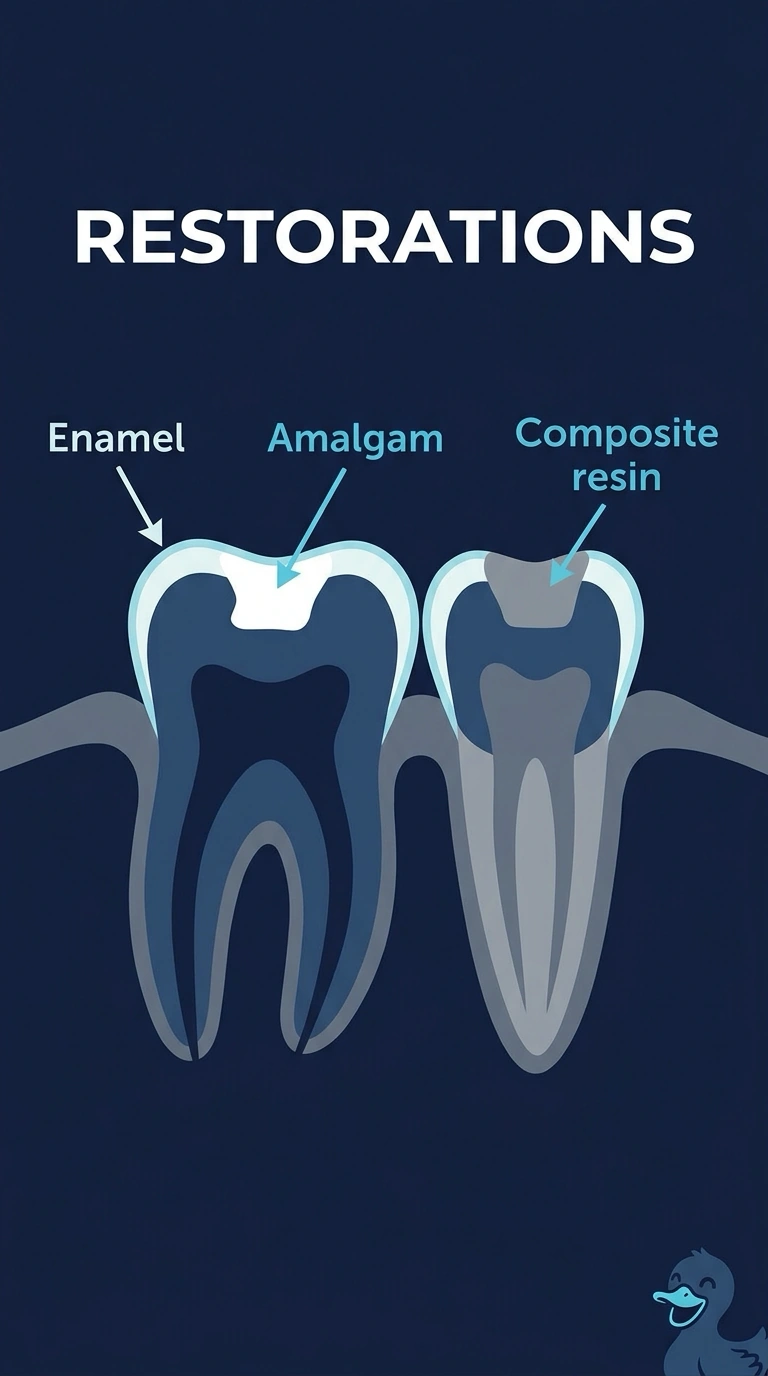
While reviewing a digital bitewing radiograph, you observe a Class II restoration in a mandibular first molar that appears uniformly bright white with sharp margins, and a Class II restoration in the adjacent premolar that is less dense than enamel yet slightly more radiopaque than dentin. Which materials most likely correspond to these two findings?
Select an answer to reveal the explanation.
Short Explanation
Reading restorative materials on a radiograph is like weighing luggage by how much beam energy they block: heavy metals glow bright white for you, while tooth-colored resins let more photons pass. The trap is mistaking a moderately radiopaque composite for an unfilled acrylic, which actually looks radiolucent.
Full Explanation
Radiographic density depends on the atomic number and thickness of the restorative material. Selecting Amalgam or cast metal in the molar and composite resin in the premolar accurately matches the image, because metallic restorations absorb nearly all incident X-ray photons and appear completely radiopaque with crisp borders, whereas modern filled composite resins appear slightly more radiopaque than dentin but less dense than enamel. Choosing Composite resin in the molar and unfilled acrylic resin in the premolar fails because composite does not block the beam as completely as metal, and unfilled acrylic typically appears radiolucent. Picking Glass ionomer cement in the molar and gutta-percha in the premolar is incorrect because glass ionomer is less radiopaque than amalgam and gutta-percha is a root canal obturation material rather than a coronal Class II restoration. Selecting Zinc oxide-eugenol base in the molar and porcelain crown in the premolar reverses the clinical presentation, as porcelain crowns cover the entire crown rather than forming a small Class II filling. Remember that older, non-radiopaque composites can mimic recurrent caries on a radiograph. Always correlate radiographic radiolucencies under restorations with clinical tactile examination and the patient's chart.
Prefer to study offline? Printable PDF study book + test engine ($7.50, unofficial). These questions stay free here.