
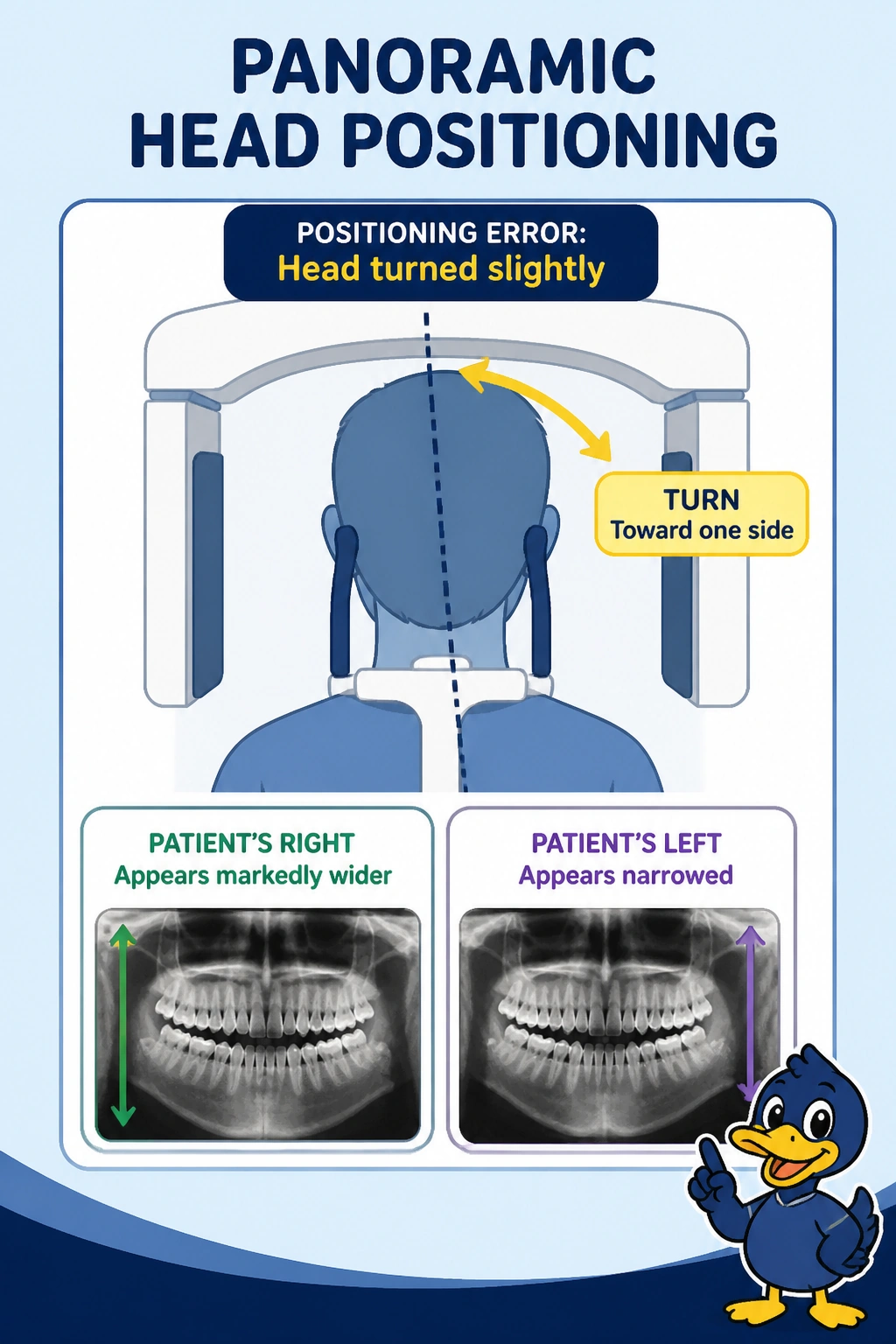
While evaluating a digital panoramic image, you notice that the mandibular ramus and posterior teeth on the patient's right side appear markedly wider than those on the left side, which look narrowed. Which positioning error most likely caused this asymmetry?
Select an answer to reveal the explanation.
Short Explanation
When one side of the jaw looks stretched wide and the other looks squished narrow, your patient peeked to the side! The trap is blaming chin tilt or slumped posture, which affect both sides symmetrically. Stand directly behind the patient to confirm the midsagittal laser sits dead center.
Full Explanation
In panoramic radiography, bilateral symmetry depends on keeping the patient's midsagittal plane perpendicular to the floor and centered in the unit's headholder. When The patient's head was turned slightly toward one side, one side of the jaw shifts closer to the receptor while the opposite side shifts closer to the X-ray source, causing unequal horizontal magnification—making the posterior teeth and mandibular ramus appear wider on one side and narrower on the other. By contrast, if The patient's chin was tipped too high upward during alignment, the occlusal plane flattens or curves downward and the hard palate obscures the maxillary apices symmetrically across both sides. If The patient's tongue was not pressed against the hard palate, a uniform dark radiolucent airspace band appears across the maxillary apices without causing left-to-right width asymmetry. If The patient's neck was slumped forward instead of upright, the cervical spine creates a broad, triangular midline radiopacity over the anterior teeth rather than unilateral ramus widening. One caveat is that true facial or skeletal asymmetry can mimic mild head rotation, so check the bite block and ear-rod symmetry too. As an operational check, use the midsagittal laser light and look from behind the patient to confirm the head is not rotated before exposure.
Prefer to study offline? Printable PDF study book + test engine ($7.50, unofficial). These questions stay free here.