
A new patient arrives with a recent digital panoramic radiograph from another clinic, and the dentist still orders posterior digital bitewings during the exam. Why is a panoramic image inadequate for detecting incipient interproximal caries?
Select an answer to reveal the explanation.
Short Explanation
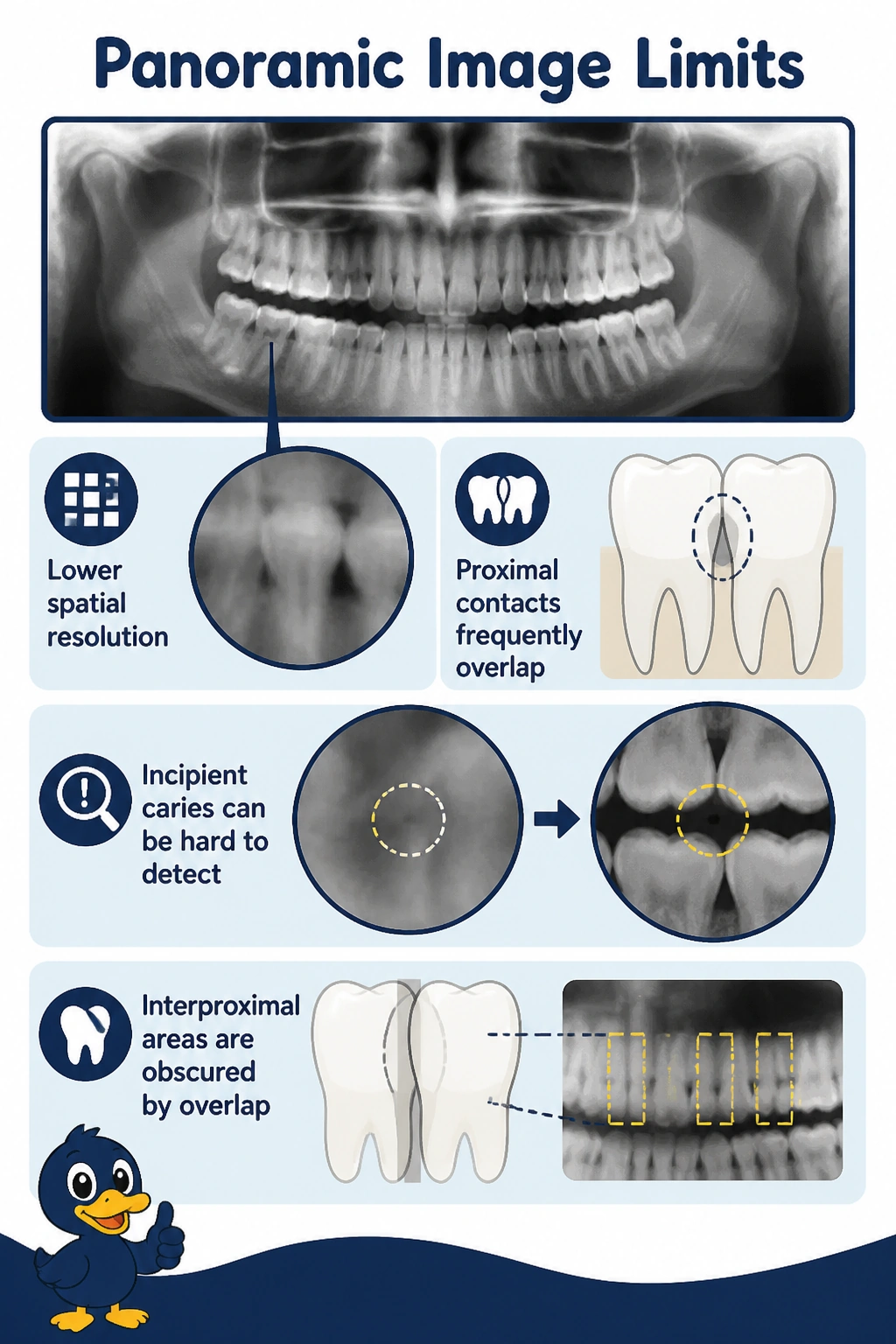
Relying on a panoramic image to spot tiny cavities between teeth is like trying to read fine print from across the street. Its wide-angle view trades away fine detail and overlaps neighboring contacts, so you still need bitewings to catch early interproximal decay.
Full Explanation
Selecting the right radiographic projection depends on matching image detail to the diagnostic task. The correct explanation is Panoramic images have lower spatial resolution and frequent proximal contact overlap because the extraoral rotating beam passes through a thicker tissue volume at a greater object-to-receptor distance, producing slight magnification and blurring compared to intraoral sensors. In addition, the fixed horizontal path of the panoramic beam frequently overlaps premolar and molar proximal surfaces, hiding early enamel demineralization. Choosing Panoramic units use a much lower kilovoltage setting that cannot penetrate tooth enamel is incorrect because panoramic units actually operate at kilovoltages sufficient to penetrate the jaws and dense teeth. Selecting Panoramic images omit the posterior teeth because the focal trough covers only incisors is false, as the curved focal trough is designed to encompass the entire dental arch from third molar to third molar. Picking Panoramic software automatically filters out small radiolucencies to reduce file size invents a nonexistent software behavior rather than addressing the geometric limitations of extraoral imaging. Caveat: advanced, large carious lesions extending deeply into dentin may still be visible on a panoramic image, even though early lesions are missed. Operational check: open the horizontal bitewings alongside the panoramic overview so interproximal contacts can be evaluated with sharp intraoral detail.
Prefer to study offline? Printable PDF study book + test engine ($7.50, unofficial). These questions stay free here.