
A municipal help-desk brief contrasts how encryption and integrity are set up for Personal versus Enterprise on clients. Which statement is accurate at technician depth?
Select an answer to reveal the explanation.
Short Explanation
Same Wi-Fi lock, different key ceremony: Personal shares a PSK; Enterprise talks 802.1X first. The SSID string alone doesn't flip the mode. MAC filters aren't a substitute for modern encryption.
Full Explanation
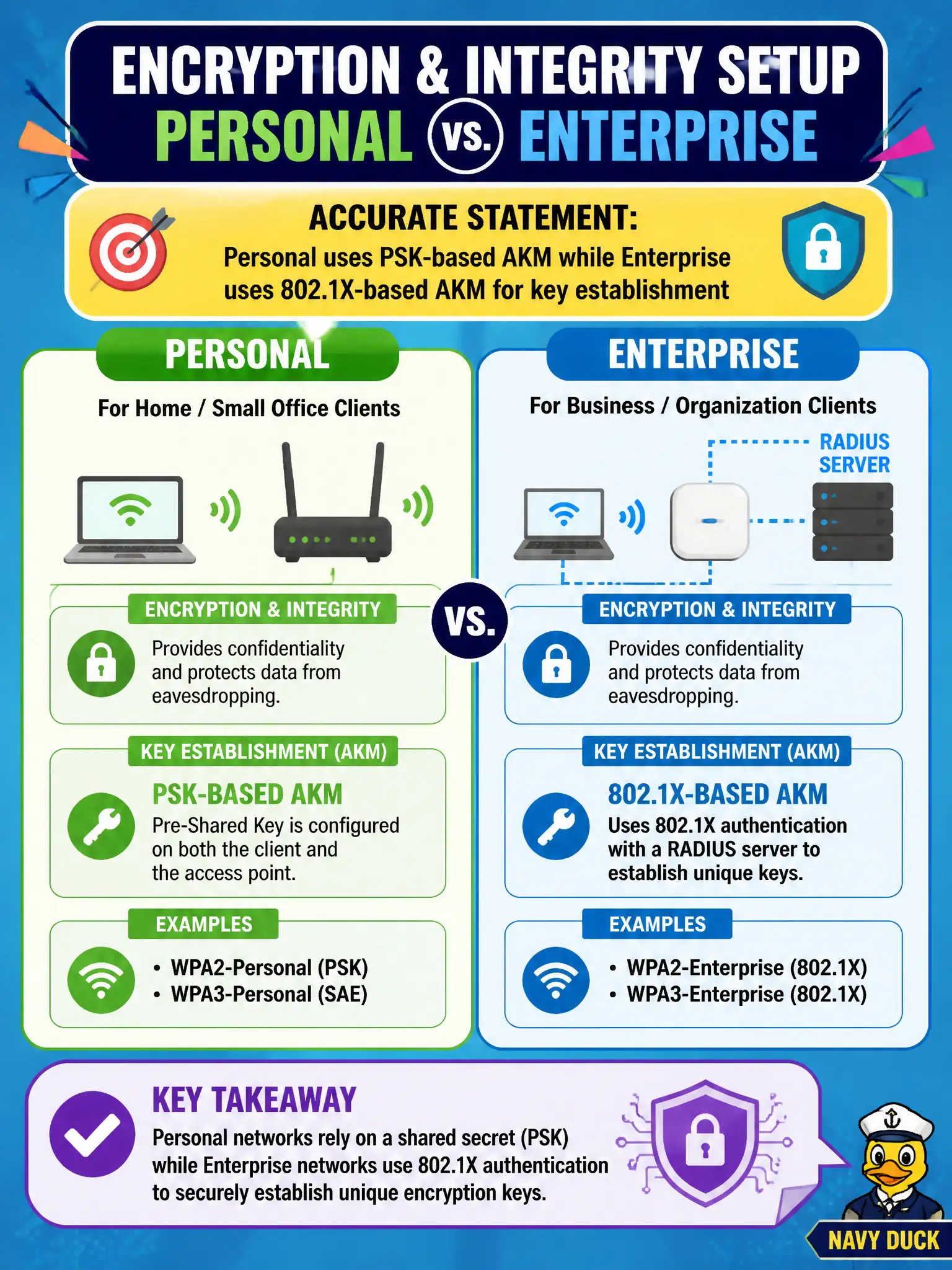
At technician depth, Personal and Enterprise differ in how authentication and key management (AKM) establish encryption and integrity keys on the client. Personal uses PSK-based AKM: the shared passphrase seeds key hierarchy for the BSS. Enterprise uses 802.1X-based AKM: EAP authentication with an authentication server drives pairwise key establishment after successful identity proof. Both modes can protect frames with modern ciphers, but the client fields and ceremony differ.
It is incorrect that both modes require EAP-TLS before any pairwise keys can exist; Personal does not use EAP-TLS for BSS join. Claiming Personal and Enterprise use identical client fields with only the SSID string changing ignores EAP versus PSK configuration. Saying Enterprise always disables encryption and relies on MAC filters alone contradicts how WPA2/WPA3-Enterprise provides robust encryption after 802.1X.
Exam caveat: associate 'PSK AKM' with Personal and '802.1X AKM' with Enterprise when contrasting client setup—do not equate SSID name changes with mode changes. Operational check: compare a civic Personal guest profile to a staff Enterprise profile side by side and confirm only the Enterprise profile exposes EAP and credential/certificate controls.