
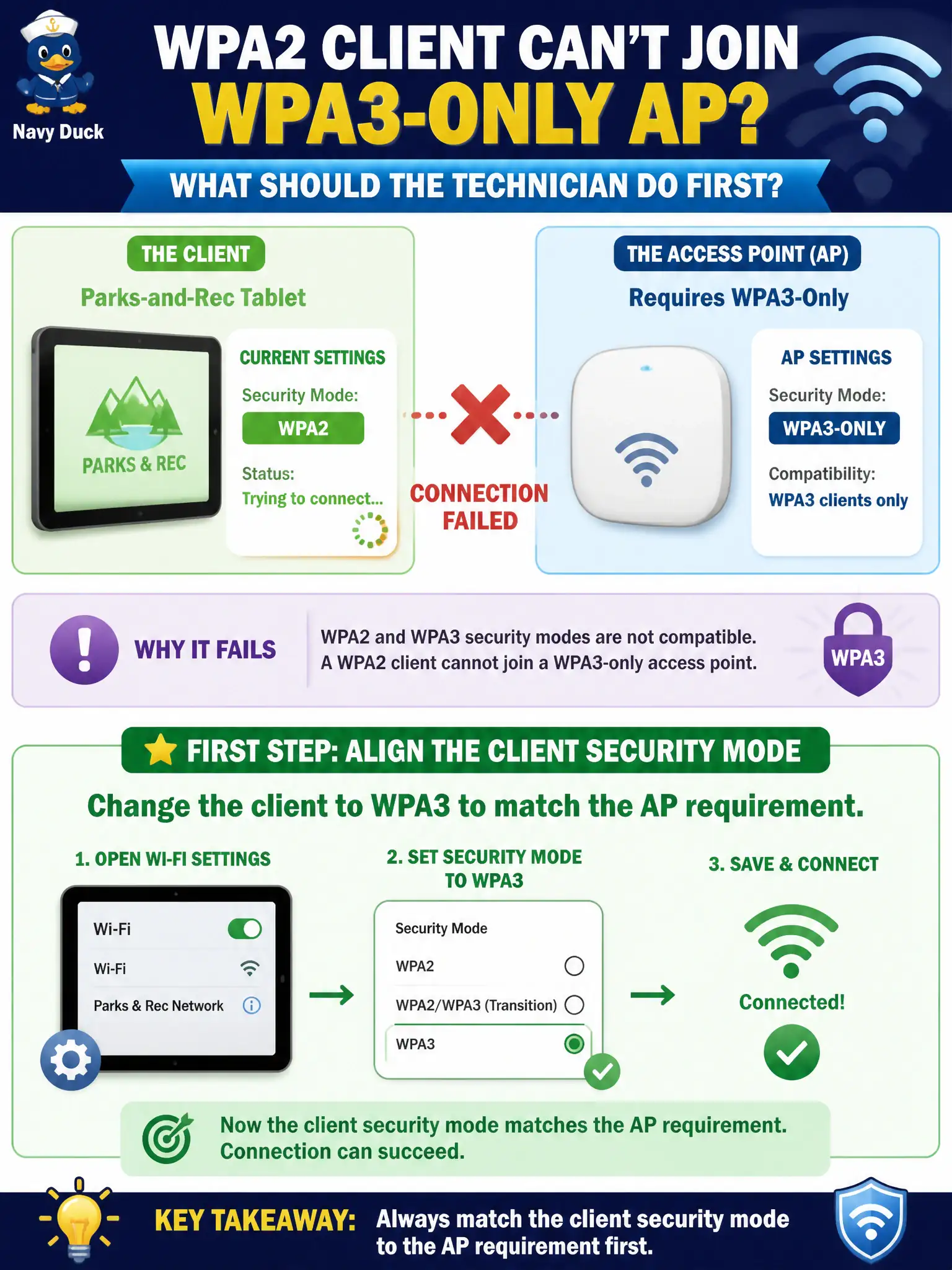
A parks-and-rec tablet set to WPA2 fails to join an AP that requires WPA3-only. What should the technician do first on the client?
Select an answer to reveal the explanation.
Short Explanation
AP says WPA3-only and the tablet still speaks WPA2—change the profile language. Power and ARP won't rewrite the security mode. Match the BSS or you never get past the door.
Full Explanation
A parks-and-rec tablet configured for WPA2 cannot authenticate to an AP that requires WPA3-only because client security mode must match BSS AKM requirements. The first client-side action is to align the wireless profile to WPA3 so negotiation can succeed on the municipal BSS. Transmit power, Layer-3 caches, and topology tricks do not rewrite the security mode the station offers during association and authentication.
Increasing client transmit power does not make a WPA2-only profile acceptable on a WPA3-only AP, regardless of signal strength at the parks facility. Switching the tablet to ad-hoc mode abandons infrastructure BSS security negotiation rather than fixing the mismatch. Clearing the ARP cache affects IP-to-MAC resolution after a Layer-2 path exists; it does not renegotiate AKM independently of the wireless profile settings.
Exam caveat: capability mismatch between client security type and AP requirement is a profile configuration problem first—do not chase RF or IP symptoms until modes align. Operational check: edit the tablet profile to WPA3 (Personal or Enterprise as the parks BSS requires), reconnect, confirm successful association, and verify application traffic flows on the WPA3-only AP.