
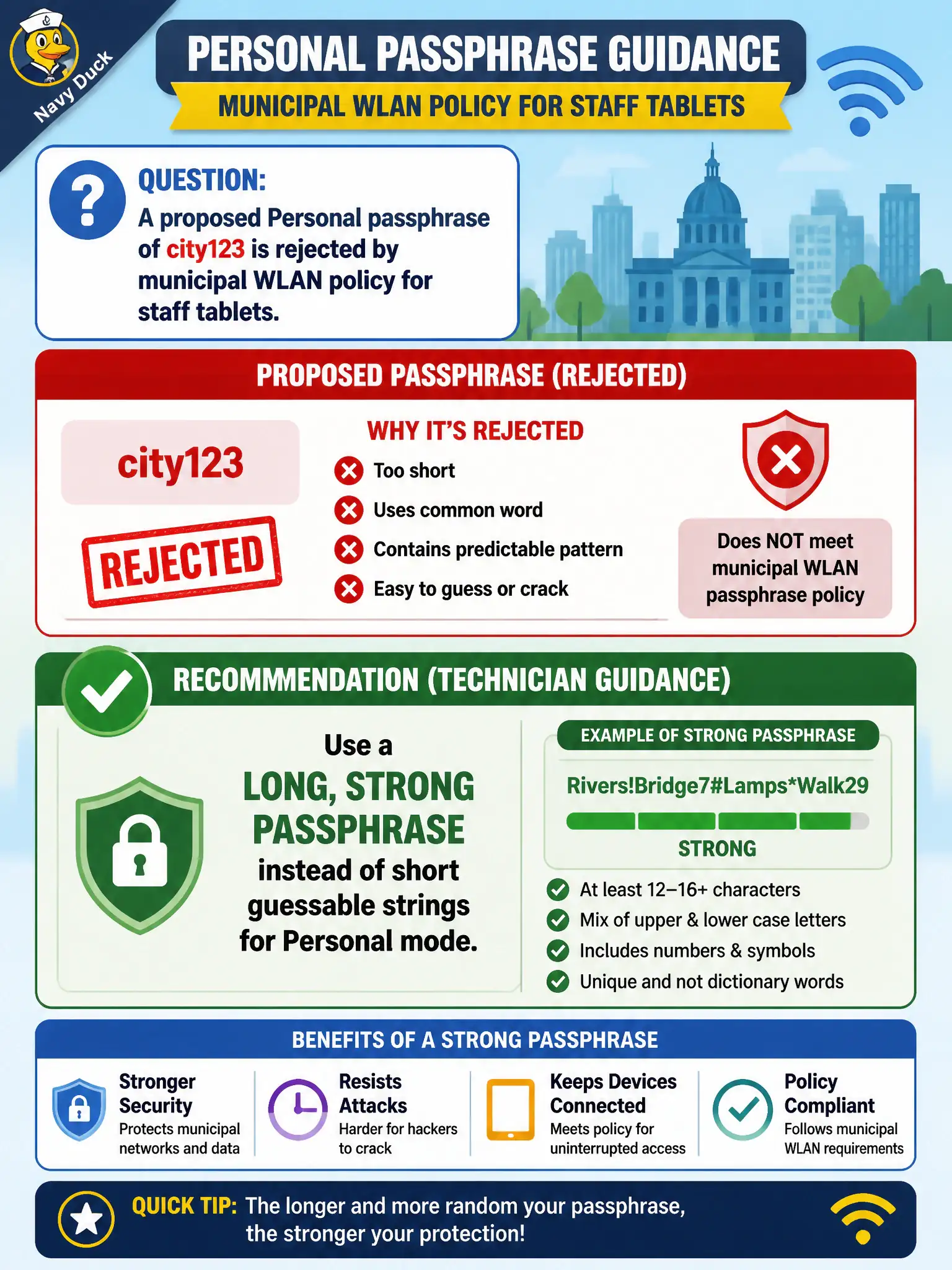
A proposed Personal passphrase of city123 is rejected by municipal WLAN policy for staff tablets. What recommendation fits technician guidance?
Select an answer to reveal the explanation.
Short Explanation
city123 is a welcome mat for guessers—Personal mode still needs a beefy passphrase. Turning off encryption or posting the key in the lobby makes it worse. Strong and secret beats short and cute.
Full Explanation
Municipal WLAN policy correctly rejects a Personal passphrase such as city123 for staff tablets because Personal/PSK security depends on passphrase strength and secrecy. Short, predictable strings are trivial to guess or spray against a civic BSS, so technician guidance is to use a long, high-entropy passphrase instead. Strong Personal keys remain shared secrets across tablets, but length and randomness materially raise the cost of offline guessing against the PSK.
Keeping city123 while disabling encryption removes confidentiality entirely and is worse than a weak passphrase for clinic or office tablets. Replacing the passphrase with the SSID name creates an equally guessable secret anyone who sees the network name can try. Publishing the passphrase on the building directory expands exposure to anyone walking through the civic lobby and defeats secrecy assumptions for Personal mode.
Exam caveat: Personal mode still requires a strong secret—WPA2/WPA3-Personal does not make weak passwords acceptable for staff tablets. Operational check: generate a long random passphrase, update tablet profiles and the BSS PSK together during a maintenance window, verify association on a sample tablet, and store the secret in the city's approved credential vault rather than on signage.