
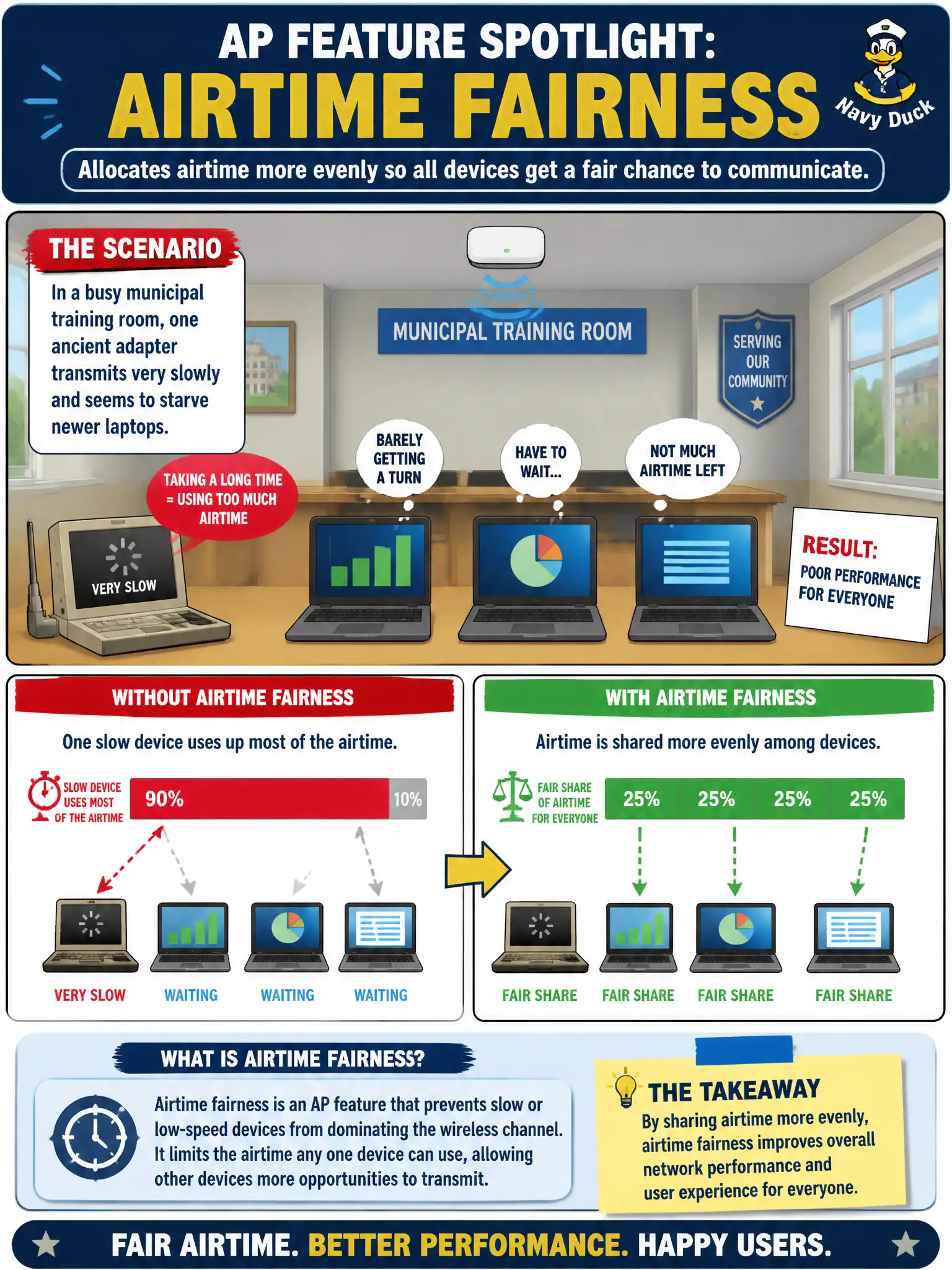
In a busy municipal training room, one ancient adapter transmits very slowly and seems to starve newer laptops. Which AP feature is meant to allocate airtime more evenly?
Select an answer to reveal the explanation.
Short Explanation
A slow station can hog the medium the way one stalling car blocks a whole lane. Airtime fairness tries to share transmit time more evenly so one sluggish client does not dominate. It is about fair airtime, not hiding the SSID or resurrecting WEP.
Full Explanation
In a busy municipal training room, one ancient adapter transmitting very slowly can starve newer laptops of airtime if the AP schedules unfairly by frames rather than time. Airtime fairness is the AP feature meant to allocate airtime more evenly so slow stations cannot dominate the shared medium. Enabling it protects aggregate classroom performance on civic WLAN without replacing every legacy NIC overnight.
Hidden SSID broadcasting is not an airtime scheduler and does not fix slow-station dominance. Hourly WEP key rotation is insecure legacy crypto theater, not fairness. Disabling all MIMO antennas reduces capability and worsens capacity rather than equalizing airtime.
Exam caveat: airtime fairness targets mixed-client airtime equity. It is not solved by hiding SSIDs, WEP tricks, or disabling MIMO.
Operational check: enable airtime fairness on the training-room AP per design, retest a mix of legacy and modern clients under load, and document the feature state in the room’s WLAN profile. Municipal technicians document the verified setting in the as-built packet so the next shift inherits a known-good civic configuration rather than tribal knowledge. Municipal technicians document the verified setting in the as-built packet so the next shift inherits a known-good civic configuration rather than tribal knowledge.