
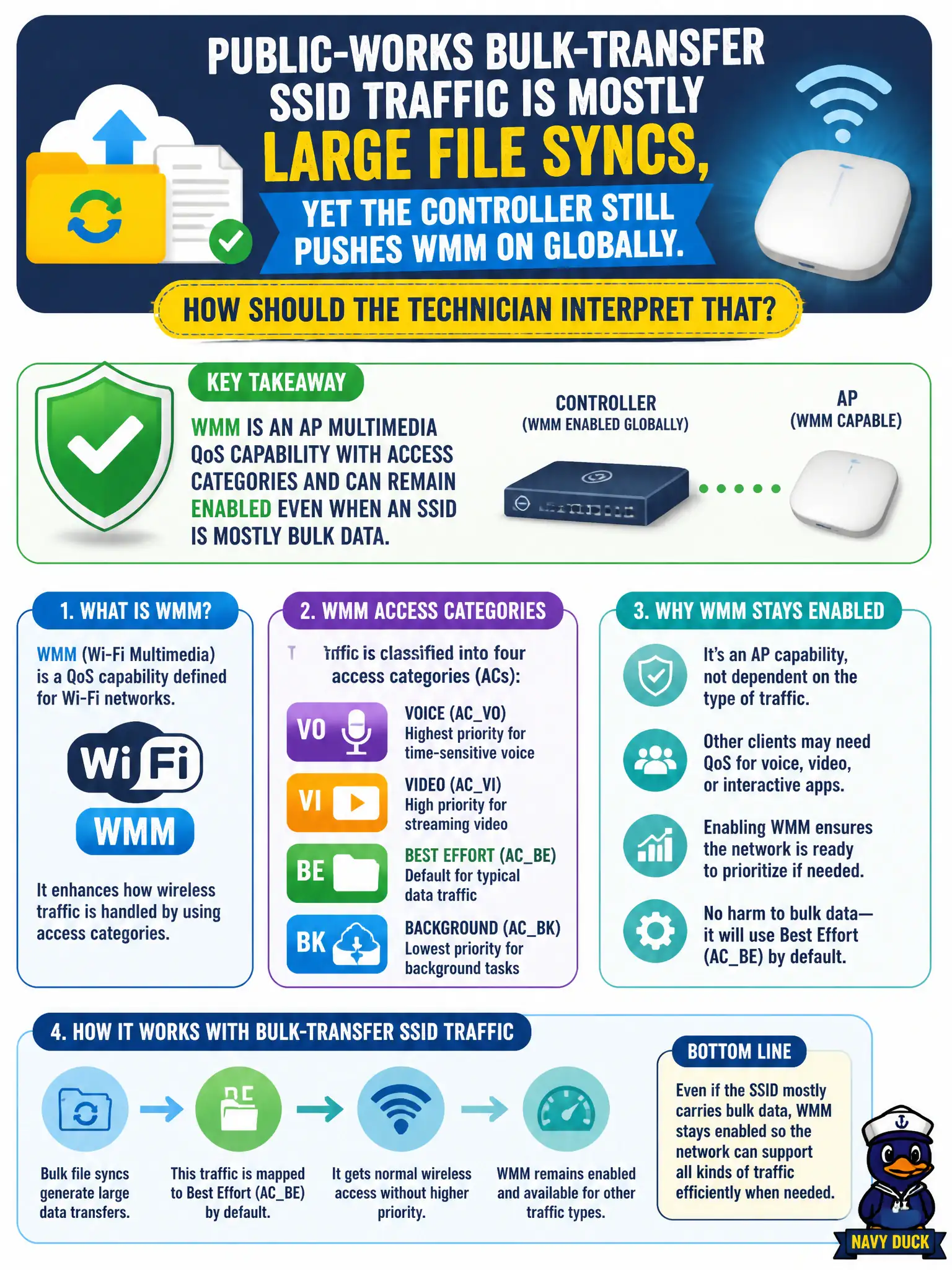
Public-works bulk-transfer SSID traffic is mostly large file syncs, yet the controller still pushes WMM on globally. How should the technician interpret that?
Select an answer to reveal the explanation.
Short Explanation
WMM is not a 'voice-only' light switch that explodes if a file sync uses the AP. It just gives the AP multimedia access categories for when mixed traffic shows up. Leaving it on for a mostly bulk SSID is normal; it does not mean the WLAN suddenly hates large transfers.
Full Explanation
Public-works bulk-transfer SSIDs may carry mostly large file syncs, yet controllers often still push WMM globally. The technician should interpret that WMM is an AP multimedia QoS capability with access categories and can remain enabled even when a particular SSID is mostly bulk data. Leaving WMM on does not inherently drop bulk transfers; it preserves QoS capability for mixed traffic and for other SSIDs on the same civic AP.
Claiming WMM must be disabled wherever voice is absent or APs will drop data invents a false failure mode. Saying WMM only applies to captive-portal guest networks incorrectly scopes the feature. Claiming WMM replaces the need for any wired QoS markings forever overstates Wi-Fi QoS and ignores end-to-end campus QoS design.
Exam caveat: WMM enabled ≠ voice-only networks. Bulk SSIDs can coexist with global WMM; do not disable WMM solely because one SSID is data-heavy.
Operational check: leave WMM enabled per controller policy on the public-works AP, verify bulk syncs still complete, confirm voice or video SSIDs on the same AP still see WMM, and avoid ad-hoc WMM-off “optimizations” undocumented in design. Municipal technicians document the verified setting in the as-built packet so the next shift inherits a known-good civic configuration rather than tribal knowledge.