
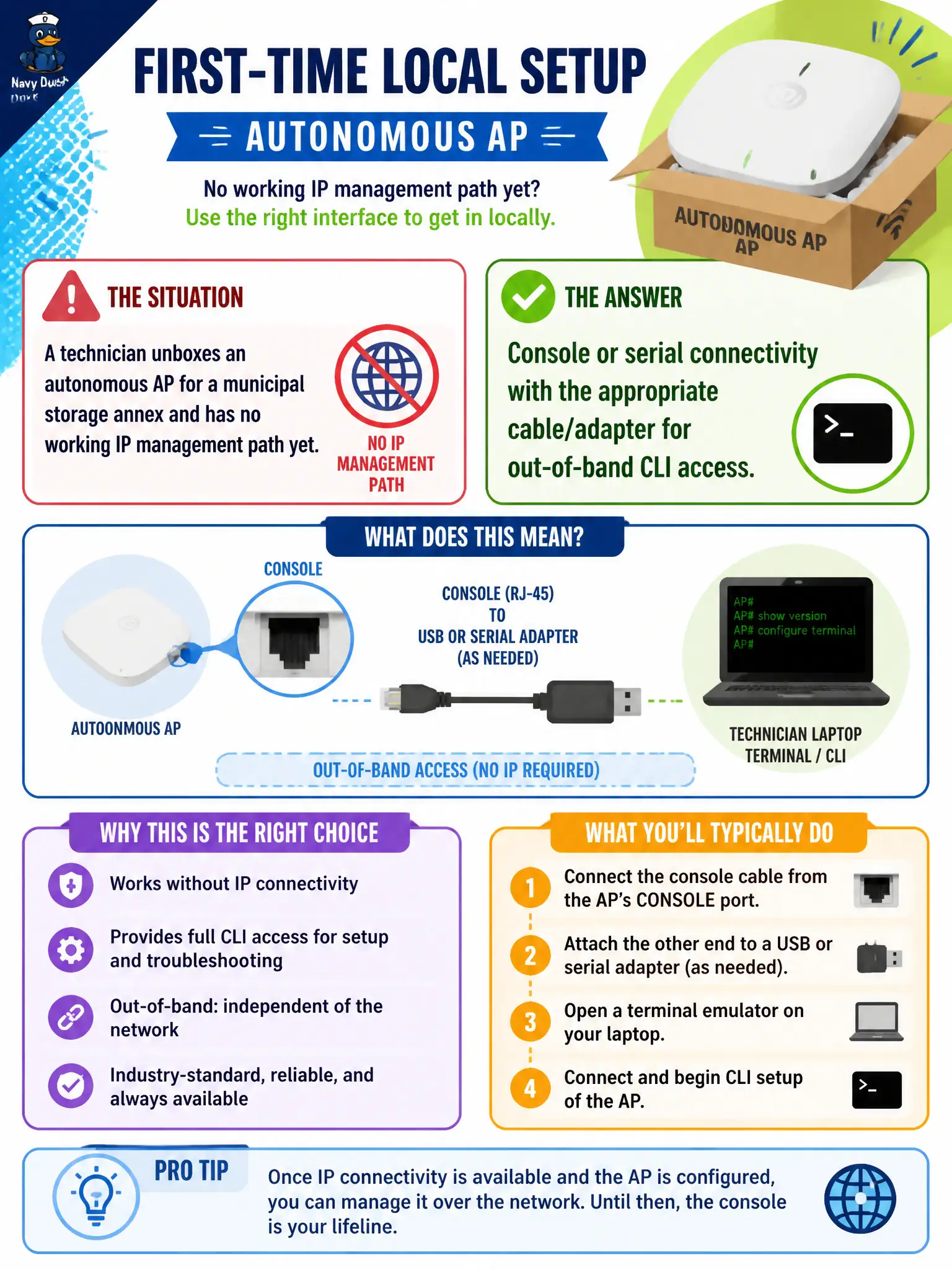
A technician unboxes an autonomous AP for a municipal storage annex and has no working IP management path yet. Which management interface is appropriate for first-time local setup?
Select an answer to reveal the explanation.
Short Explanation
When the network path is a blank slate, the console cable is your flashlight. Serial gets you into the AP without needing an IP address or a working LAN. Guest SSIDs and random phones are not day-zero management plans.
Full Explanation
When a technician unboxes an autonomous AP for a municipal storage annex and has no working IP management path yet, console or serial connectivity with the appropriate cable or adapter is the appropriate management interface for first-time local setup. Out-of-band CLI access does not depend on VLAN correctness, DHCP, or IP reachability that may still be broken in the closet. Civic staging often begins on the serial console before management IP addressing is finalized.
Using only public Telnet across the Internet before any password change is insecure and may be unreachable without IP. Bluetooth pairing with a random citizen's phone is not an approved municipal management station method. Waiting for clients to associate so the AP can be managed through a guest SSID inverts the hardening order and exposes management poorly.
Exam caveat: console/serial is the classic first-boot path when IP management is unavailable on autonomous APs. Operational check: connect the correct serial adapter, open a terminal at the vendor baud rate, log in locally, set a unique admin password and management IP, then verify HTTPS or SSH works on the management VLAN before leaving the annex. Only after console bootstrap succeeds should the annex AP be moved to HTTPS or SSH management on the production management VLAN.