
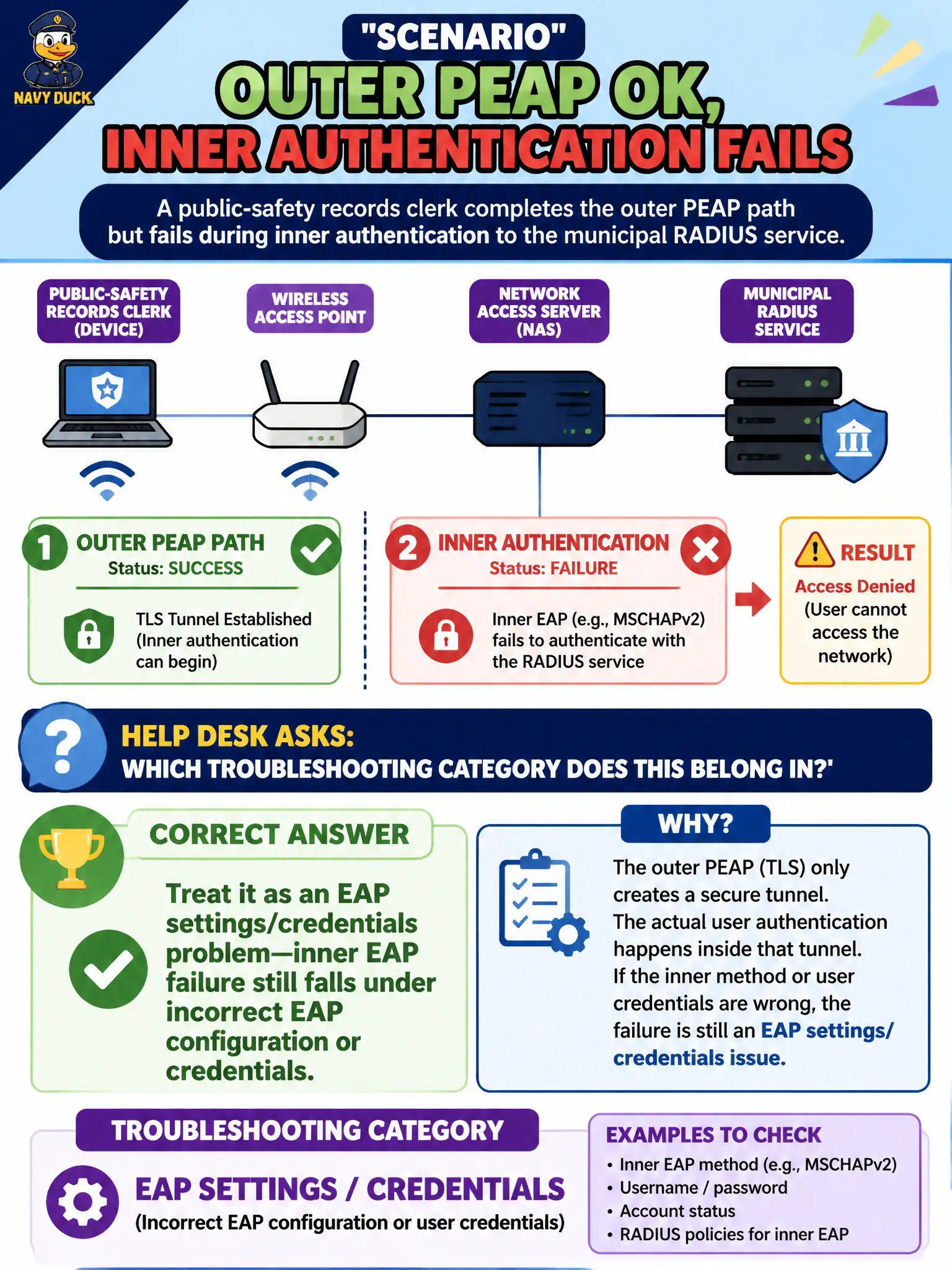
A public-safety records clerk completes the outer PEAP path but fails during inner authentication to the municipal RADIUS service. Help desk asks which troubleshooting category this belongs in. What is correct?
Select an answer to reveal the explanation.
Short Explanation
Outer EAP can look fine while the inner username/password or method still bombs. That’s still an EAP settings/credentials case. Fix the inner identity, password, or method—don’t wander into path loss or DHCP rabbit holes first.
Full Explanation
A public-safety records clerk who completes the outer PEAP path but fails during inner authentication to the municipal RADIUS service belongs in the EAP settings/credentials category—inner EAP failure still falls under incorrect EAP configuration or credentials. Outer success only proves the tunnel setup path began; inner identity/password/method still must succeed. Help desk should not reclassify this as RF math or PoE.
Classifying it only as free-space path loss because inner EAP runs exclusively over RF math fails by concept: inner EAP is an authentication exchange, not a path-loss equation. Assuming PoE class mismatch on the AP is the sole cause of inner EAP credential rejection fails without power evidence and mismatches AAA logs. Ignoring EAP and replacing the building’s DHCP scope whenever inner authentication fails fails: DHCP does not validate inner EAP credentials.
Exam caveat: outer PEAP OK + inner fail ⇒ credentials/inner EAP config, not coverage redesign.
Operational check: verify username/password or inner method against directory; check RADIUS reject reasons; correct the profile; retry; involve identity team if account lockout or policy denies appear. When RADIUS logs show outer PEAP success and inner reject, capture the reject reason code and identity string before touching RF—most civic inner failures are account, password, or inner-method issues.