
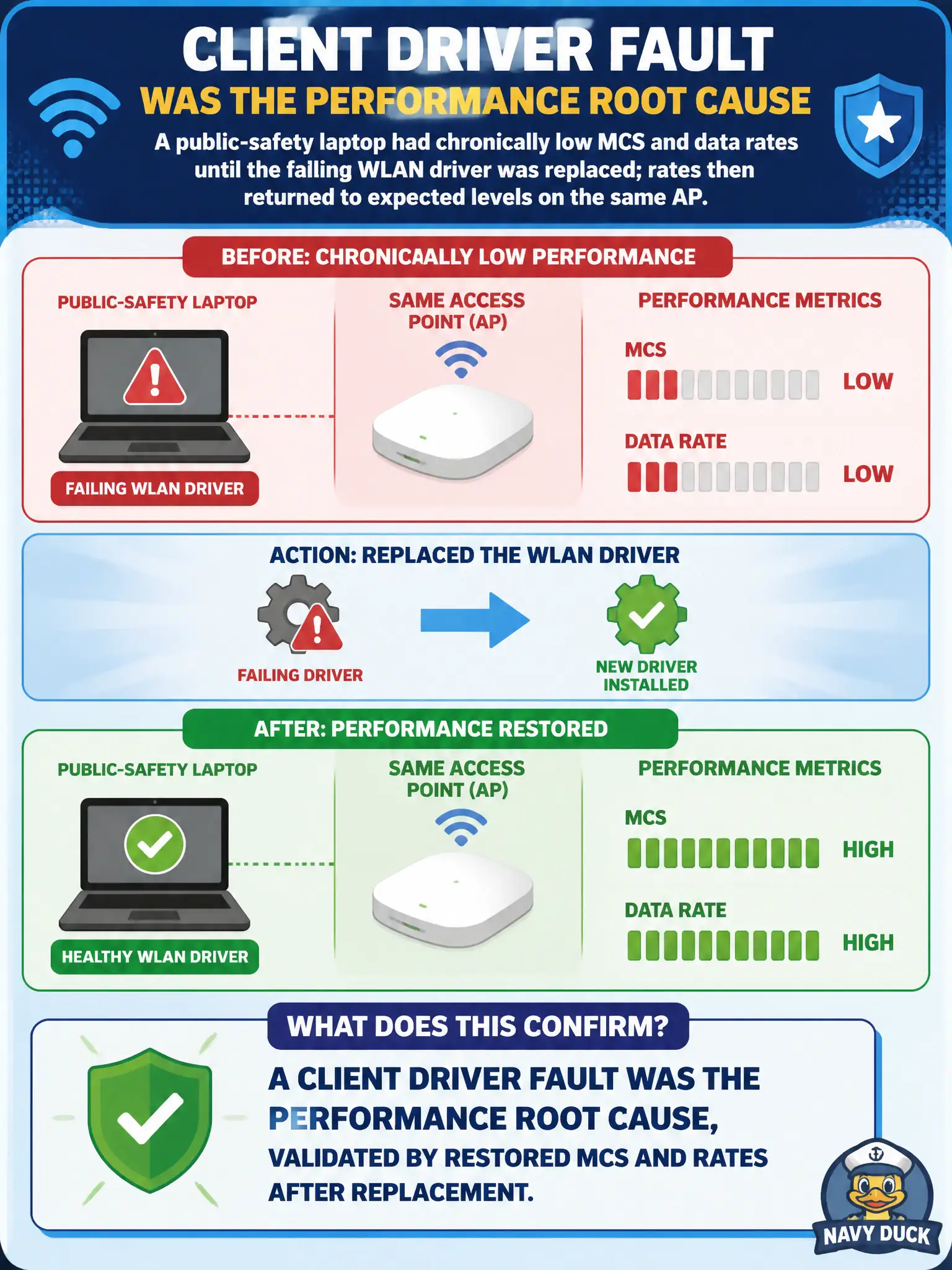
A public-safety laptop had chronically low MCS and data rates until the failing WLAN driver was replaced; rates then returned to expected levels on the same AP. What does this confirm?
Select an answer to reveal the explanation.
Short Explanation
When swapping the sick driver brings MCS and rates back on the same AP, you have your culprit. Same radio path, new software path—performance returns. That is a clean driver confirmation, not a redesign trophy.
Full Explanation
A public-safety laptop with chronically low MCS and data rates until the failing WLAN driver was replaced—after which rates returned to expected levels on the same AP—confirms a client driver fault was the performance root cause, validated by restored MCS and rates after replacement. Same AP before/after isolates the client stack. Evidence-based validation is core CWTS performance troubleshooting.
AP channel plans automatically rewriting themselves when drivers fail fails as mysticism unsupported by the controlled driver replacement. Low MCS caused solely by illegal outdoor channels on indoor APs fails when the AP and environment were unchanged and the driver swap fixed rates. Replacing the driver being unrelated while only SSID rename restores MCS fails because the observed cure was driver replacement, not rename.
Exam caveat: fix-and-verify with a single changed variable (driver) proves causality.
Operational check: replace/update the WLAN driver; capture MCS/rates before and after on the same AP; standardize known-good drivers on public-safety images; avoid channel redesign when driver replacement already restored performance. Record MCS and retry counters in the public-safety ticket before and after driver replacement so future similar faults are recognized quickly as client performance issues.