
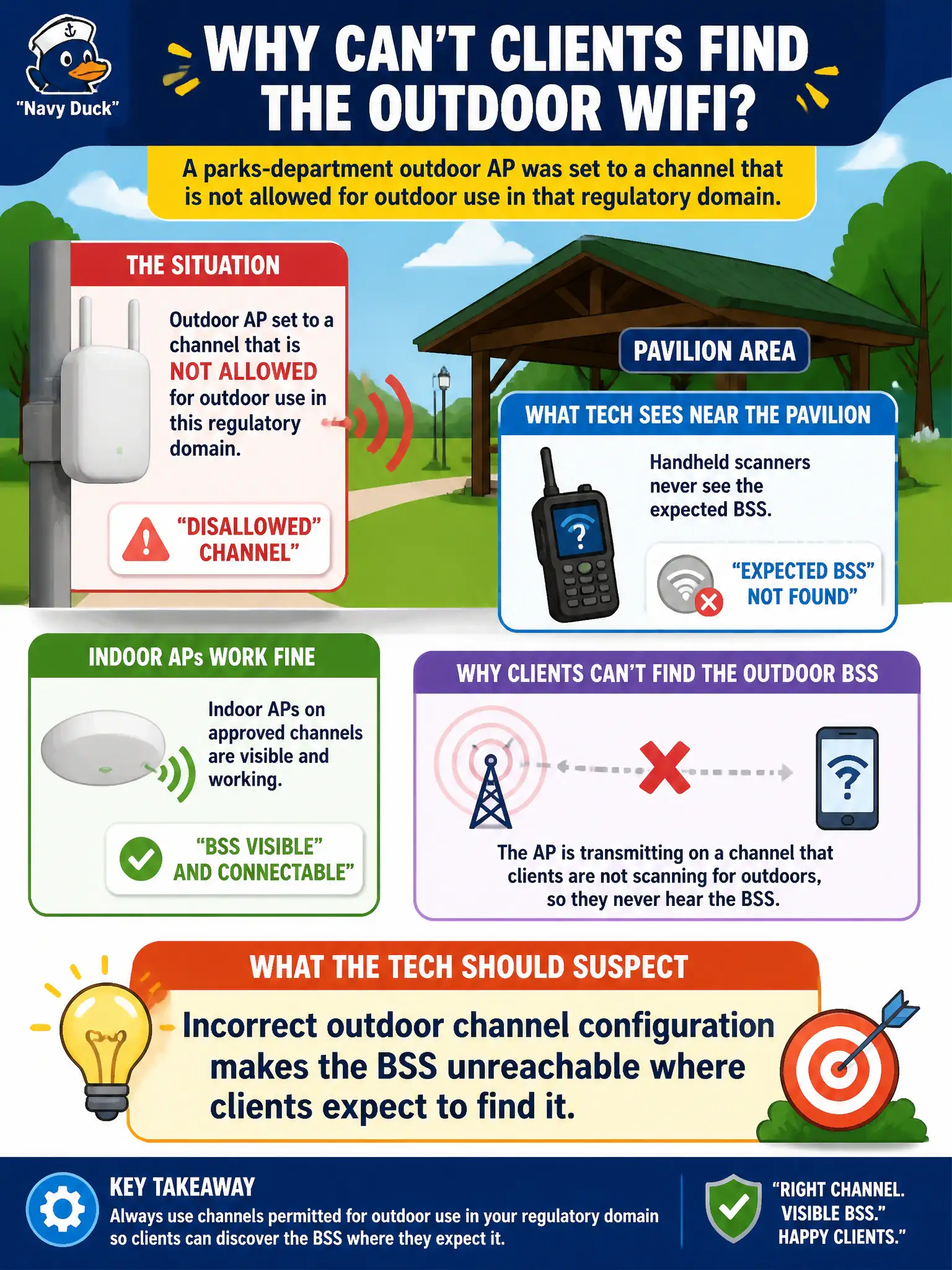
A parks-department outdoor AP was set to a channel that is not allowed for outdoor use in that regulatory domain. Handheld scanners near the pavilion never see the expected BSS, though indoor APs on approved channels work. What should the tech suspect?
Select an answer to reveal the explanation.
Short Explanation
Wrong channel outdoors is like putting the radio station on a frequency nobody's allowed to tune. Clients keep listening where the design said the BSS would live and hear nothing. Fix the AP radio to the approved outdoor channel from the design.
Full Explanation
A parks-department outdoor AP set to a channel not allowed for outdoor use in that regulatory domain, with handheld scanners near the pavilion never seeing the expected BSS while indoor APs on approved channels work, should be suspected as incorrect outdoor channel configuration making the BSS unreachable where clients expect to find it. Regulatory domain and indoor/outdoor channel rules constrain legal operation; a disallowed outdoor channel can leave clients without a usable BSS. Indoor success on approved channels contrasts the outdoor misconfiguration.
Client MIMO antennas being disabled whenever outdoor APs are used fails as a universal rule and does not explain regulatory channel mistakes. WPA2-Enterprise cannot operate on any outdoor access point fails by concept: Enterprise security is independent of indoor/outdoor placement. USB3 noise on the scanners forcing every outdoor SSID to disappear fails because indoor APs are visible and the change window is the outdoor channel setting.
Exam caveat: outdoor APs must use outdoor-allowed channels for the regulatory domain. CWTS install questions often test channel legality versus clever RF excuses.
Operational check: read the AP’s configured channel and regulatory domain; compare to outdoor-allowed channels; set a compliant outdoor channel/power per design; verify pavilion scanners discover the BSS; leave indoor APs unchanged.