
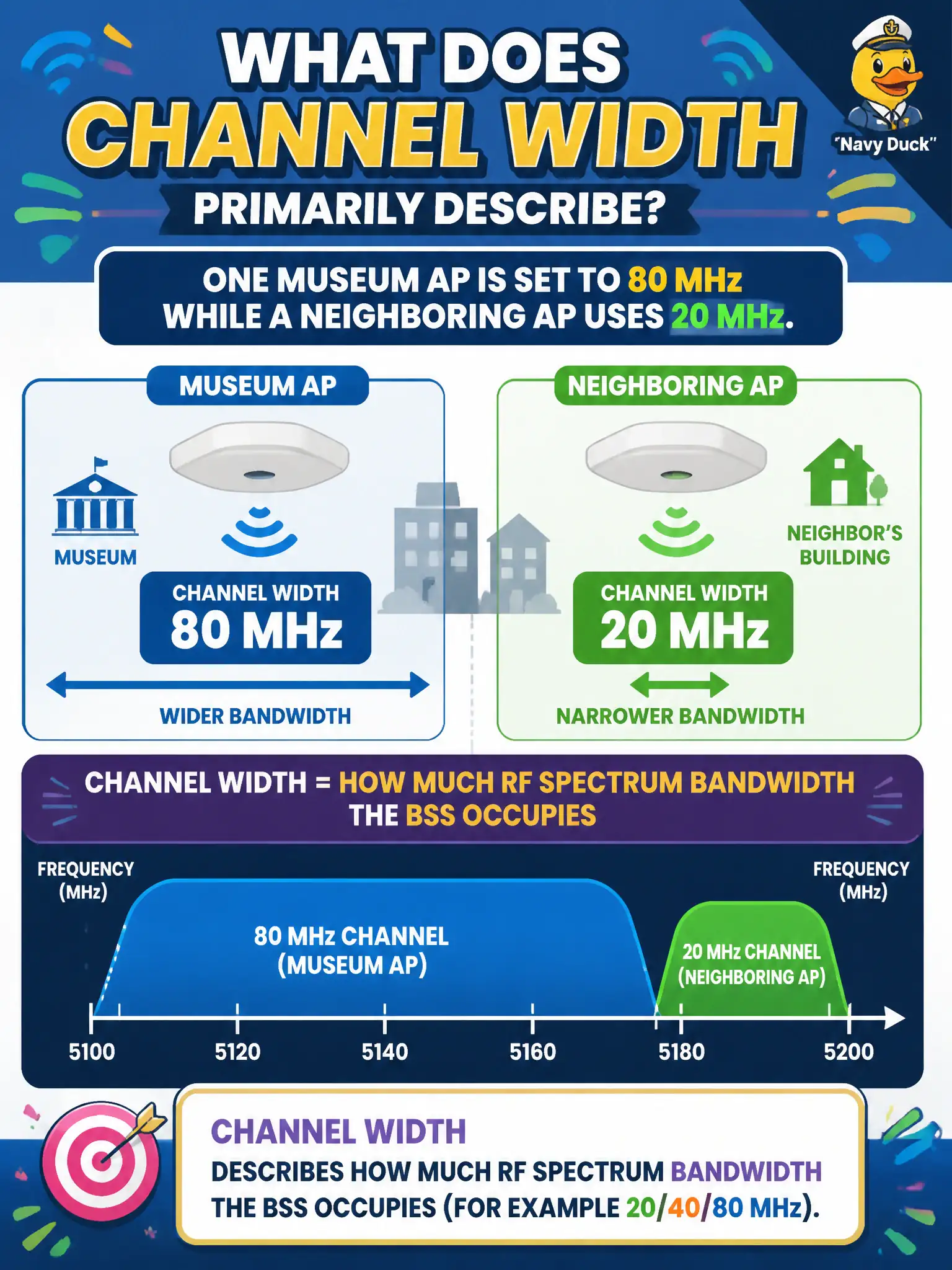
One museum AP is set to 80 MHz while a neighboring AP uses 20 MHz. What does channel width primarily describe?
Select an answer to reveal the explanation.
Short Explanation
Channel width is how wide a slice of spectrum the BSS sits on — 20, 40, 80, and friends. It is not PoE watts, switch speed, or SSID count. Wider can mean more throughput potential and more neighbors to bump into.
Full Explanation
Channel width primarily describes how much RF spectrum bandwidth the BSS occupies (for example 20/40/80 MHz). A museum AP on 80 MHz versus a neighbor on 20 MHz differs in occupied bandwidth—not in how many SSIDs it may broadcast, not in Ethernet backhaul speed, and not in PoE class. Exam caveat: wider channels can raise capacity but also increase interference exposure and utilization impact in dense civic floors. Operational check: confirm each museum AP’s width matches the design’s coexistence plan, survey adjacent BSS overlap, and roll back width if utilization or interference spikes. Record occupied bandwidth separately from SSID count and switch PoE in municipal inventories. In municipal WLAN operations, record the rationale in the work order so future on-call staff know which concept applied and which failure modes the rejected options would create for city services. Re-validate after the next maintenance window that the same control still holds under the AP firmware and client mix used by the civic network team. Keep civic notes tied to the approved design document and absolute measurements where RF levels matter. Keep civic notes tied to the approved design document and absolute measurements where RF levels matter.