
A clerk confuses WPA-Personal with WPA2-Personal on a permit-office router. What clarification should the technician give?
Select an answer to reveal the explanation.
Short Explanation
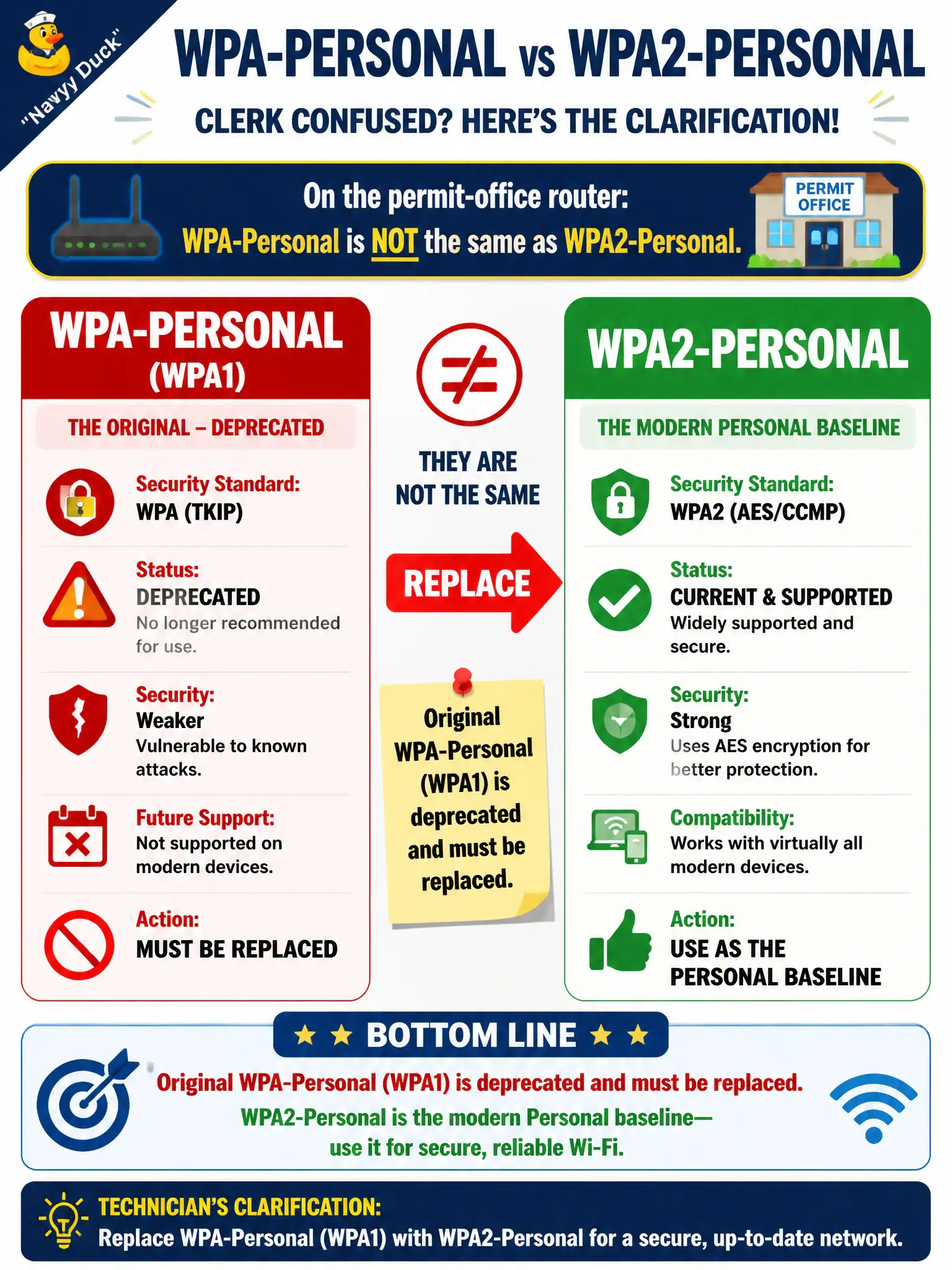
The short name is the old one. WPA-Personal means original WPA1 and needs to go; WPA2-Personal is the modern Personal starting point—and WPA3-Personal is even better when clients allow it.
Full Explanation
Clerks confusing WPA-Personal with WPA2-Personal on a permit-office router need a precise clarification: original WPA-Personal is deprecated WPA1 and must be replaced; WPA2-Personal is the modern Personal baseline (with WPA3-Personal preferred when clients allow). Name similarity does not make the suites equivalent for municipal small-office Wi-Fi.
Calling the names interchangeable as the same current Personal standard erases the deprecation of WPA1. Claiming WPA-Personal is newer because the shorter name shipped later reverses history. Saying WPA2-Personal is deprecated so offices should fall back to original WPA-Personal inverts the migration path.
Exam caveat: WPA-Personal ≠ WPA2-Personal. Replace WPA1 Personal with WPA2/WPA3 Personal on civic SOHO gear.
Operational check: show the clerk the router security menu distinguishing WPA vs WPA2/WPA3, configure WPA2-Personal or WPA3-Personal with a strong passphrase, update device profiles, and retire WPA1. Municipal technicians document the verified setting in the as-built packet so the next shift inherits a known-good civic configuration rather than tribal knowledge. Municipal technicians document the verified setting in the as-built packet so the next shift inherits a known-good civic configuration rather than tribal knowledge.