
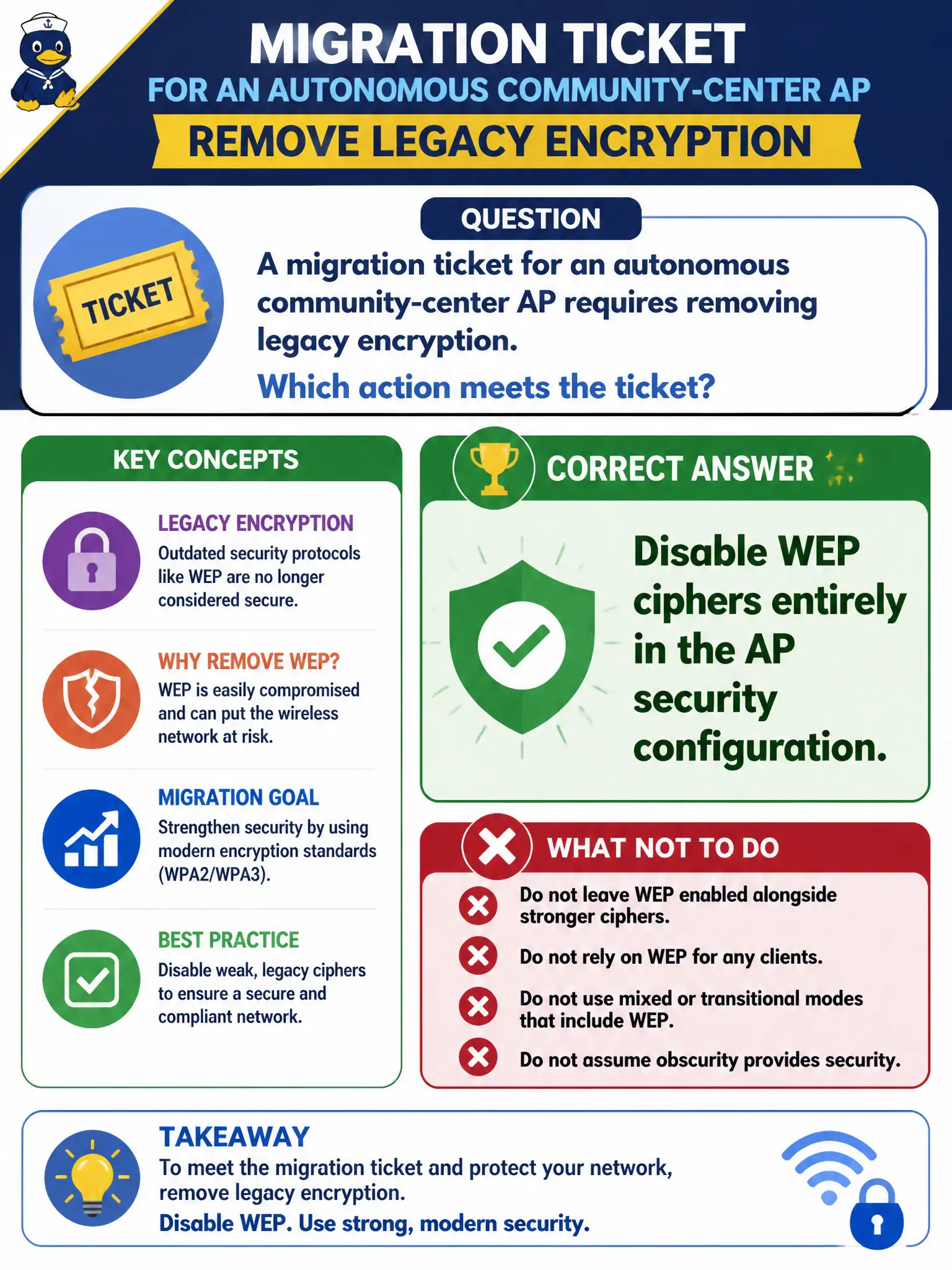
A migration ticket for an autonomous community-center AP requires removing legacy encryption. Which action meets the ticket?
Select an answer to reveal the explanation.
Short Explanation
The ticket is a clean break, not a rename. Turn WEP off completely in the AP's security settings so no cipher suite still offers that broken crypto—compatibility SSIDs and hidden names do not count as migration.
Full Explanation
A migration ticket for an autonomous community-center AP that requires removing legacy encryption is met by disabling WEP ciphers entirely in the AP security configuration. Partial retention keeps the deprecated suite available for mistakes and reconnects. Civic migration success means WEP is gone from the cipher list, not merely discouraged in a wiki.
Leaving WEP enabled for a “compatibility SSID” used only by staff badges preserves a weak network on the same air. Moving WEP keys into a longer passphrase field but keeping the WEP cipher selected changes presentation, not cryptography. Hiding the SSID and retaining WEP so casual users cannot discover the network fails both obscurity and crypto tests.
Exam caveat: removing legacy encryption means disabling WEP ciphers entirely—not hiding them or renaming key fields.
Operational check: disable all WEP options on the community-center AP, select WPA2/WPA3 AES/CCMP per ticket, verify association with a test client, and attach a cipher-list screenshot to the migration ticket. Municipal technicians document the verified setting in the as-built packet so the next shift inherits a known-good civic configuration rather than tribal knowledge.