
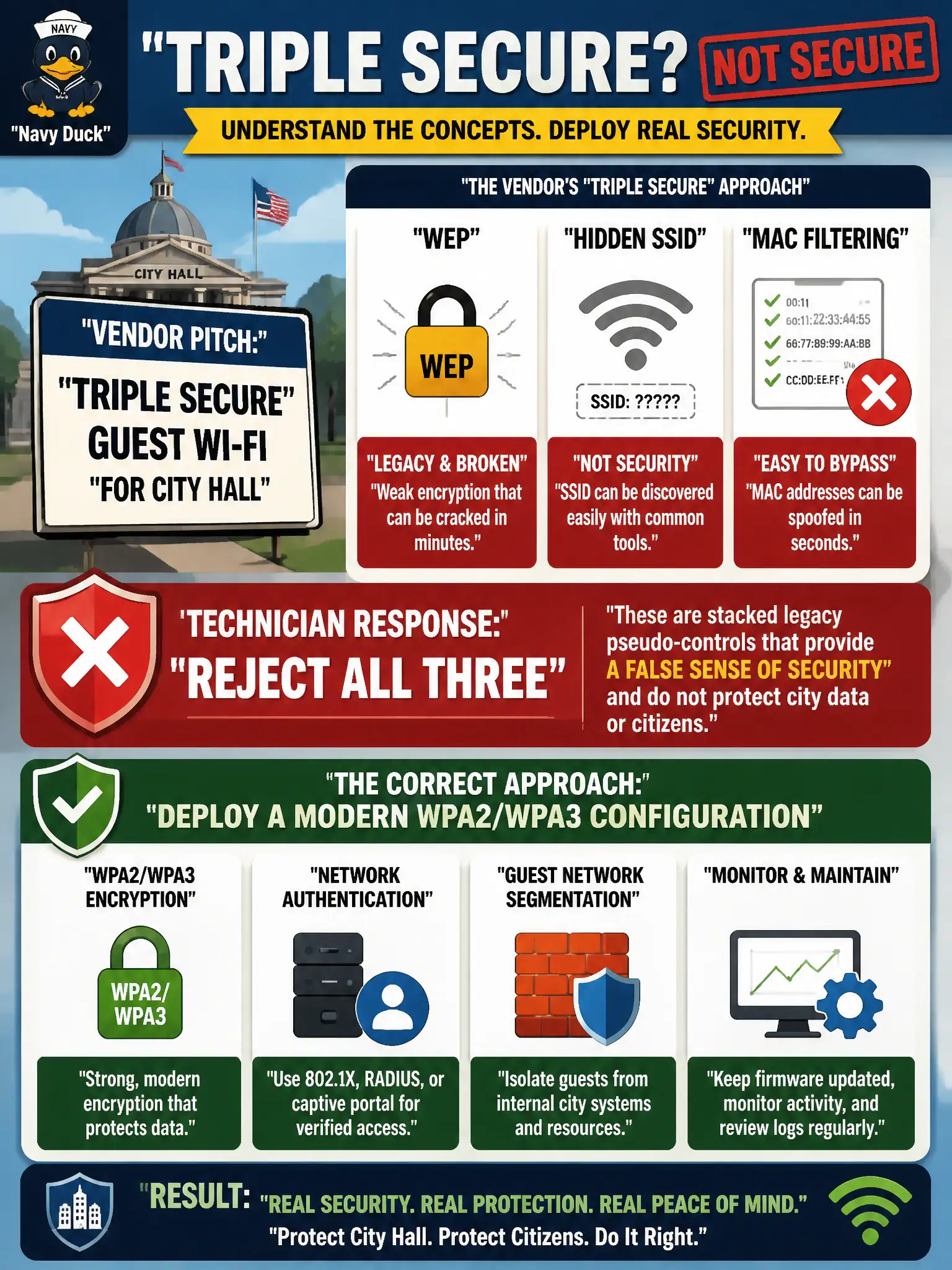
A vendor pitches "triple secure" guest Wi-Fi for city hall using WEP, a hidden SSID, and MAC filtering together. What is the correct technician response?
Select an answer to reveal the explanation.
Short Explanation
Stacking three leaky buckets does not make a sealed tank. WEP, hide-SSID, and MAC filtering are all legacy pseudo-controls—even together—so tear the bundle down and put a real WPA2 or WPA3 suite on the guest SSID.
Full Explanation
When a vendor pitches “triple secure” guest Wi-Fi for city hall using WEP, a hidden SSID, and MAC filtering together, the technician must reject all three as stacked legacy pseudo-controls and deploy a modern WPA2/WPA3 configuration. Adding weak controls does not create strong security; it creates a false sense of assurance on civic guest networks that residents and visitors use.
Accepting the bundle because three weak controls equal one strong modern suite is arithmetic nonsense in security design. Keeping WEP and the hidden SSID while dropping MAC filtering still leaves broken crypto and obscurity theater. Replacing only MAC filtering with Shared Key Authentication continues the legacy failure mode.
Exam caveat: stacking WEP, cloaking, and MAC filtering is a classic wrong answer pattern—modern RSN/WPA2/WPA3 is the remediation.
Operational check: refuse the vendor bundle in writing, configure guest Wi-Fi with WPA2/WPA3 (and portal if designed), verify WEP/Shared Key/MAC-primary are not relied upon, and file the secure baseline with city hall IT. Municipal technicians document the verified setting in the as-built packet so the next shift inherits a known-good civic configuration rather than tribal knowledge.