
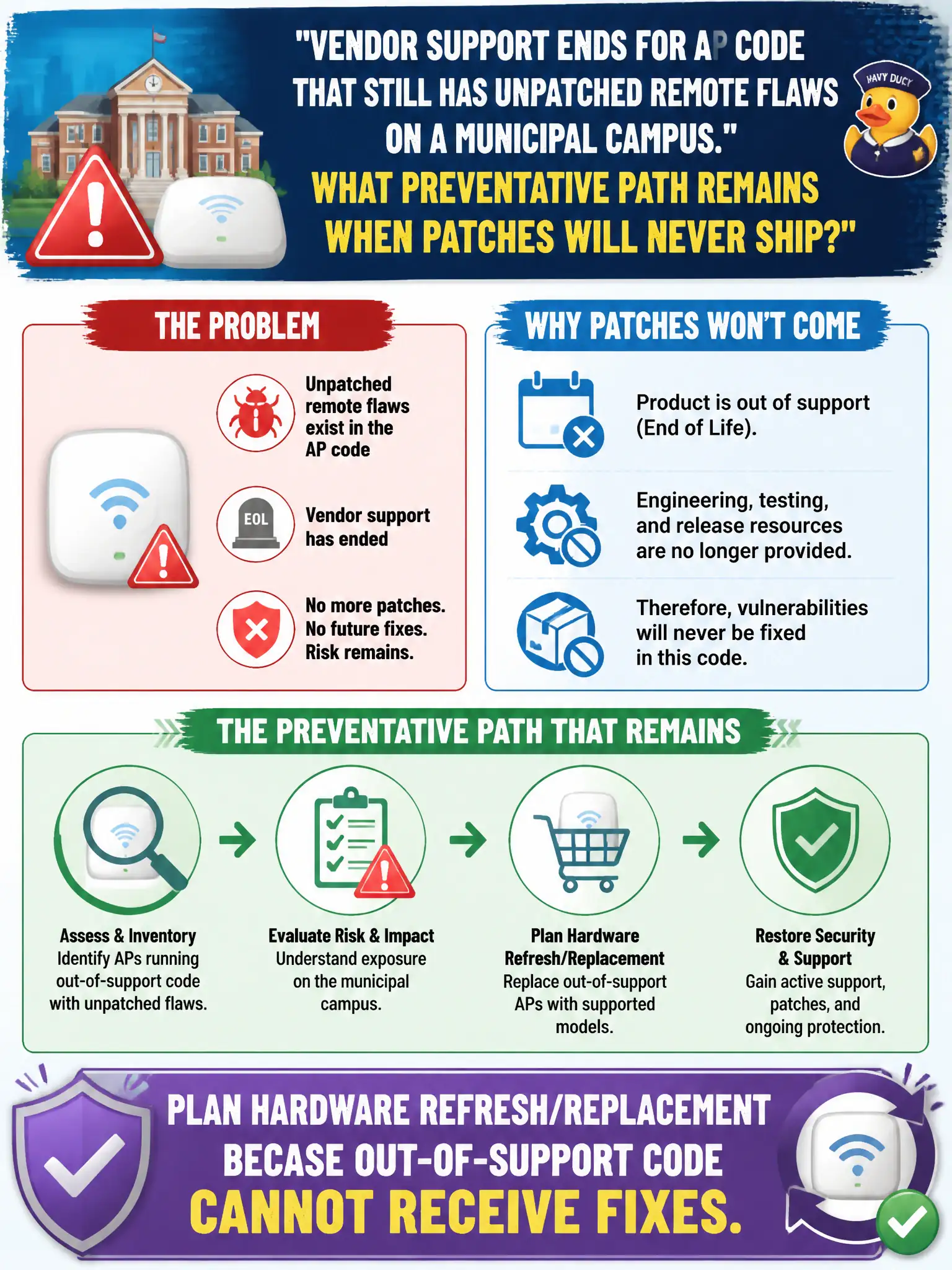
Vendor support ends for AP code that still has unpatched remote flaws on a municipal campus. What preventative path remains when patches will never ship?
Select an answer to reveal the explanation.
Short Explanation
When the vendor stops mailing lock upgrades, you replace the door—not rename the street. Out-of-support AP code means a hardware refresh plan, not hoping nobody notices.
Full Explanation
When vendor support ends for AP firmware containing unpatched remote vulnerabilities on a municipal campus, the only viable preventative path is to plan for hardware refresh or replacement. Unsupported code will not receive security patches, leaving devices perpetually exposed to known exploits. Continuing to operate these APs indefinitely relying on obscurity such as hidden SSIDs offers no real protection, as attackers use automated tools to discover devices regardless of SSID broadcast status. Downgrading to WEP is counterintuitive and dangerous; WEP is an obsolete protocol with severe cryptographic weaknesses that increase vulnerability rather than reduce it. Disabling logging to hide evidence of exploitation does not mitigate the underlying risk and hampers incident detection and response. The caveat is that hardware refresh cycles require budget and logistical planning, so interim compensating controls like network segmentation and strict access control lists may be necessary. Operational checks include inventorying all APs, confirming firmware versions, and verifying that no unsupported devices remain in critical roles without a replacement plan, ensuring the network’s security posture is maintained proactively.