
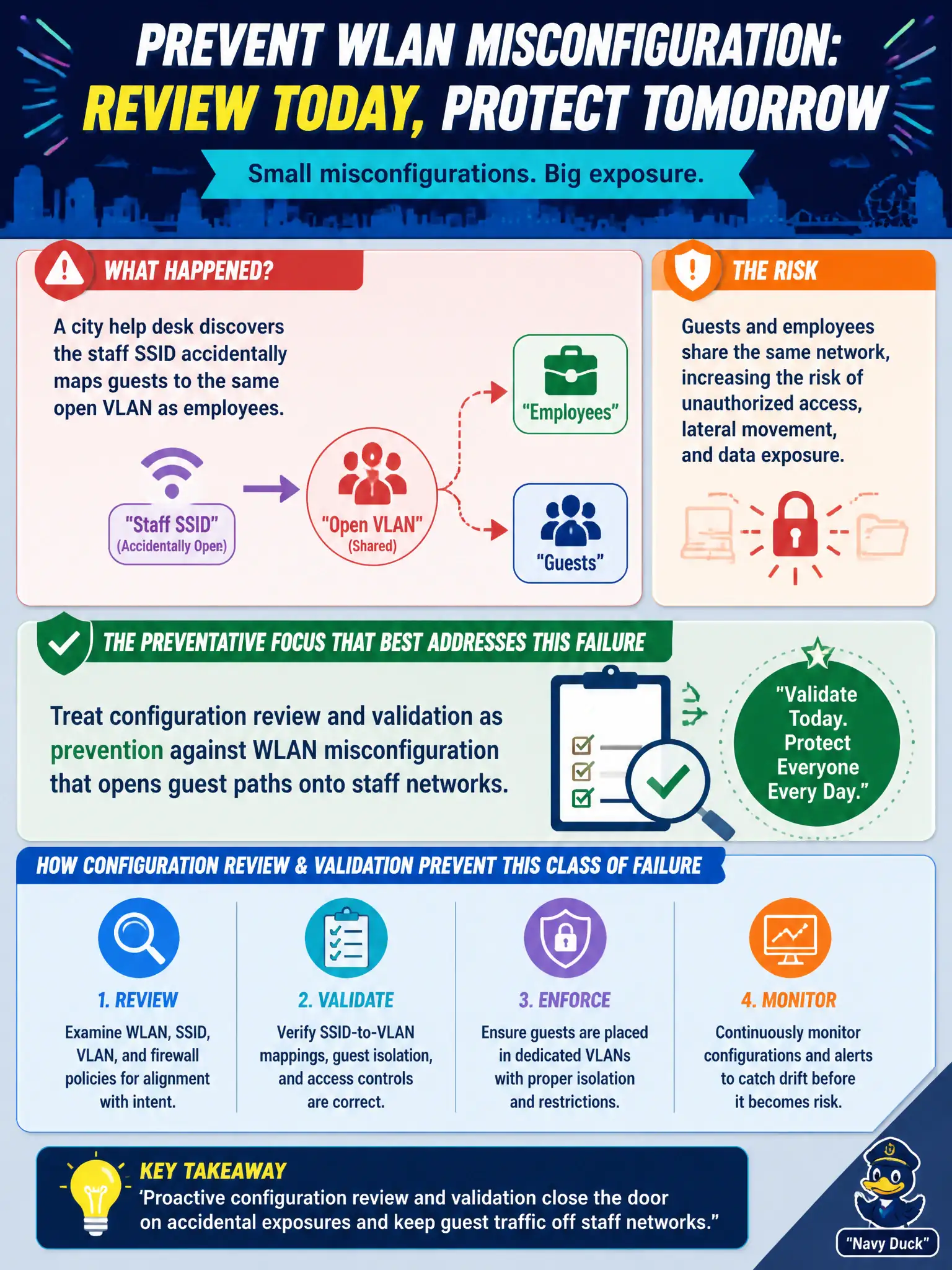
A city help desk discovers the staff SSID accidentally maps guests to the same open VLAN as employees. What preventative focus best addresses this class of failure?
Select an answer to reveal the explanation.
Short Explanation
Misconfiguration is the unlocked side door labeled ‘Staff’ that still leads into the guest hallway. Reviews and validation catch the wrong VLAN map before the public walks through it—antenna shopping will not.
Full Explanation
Preventative focus on configuration review and validation is essential to avoid WLAN misconfigurations that inadvertently allow guest devices access to staff VLANs. In municipal WLAN environments, strict segmentation between guest and staff networks is critical to protect sensitive city data and infrastructure. Regularly reviewing and validating SSID-to-VLAN mappings ensures that guest traffic remains isolated, preventing unauthorized access to employee resources. Relying on directional antennas to prevent misconfiguration is ineffective because physical antenna patterns do not enforce logical network segmentation. Disabling all guest SSIDs permanently is an extreme measure that undermines public access goals and does not address the root cause of configuration errors. Ignoring VLAN mappings because SSID names alone enforce separation is a misconception; SSID names are merely identifiers and do not control traffic segregation. The scope of this control includes automated configuration audits and manual checks to confirm VLAN assignments align with policy. Practically, the help desk should implement a process to routinely verify VLAN mappings for all SSIDs to prevent accidental network exposure.