
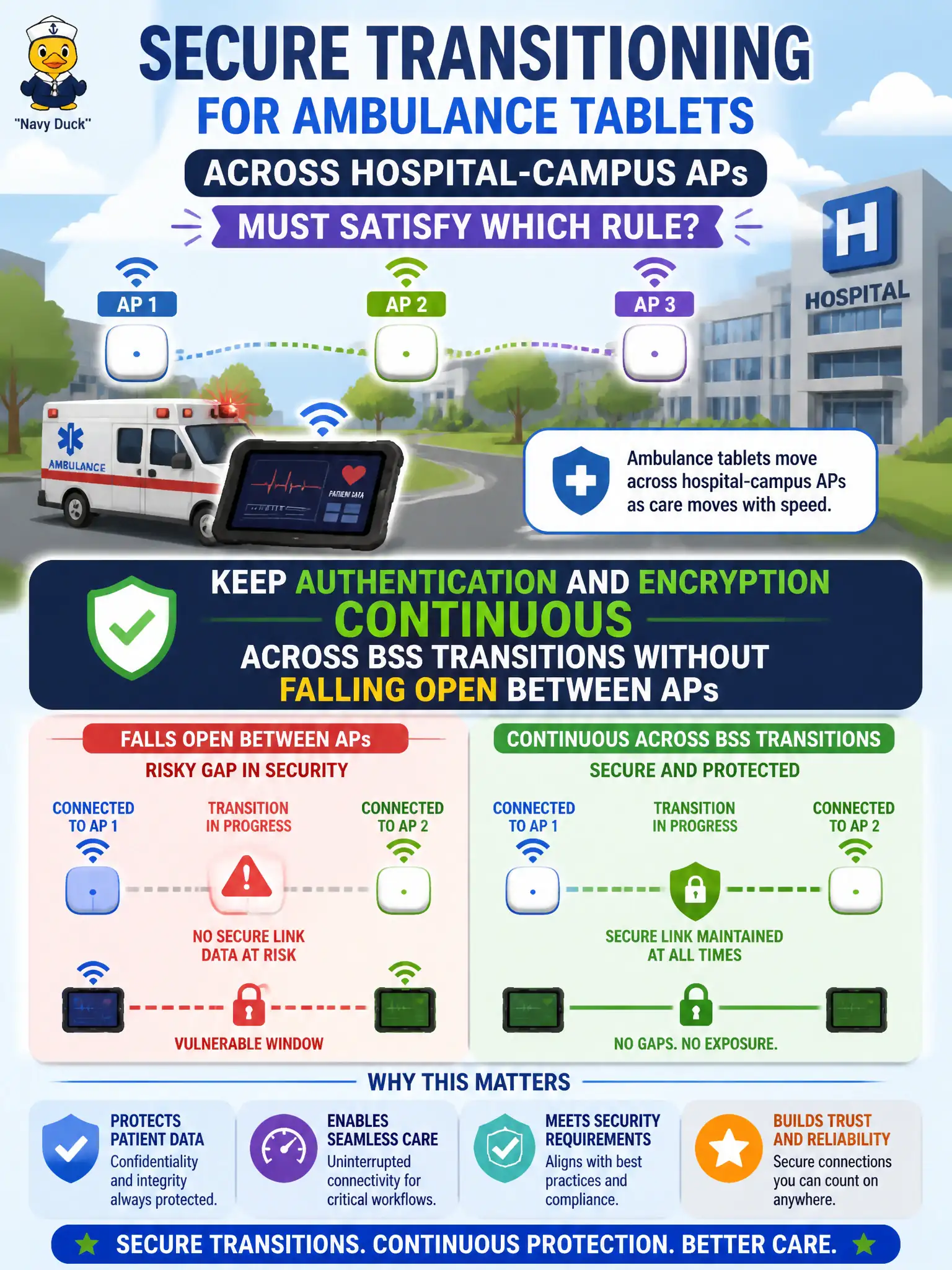
Secure transitioning for ambulance tablets across hospital-campus APs must satisfy which rule?
Select an answer to reveal the explanation.
Short Explanation
Roaming should feel like changing lanes on the same highway, not exiting onto an unpaved open road between towers. Keep auth and encryption on for the whole trip. Portal passwords every hop are how clinicians throw tablets.
Full Explanation
In municipal WLANs supporting critical ambulance tablet communications across hospital campuses, maintaining continuous authentication and encryption during AP transitions is essential to prevent data exposure and service interruption. The correct approach ensures that when a tablet moves from one AP's Basic Service Set (BSS) to another, the security context—both authentication and encryption keys—remains intact without reverting to an open or unsecured state. This continuous security is typically achieved through fast roaming protocols like 802.11r, which allow pre-authentication and key caching, enabling seamless handoffs without dropping encryption. Conversely, dropping to an open SSID between APs undermines security by exposing sensitive patient data during transitions. Pausing encryption until the tablet remains stationary introduces unacceptable latency and risks data leakage during movement. Requiring users to re-enter guest portal passwords after every AP hop is impractical and disruptive in emergency contexts where uninterrupted connectivity is vital. However, it is important to note that continuous encryption depends on compatible client and infrastructure support for fast roaming standards; legacy devices might not fully support these mechanisms. To operationally verify, one can monitor handoff events with packet captures ensuring no unencrypted frames are transmitted during transitions and confirm that authentication remains valid throughout roaming.