
A vendor claims per-user PSK gives the city the same security properties as WPA3-Enterprise 802.1X. What is the accurate distinction?
Select an answer to reveal the explanation.
Short Explanation
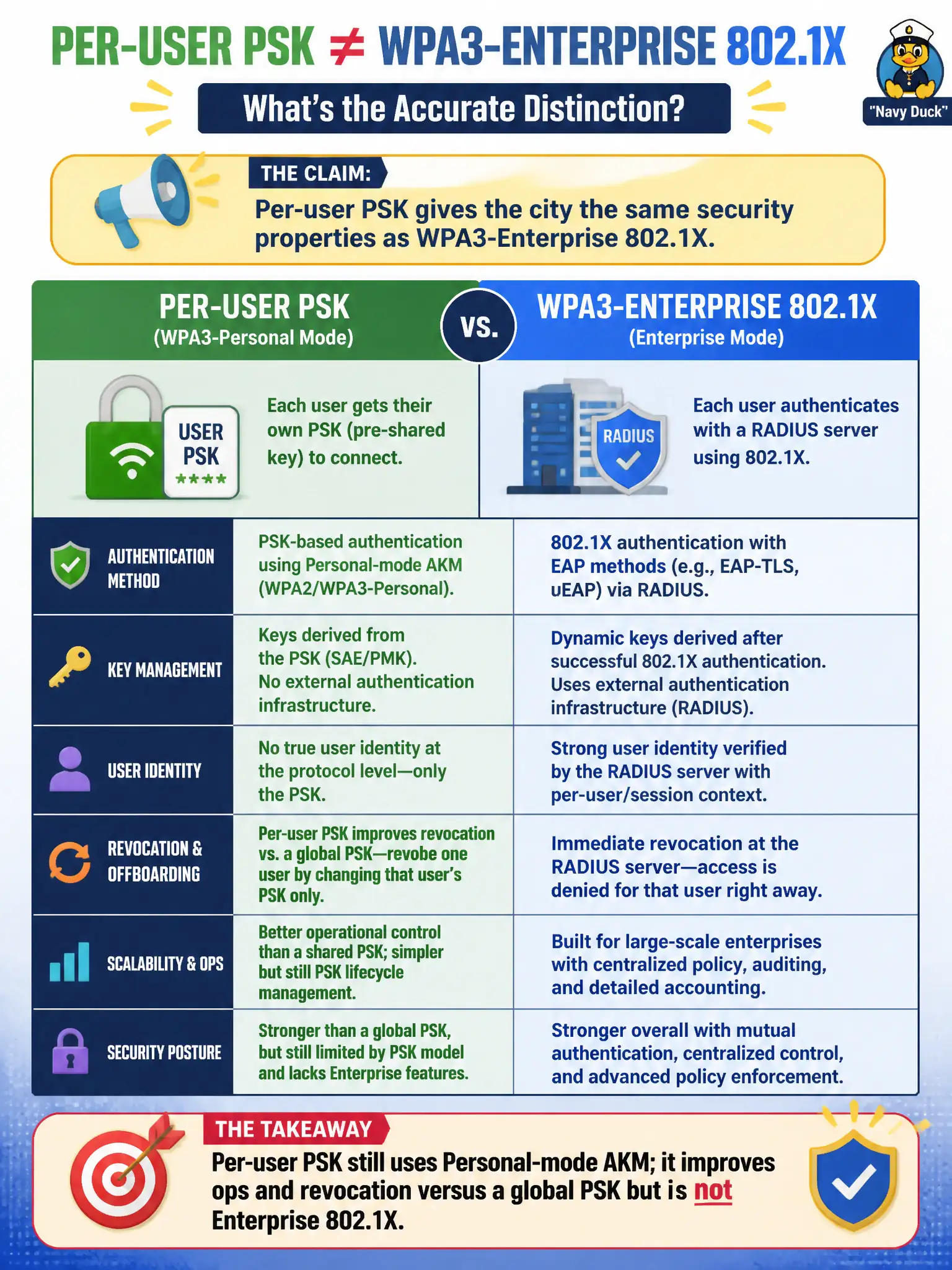
Unique PSKs tidy the Personal-mode mess, but they are still Personal-mode under the hood—not full Enterprise with RADIUS and EAP. Think better locker codes, not a badge-and-directory system. Marketing blurbs that equate the two oversell it.
Full Explanation
Per-user PSK improves operational management by assigning unique Pre-Shared Keys to individual users, allowing for easier revocation and accountability compared to a global shared PSK. However, it remains a Personal-mode Authentication and Key Management (AKM) method and does not provide the full security properties of WPA3-Enterprise 802.1X, which uses dynamic key generation, mutual authentication, and centralized authentication servers. The vendor’s claim that per-user PSK fully replaces RADIUS and EAP-TLS is incorrect; these protocols provide stronger identity verification and cryptographic protections not achievable with PSKs. The idea that per-user PSK is identical to WPA3-Enterprise 192-bit mode is false because WPA3-Enterprise employs more robust cryptographic suites and authentication frameworks. Lastly, the assertion that per-user PSK requires disabling AES encryption is wrong; AES remains the standard encryption method in all modern Wi-Fi security modes, including Personal and Enterprise. The operational caveat is that while per-user PSK enhances management and security over a shared key, it should not be considered a substitute for full Enterprise-grade authentication in high-security municipal WLANs. To verify understanding, consider if per-user PSK can enforce mutual authentication and dynamic keying like 802.1X: it cannot, confirming the distinction.