
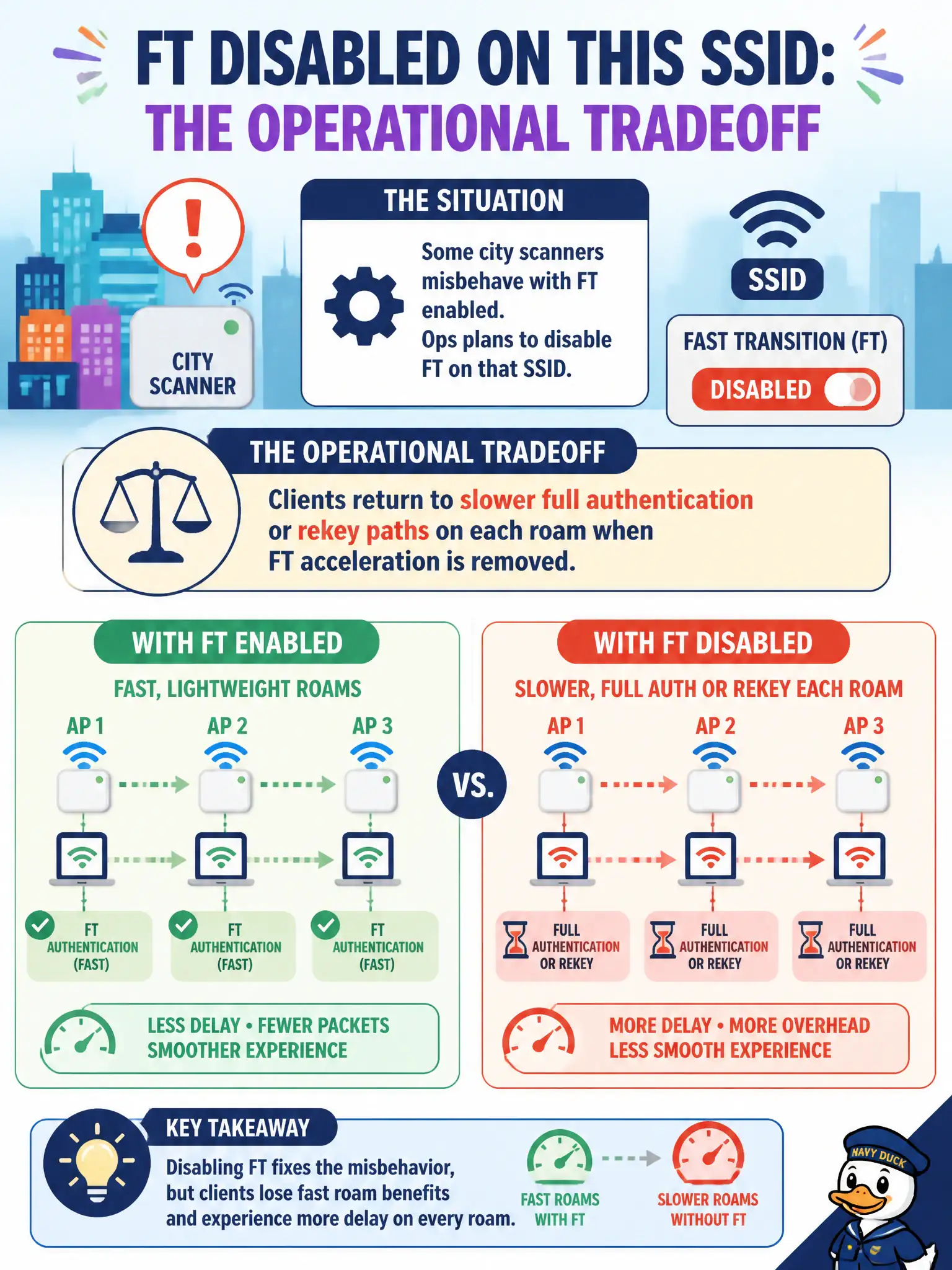
Some city scanners misbehave with FT enabled, so ops plans to disable it on that SSID. What operational tradeoff should they expect?
Select an answer to reveal the explanation.
Short Explanation
Turning FT off is yanking the express lane—security can stay, but every roam may wait in the full-auth line again. Expect slower handoffs, not magical WEP or open access. Voice may feel it first.
Full Explanation
Disabling Fast Transition (FT) on a city SSID due to scanner compatibility issues means clients lose the benefit of accelerated roaming. FT allows clients to reuse key material and perform a streamlined reassociation process when moving between APs, minimizing latency and packet loss. Without FT, devices must perform a full authentication or rekey process on each roam, which is slower and can cause noticeable delays or service interruptions, especially in latency-sensitive applications like voice or video. The incorrect notions include the idea that roaming would revert to WEP encryption, which is outdated and insecure; FT removal does not cause automatic fallback to WEP. Another false assumption is that clients would no longer require authentication, which is not true since authentication remains mandatory for secure access. Lastly, believing voice latency always improves without FT is incorrect; FT is designed to reduce latency during roaming, so disabling it typically worsens voice performance. The key operational caveat is that while disabling FT may be necessary for compatibility, network operators should anticipate increased roaming delays and plan accordingly, possibly by optimizing other network parameters. To verify understanding, consider a device moving between APs without FT: will it experience longer authentication times? Yes, confirming the tradeoff in operational performance.