
Library kiosks and volunteer tablets need Personal-mode Wi-Fi without one citywide passphrase. Which approach improves accountability?
Select an answer to reveal the explanation.
Short Explanation
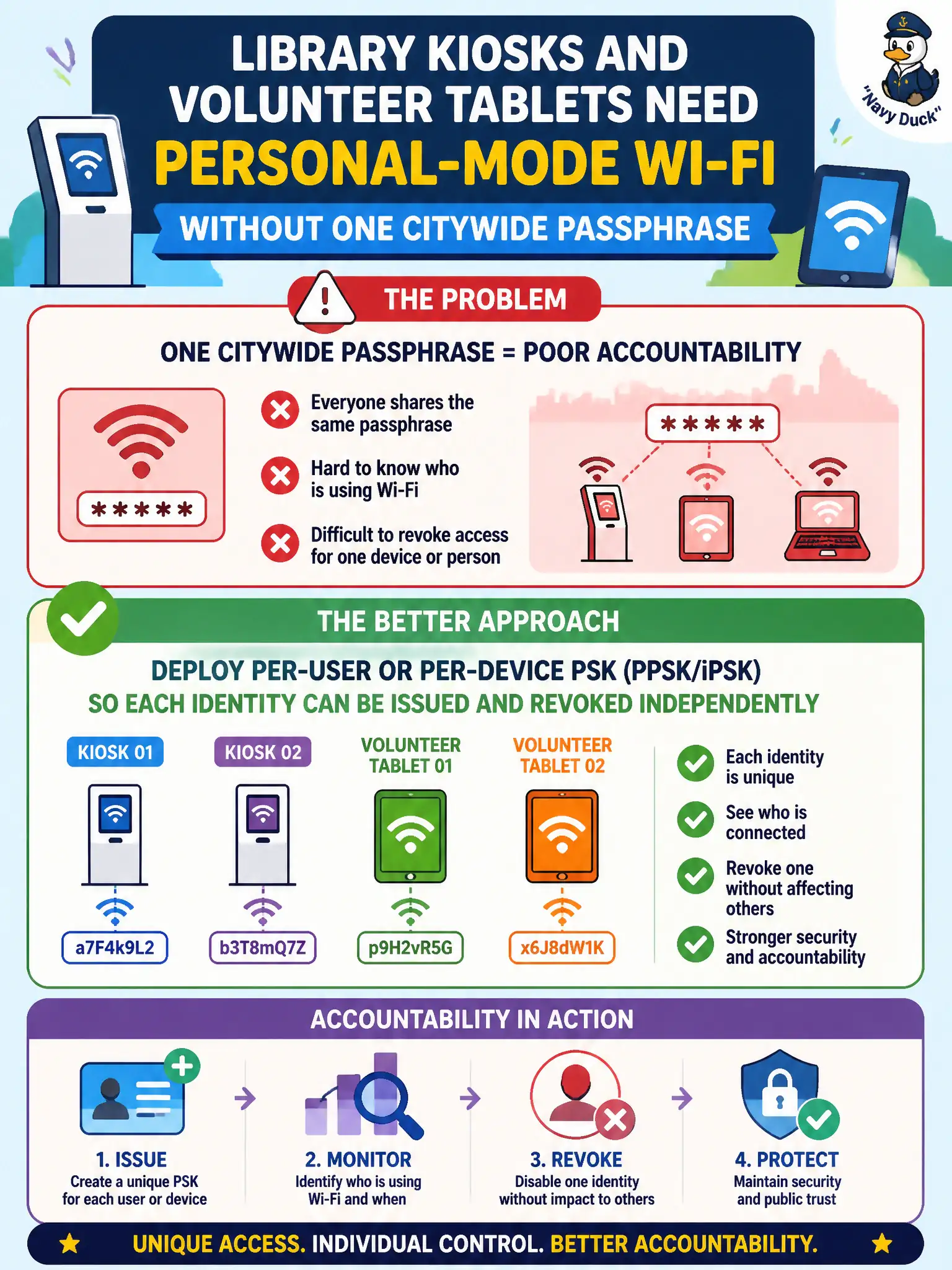
Per-user PSKs are like individual locker codes instead of one code for the whole library. Lose one volunteer’s key and you revoke that identity, not the entire building. Open SSIDs and FAQ passphrases undo that gain.
Full Explanation
For library kiosks and volunteer tablets requiring Personal-mode Wi-Fi without a single citywide passphrase, deploying per-user or per-device PSKs (PPSK or iPSK) enhances accountability by assigning unique credentials to each identity. This setup allows administrators to issue distinct keys to individual users or devices, enabling precise tracking of network activity and straightforward revocation if a key is compromised or a user departs. This granular control improves security and operational management over a shared passphrase environment. The flawed alternatives include printing the same PSK in a public FAQ, which exposes the network to unauthorized access and eliminates accountability since everyone uses the same key. Moving kiosks to an open SSID with no logs removes encryption and auditing, leaving the network vulnerable to eavesdropping and attacks without any traceability. Disabling encryption entirely and relying on physical locks is insufficient because physical security cannot protect wireless transmissions from interception or unauthorized access. The operational caveat is that per-user or per-device PSKs require a management system capable of generating, distributing, and revoking keys efficiently, which may add complexity but is essential for secure municipal WLAN deployments. To confirm comprehension, consider if a volunteer leaves: can their access be revoked without disrupting others? Yes, by revoking their unique PSK, demonstrating the accountability advantage.