
For a city voice SSID, engineers must choose between 802.11r FT and OKC. What selection guidance is most appropriate?
Select an answer to reveal the explanation.
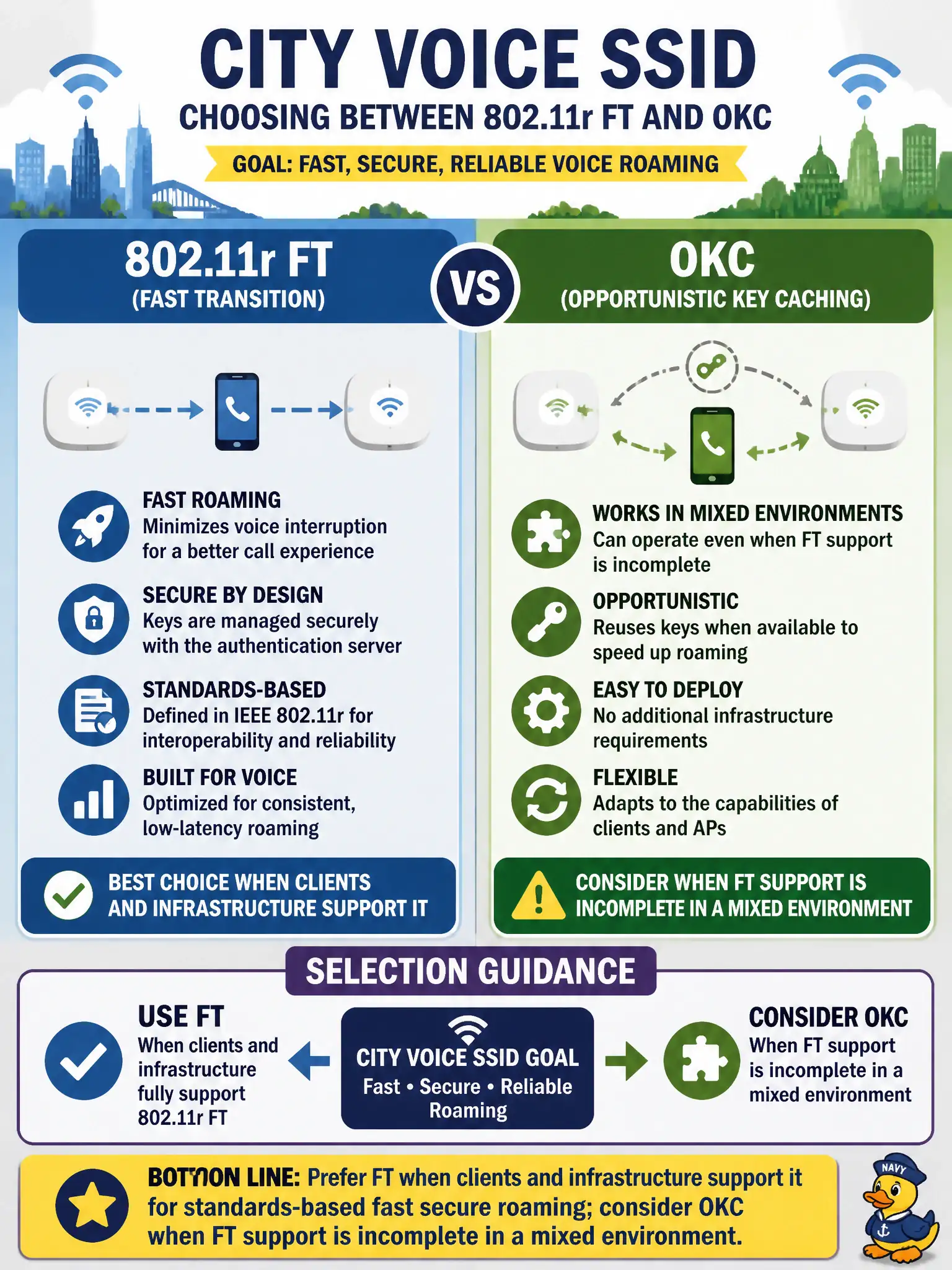
Short Explanation
If the whole voice fleet and WLAN gear speak 802.11r, take that standards path. If the mix is messy, OKC can still shave roam time without throwing security away. WEP and portal-every-hop are how calls die.
Full Explanation
When choosing between 802.11r Fast BSS Transition (FT) and Opportunistic Key Caching (OKC) for a city voice SSID, the best guidance is to prefer FT when both clients and infrastructure support it, as FT provides standards-based fast secure roaming with broad interoperability and security assurances. FT's standardized approach ensures consistent behavior and robust security during roaming. OKC serves as a fallback option in mixed environments where FT support is incomplete, offering a practical but less standardized fast roaming optimization. Always choosing WEP is inappropriate due to its severe security weaknesses and incompatibility with modern fast roaming methods. Using FT only on guest open networks or OKC only for printers misapplies these technologies, as both are designed to optimize secure roaming for clients needing seamless and secure connectivity. Disabling both and forcing captive-portal reauthentication on every roam introduces latency and user inconvenience, unsuitable for voice traffic. A key consideration is verifying client and AP support for FT to maximize benefits. Operationally, testing voice handsets roaming with FT enabled should demonstrate minimal latency and maintained security, while fallback to OKC should be seamless if FT is unsupported.