
A mixed-vendor municipal campus needs faster secure reassociation without depending solely on 802.11r client support. Which technique fits that conceptual need?
Select an answer to reveal the explanation.
Short Explanation
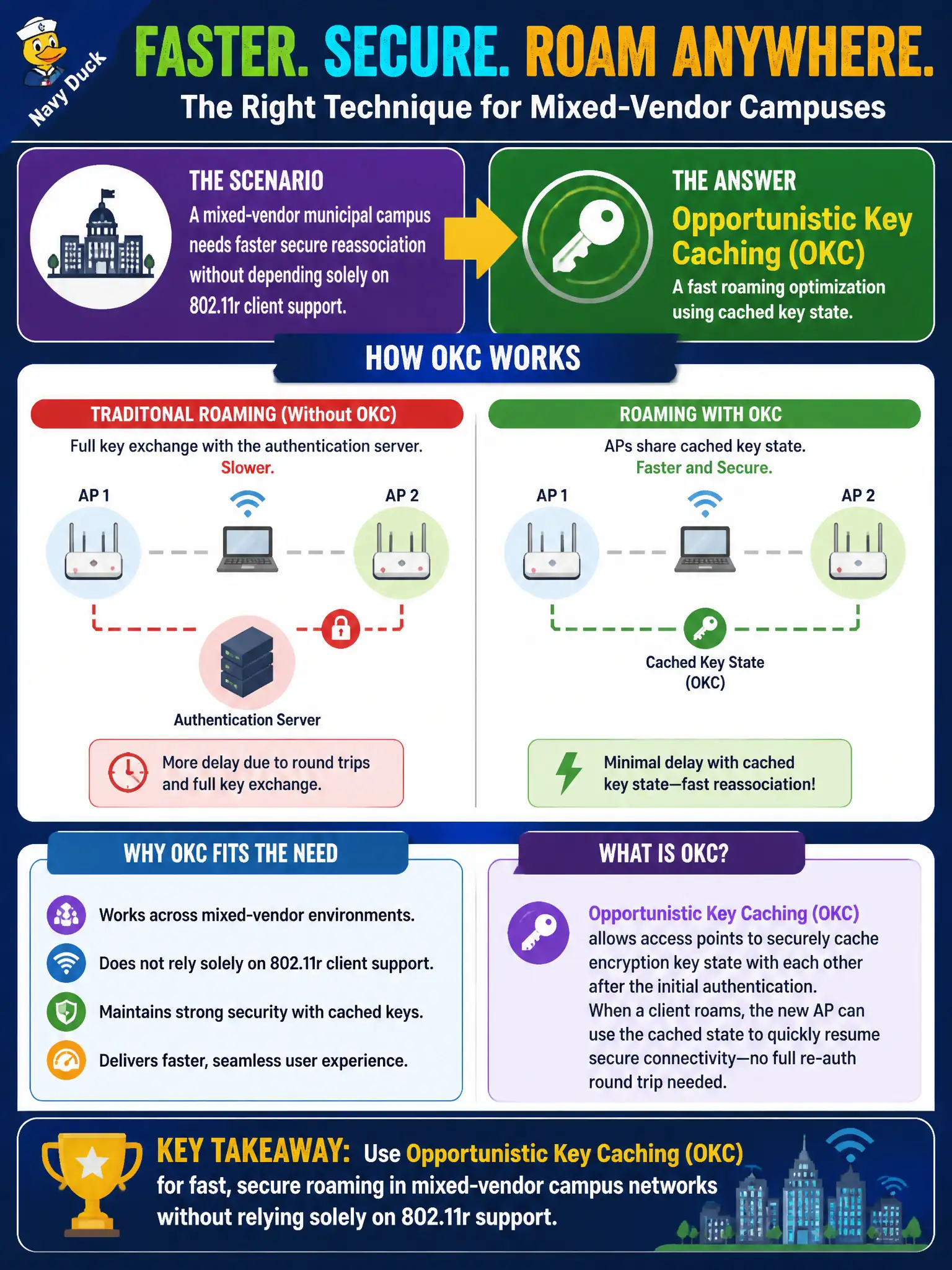
OKC is the campus’s shared memory of recent secure keys so the next AP does not start from zero. Handy when not every client speaks 802.11r cleanly. Open roamers SSIDs and WEP are not the mixed-vendor answer.
Full Explanation
In a mixed-vendor municipal campus WLAN where faster secure reassociation is desired without relying solely on 802.11r client support, Opportunistic Key Caching (OKC) is an effective technique. OKC enables clients to cache key state from previous authentications, allowing them to quickly re-associate with new APs by reusing cached keys instead of performing a full 802.1X authentication each time. This reduces roaming latency and maintains security without requiring full 802.11r support across all devices. Daily WEP rekeying is outdated and insecure, as WEP is vulnerable and does not support modern key caching or fast roaming. Broadcasting a second open SSID for roamers exposes the network to unauthorized access and does not provide encryption or authentication. Disabling pairwise keys after the first association compromises security by removing individualized encryption, increasing vulnerability to eavesdropping. It is important to note that OKC is a vendor-specific optimization and may not be standardized, so compatibility testing across devices is essential. Operationally, verifying that clients roam quickly with maintained encryption and without full re-authentication confirms OKC effectiveness.