
A city IT team manages tablets used by building inspectors on the staff WLAN. How should MDM best reduce evil-twin risk for EAP?
Select an answer to reveal the explanation.
Short Explanation
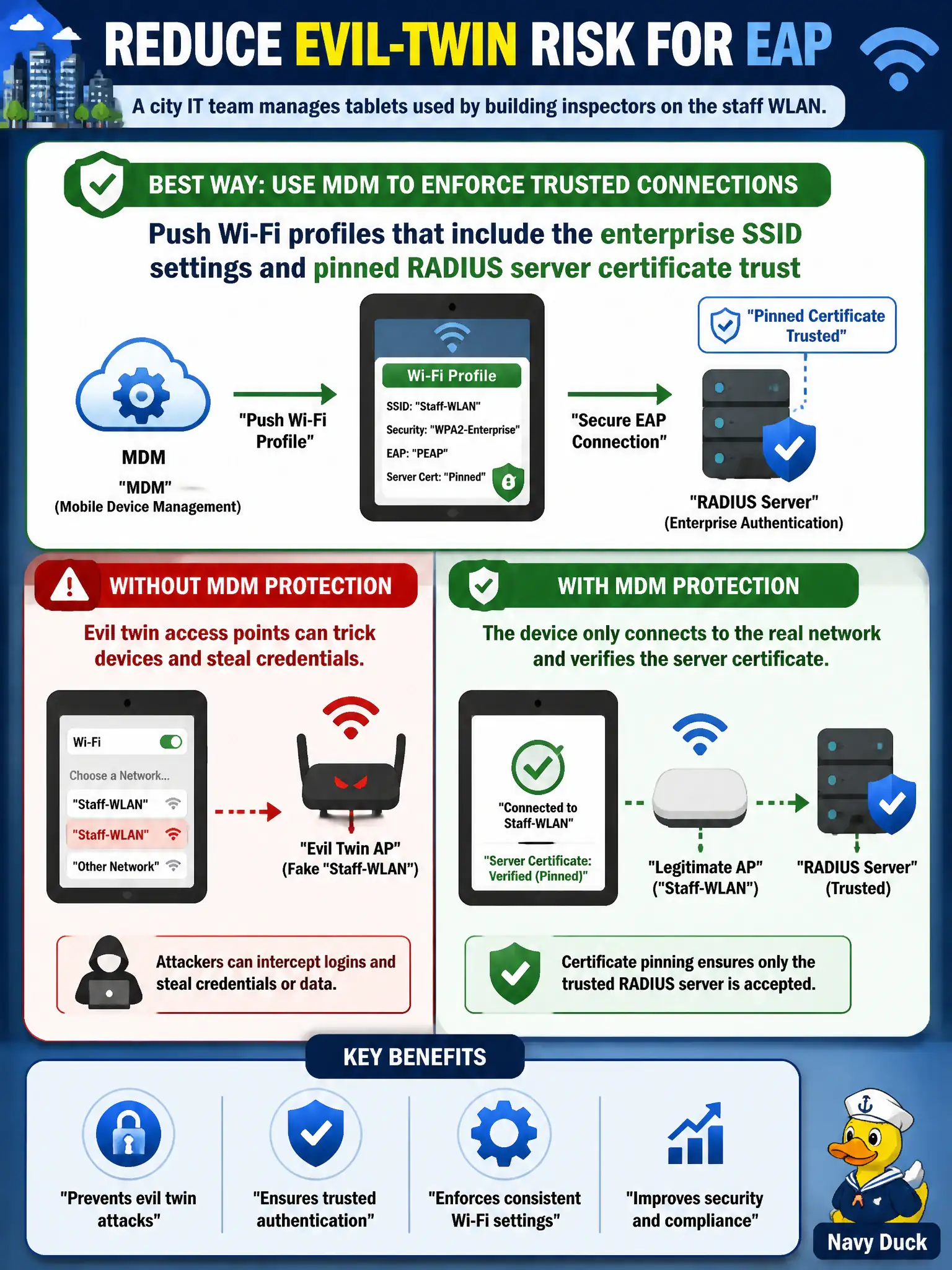
Picture MDM as a locked lunchbox of Wi-Fi settings the city hands every tablet. Inside sit the right SSID, EAP knobs, and a pin for the real RADIUS server cert so fake portals do not get a free pass. Shared passwords on truck dashboards and skipping cert checks invite trouble.
Full Explanation
To effectively reduce the risk of evil-twin attacks in a municipal WLAN environment where building inspectors use tablets with EAP authentication, the best practice is to push Wi-Fi profiles via Mobile Device Management (MDM) that include the enterprise SSID settings along with pinned RADIUS server certificate trust. This approach ensures that the tablets only connect to the legitimate city WLAN by validating the RADIUS server's certificate during the EAP process, preventing attackers from impersonating the authentication server. Pinning the server certificate means the client explicitly trusts only the known certificate, blocking connections to rogue APs that mimic the SSID but present fraudulent certificates. Conversely, publishing the WPA passphrase on laminated cards inside inspection trucks exposes sensitive credentials physically, enabling attackers to easily obtain and misuse them, which undermines security. Allowing inspectors to pick any open SSID resembling the city name removes control over trusted networks and opens the door to connecting to malicious APs, defeating the purpose of secure EAP authentication. Disabling certificate checking to speed roaming sacrifices a core security mechanism that prevents man-in-the-middle attacks, making devices vulnerable to evil twins. It is important to note that certificate pinning requires proper certificate lifecycle management to avoid connectivity issues during certificate renewals. As an operational check, verify that tablets only connect to the enterprise SSID and reject connections when presented with invalid or untrusted RADIUS server certificates, confirming that evil-twin mitigation is active.