
Architects describe why enterprise WLAN should use AAA rather than only local AP user databases. What purpose do AAA servers primarily serve?
Select an answer to reveal the explanation.
Short Explanation
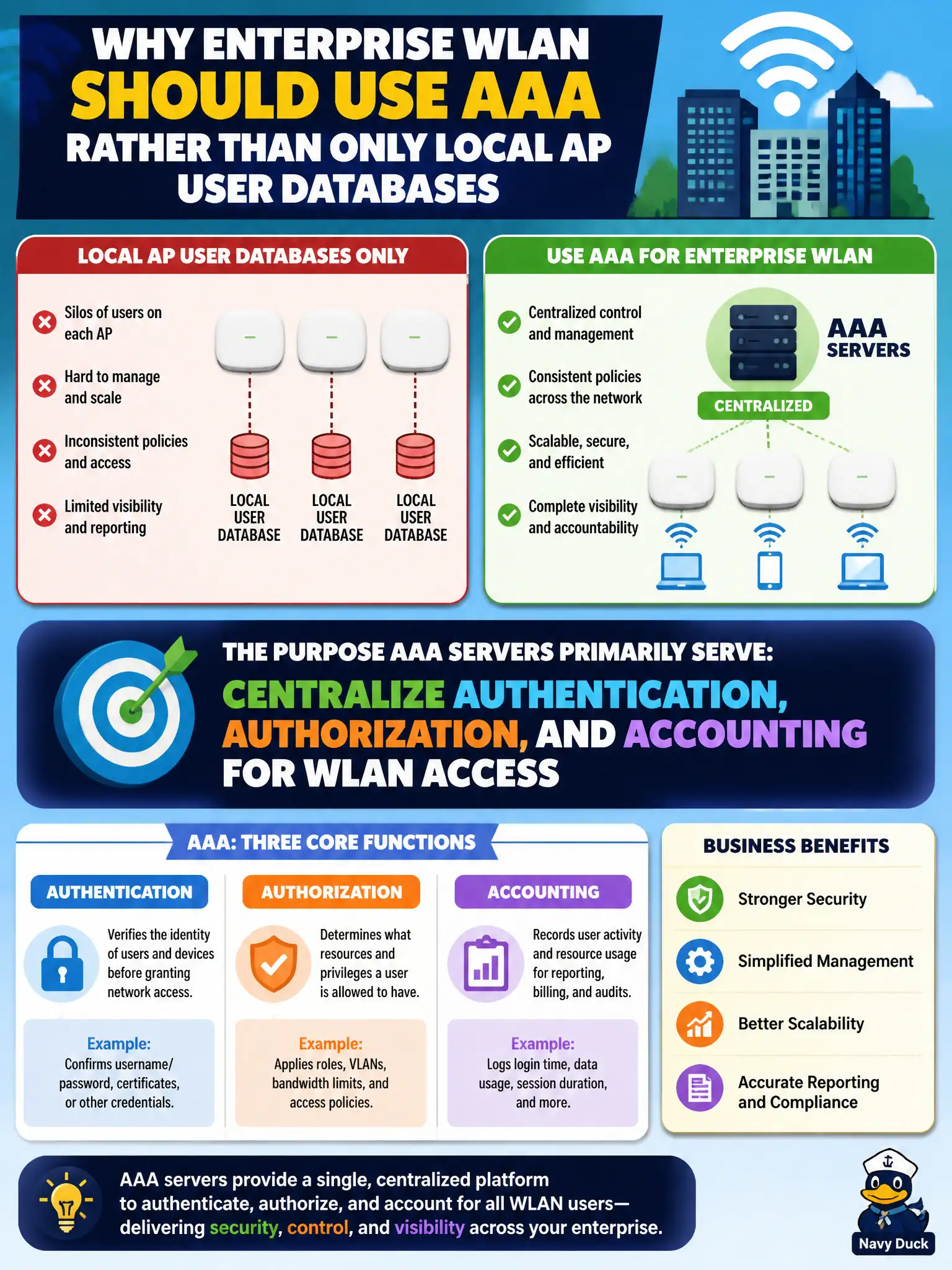
AAA is the front desk for who you are, what you get, and what you did—centralized for the WLAN. Hiding SSIDs or shuffling antenna tables is not AAA’s job.
Full Explanation
Enterprise WLAN should use AAA rather than only local AP user databases because AAA servers primarily centralize authentication, authorization, and accounting for WLAN access. Central AAA gives consistent identity policy across hundreds of municipal APs, enables role assignment after successful authentication, and produces accounting trails needed for audits and investigations. Local per-AP user lists do not scale across city buildings and inevitably drift out of sync as staff join and leave. AAA does not exist to replace all encryption with SSID hiding across the campus. It does not store only antenna gain tables for predictive surveys. It does not provide Layer-1 spectrum coordination between neighboring cities or other RF engineering functions outside identity and policy. Exam caveat: protecting the RADIUS shared secret or RadSec channel is part of complete AAA design—strong EAP on the air still fails if the AP-to-RADIUS trust relationship is weak or left at vendor defaults. Operational check: authenticate a staff client and confirm Authentication success, Authorization attributes, and Accounting start/stop appear on the central AAA platform rather than only in a local AP debug log, then fail AAA briefly to verify APs do not silently fall back to an insecure local accept.