
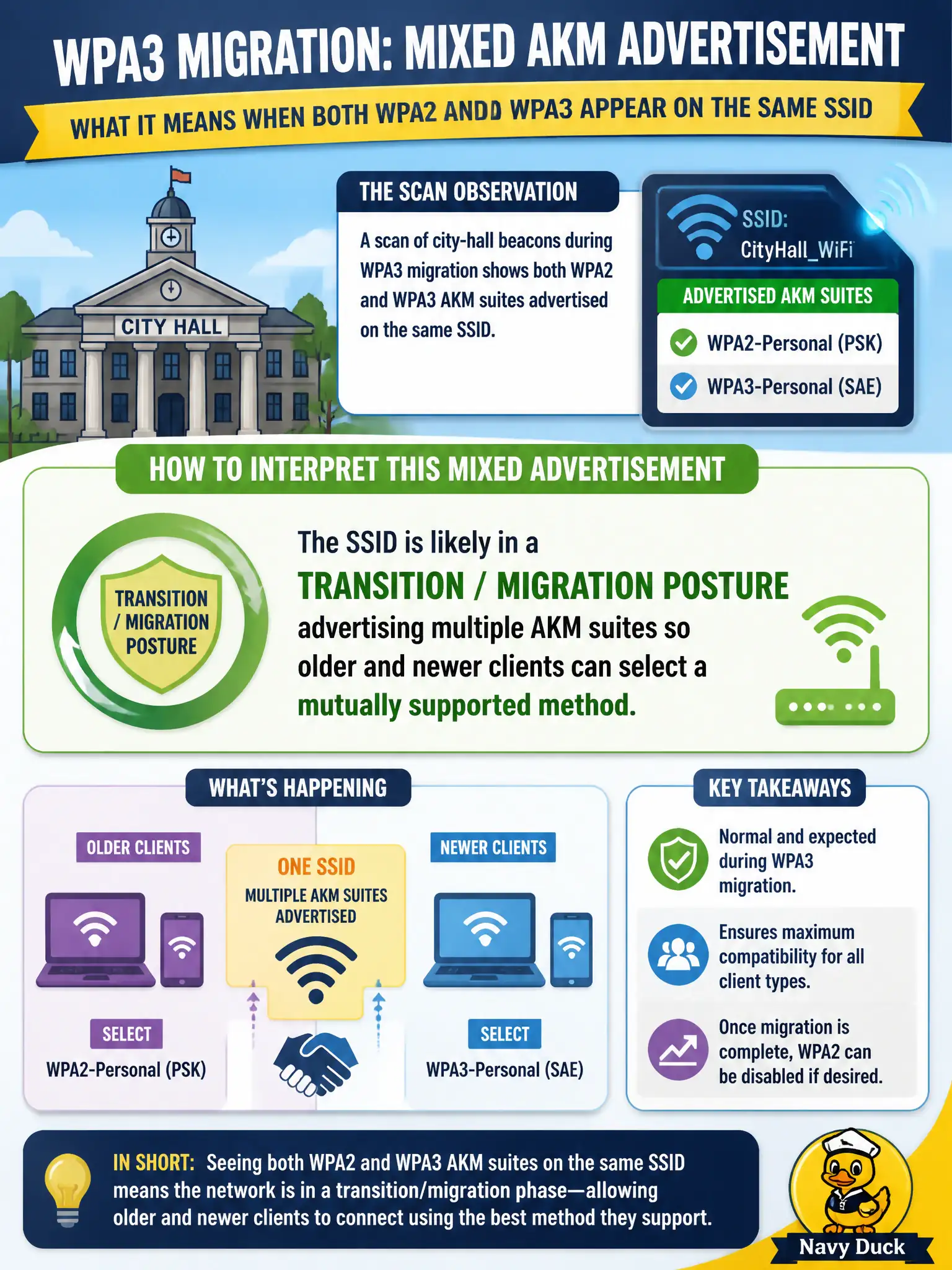
A scan of city-hall beacons during WPA3 migration shows both WPA2 and WPA3 AKM suites advertised on the same SSID. How should the candidate interpret that mixed advertisement?
Select an answer to reveal the explanation.
Short Explanation
Seeing both WPA2 and WPA3 AKMs on one beacon is usually the migration billboard for mixed clients. It signals a transition posture, not proof the WLAN is open or that roaming somehow broke.
Full Explanation
A scan of city-hall beacons during WPA3 migration that shows both WPA2 and WPA3 AKM suites on the same SSID most often means the SSID is in a transition or migration posture advertising multiple AKM suites so older and newer clients can select a mutually supported method. Mixed advertisements are a deliberate compatibility billboard during cutover, not automatic proof of misconfiguration into open mode. Candidates should interpret the mixed list as a migration signal and then ask how long it is allowed to remain. Mixed suites do not always mean the AP is in pure open mode with a cosmetic AKM list. They do not always mean RSN Override is disabled and FT is impossible. Beacon AKM lists are not descriptions of wired switchport 802.1X methods only; they advertise WLAN Personal/Enterprise (and related) choices clients use before associating. Exam caveat: transition advertisements that never shrink become permanent weak-suite exposure—pair the observation with a retirement metric for legacy AKMs. Operational check: export beacon RSN AKMs for each city-hall SSID weekly during migration, chart which clients still choose WPA2 AKM, and gate the move to WPA3-only on measured legacy client elimination rather than on calendar hope alone.