
Compared with a single shared PSK on the utilities field SSID, what security property does Enterprise AKM add when linemen authenticate with unique credentials?
Select an answer to reveal the explanation.
Short Explanation
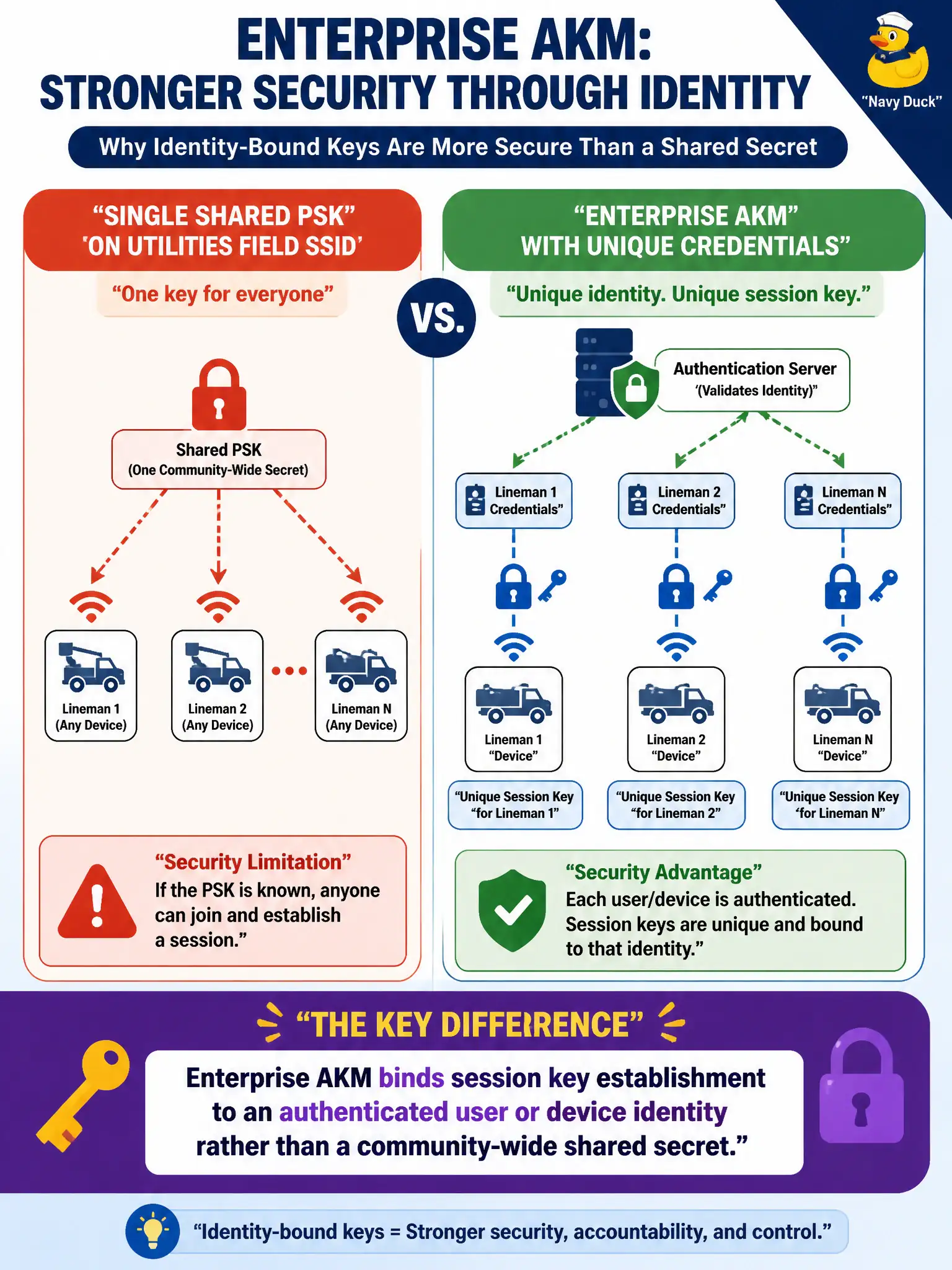
Shared PSK is one house key on a nail by the door—anyone with the nail is “the utility.” Enterprise AKM badges each lineman first, then mints keys tied to that successful identity. Revocation and accountability finally mean something.
Full Explanation
Compared with a single shared PSK on the utilities field SSID, Enterprise AKM adds the property of binding session key establishment to an authenticated user or device identity rather than to a community-wide shared secret. Each lineman’s successful 802.1X result feeds keying for that session, enabling accountability, revocation, and differentiated authorization that a nail-on-the-wall passphrase cannot provide. That is the core security-property upgrade civic utilities should cite when moving field networks off Personal PSK. Enterprise AKM does not remove the need for pairwise transient keys after authentication succeeds; the 4-way handshake still matters. It does not force all traffic onto an open SSID so RADIUS accounting can inspect cleartext payloads. It does not replace AES-based ciphers with WEP to simplify meter-reading handhelds. Exam caveat: Enterprise gains evaporate if devices share a single machine account or if certificates are cloned across handhelds—identity binding must be real in operations, not only in architecture slides. Operational check: authenticate two linemen to the field Enterprise SSID, confirm distinct AAA identity in accounting logs, revoke one account or certificate, and verify only the revoked session loses access while the other remains productive.