
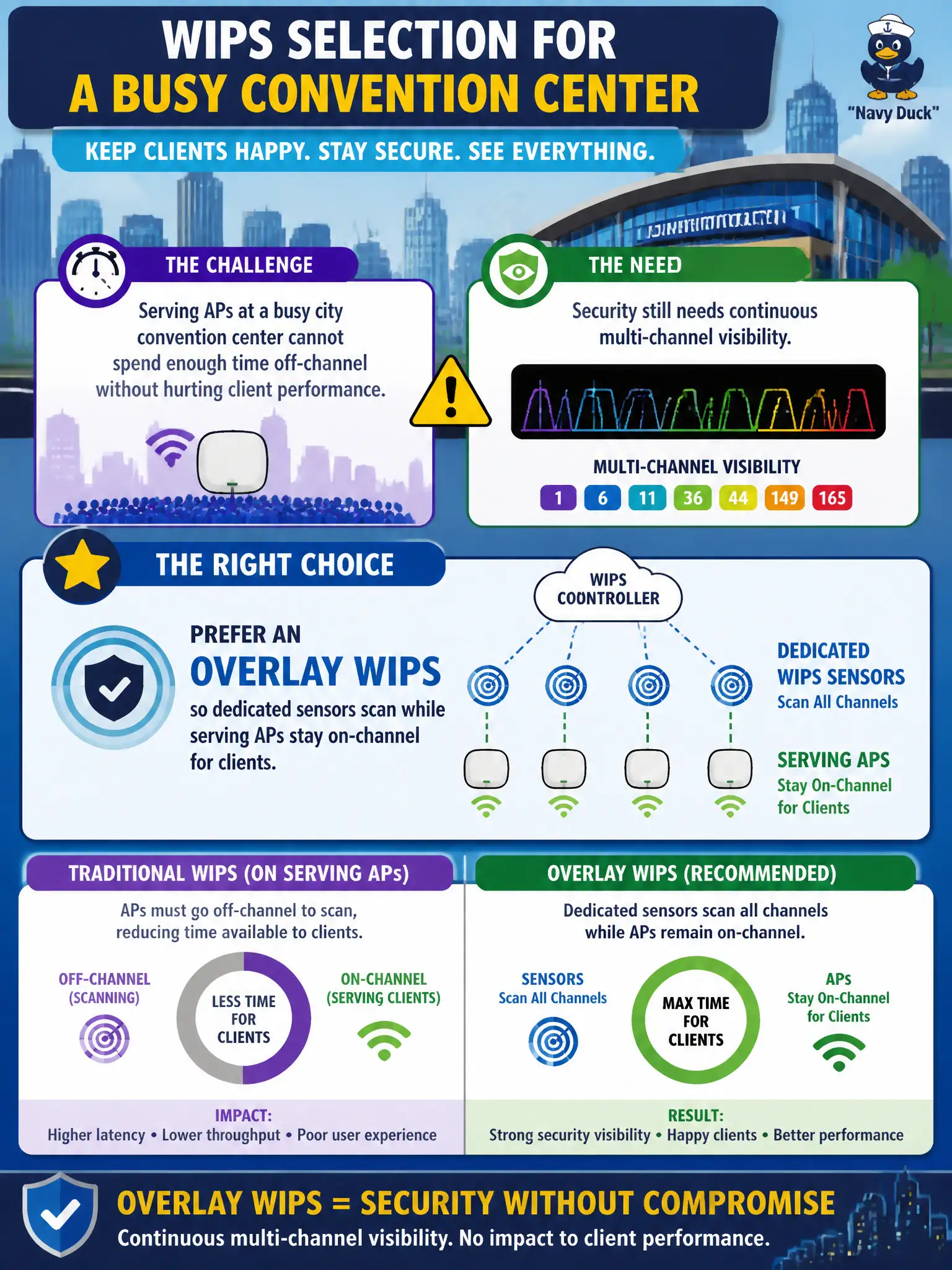
Serving APs at a busy city convention center cannot spend enough time off-channel without hurting client performance. Security still needs continuous multi-channel visibility. Which WIPS selection follows?
Select an answer to reveal the explanation.
Short Explanation
If serving radios are glued to the client channel, they cannot moonlight as full-time security scanners. Overlay sensors carry that load so fans and attendees keep airtime. Wired DHCP tricks do not see RF rogues.
Full Explanation
At a busy city convention center, serving APs that cannot spend enough time off-channel without hurting client performance should drive the architect to prefer an overlay WIPS. Dedicated sensors scan continuously across channels while serving APs remain on-channel for attendees, preserving both security visibility and airtime for dense client populations. Integrated-only scanning with effectively zero off-channel time cannot meet continuous multi-channel monitoring requirements when every radio is glued to serving duty. Turning off WIPS and merely increasing beacon intervals abandons threat detection without solving the monitoring architecture problem. Using DHCP snooping alone as the wireless IDS confuses a wired edge control with RF rogue detection in exhibit halls and ballrooms. Exam caveat: overlay sensor density and placement still need RF planning—too few sensors create blind spots behind booths, in loading docks, and across multi-floor halls. Operational check: compare rogue detection latency and client throughput under integrated off-channel scanning versus overlay sensors during a simulated show-floor load, then select the architecture that simultaneously meets SOC alert SLAs and facilities performance SLAs.