
A parks department small site will use Personal mode. Why is WPA3-Personal with SAE preferred over classic WPA2-Personal PSK authentication?
Select an answer to reveal the explanation.
Short Explanation
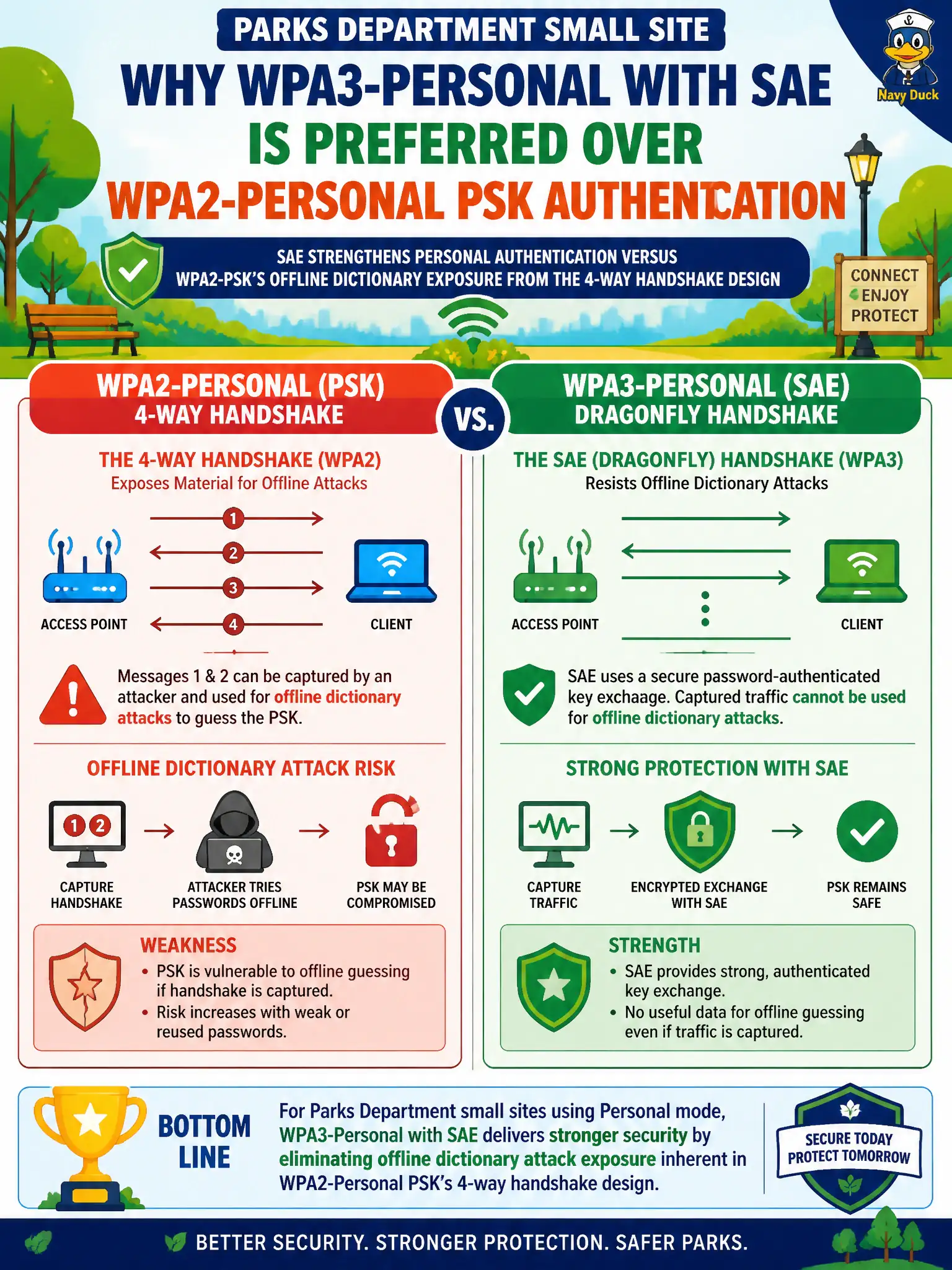
WPA2-Personal’s PSK dance leaked enough for offline password guessing. SAE (dragonfly) hardens that Personal-mode story. It isn’t ‘go open,’ swap in WEP, or suddenly demand client certs.
Full Explanation
For a parks department small site using Personal mode, WPA3-Personal with SAE is preferred over classic WPA2-Personal PSK authentication because SAE strengthens Personal authentication versus WPA2-PSK’s offline dictionary exposure from the four-way handshake design. SAE does not remove the need for a passphrase or convert the network to open. SAE does not replace AES encryption with WEP. SAE does not force every Personal client to present an EAP-TLS certificate. Exam caveat: SAE improves password-based Personal AKM; it is not Enterprise 802.1X and not a reason to disable encryption. Operational check: migrate the parks SSID to SAE (or Transition Mode only if legacy devices require it), set a long random passphrase, validate client joins, and reassess Transition Mode quarterly. Note the preference for SAE-only in the municipal small-site Personal standard when client fleets allow. In municipal WLAN operations, record the rationale in the change ticket so future on-call staff know which control was chosen and which failure modes the rejected options would create for city services. Re-validate after the next maintenance window that the same control still holds under the infrastructure versions and client fleets used by the civic environment.