
Which project-documentation practice best supports a repeatable municipal WLAN security test?
Select an answer to reveal the explanation.
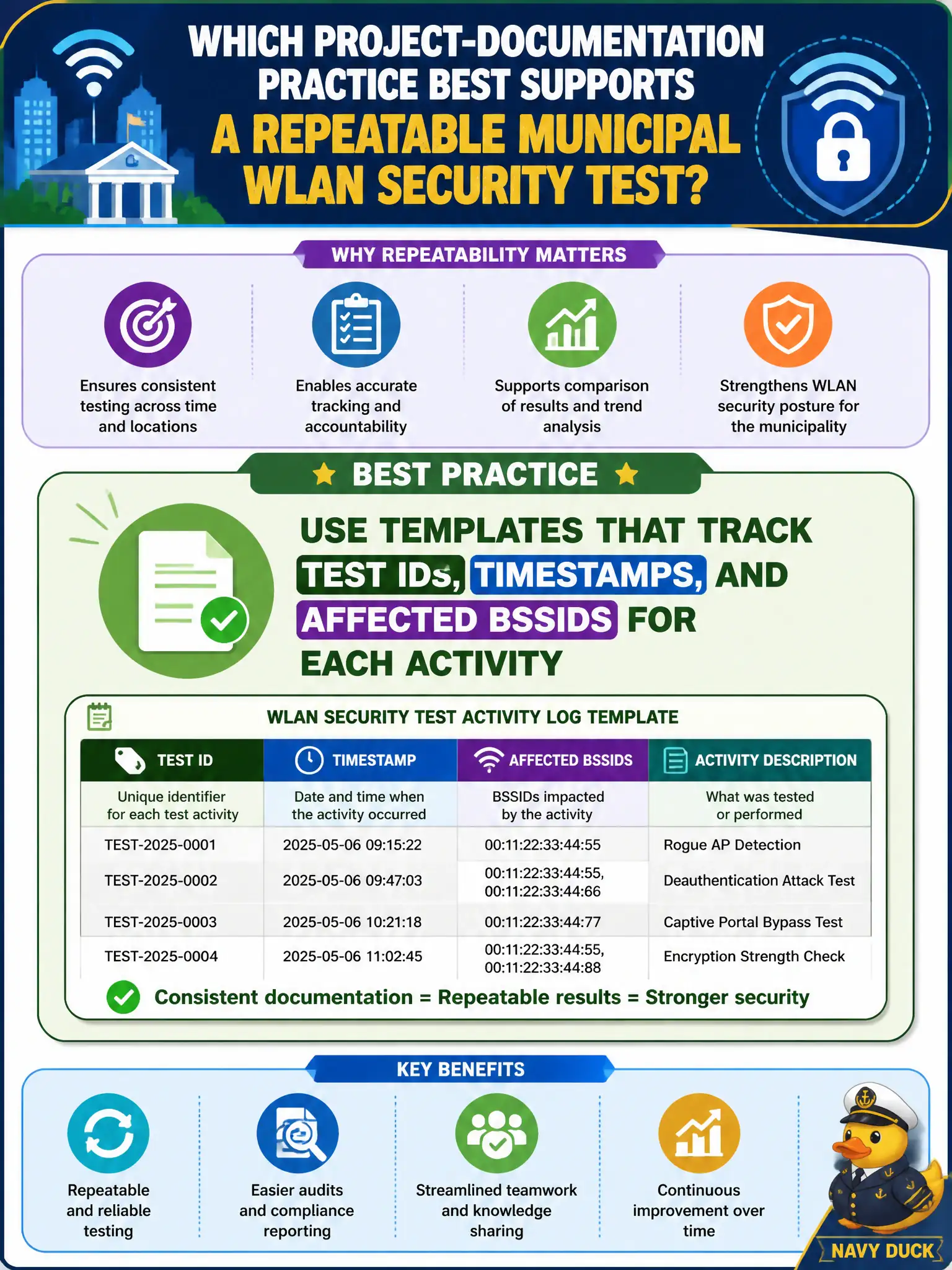
Short Explanation
Good test paperwork is a flight log: test ID, when it happened, which BSSID got touched. Templates beat vanishing chat threads when the city asks what was tested last Tuesday.
Full Explanation
Repeatable municipal WLAN security testing depends on documentation templates that track test IDs, timestamps, and affected BSSIDs for each activity so results can be reproduced, audited, and remediated. Keeping results only in auto-deleting personal chat destroys institutional memory. Disappearing sticky notes without timestamps cannot support retests. Omitting BSSID identifiers prevents mapping findings to access points and confuses which closet or SSID needs fixes. Exam caveat: documentation quality is itself a scored professional practice under security-testing process—identifiers and timestamps are not bureaucracy; they are how wireless findings become actionable for city operations. Operational check: adopt a standard worksheet with test ID, UTC timestamp, site, SSID, BSSID, technique, and result fields; require every tester to complete a row per activity; and archive the sheet with the engagement report. Spot-check that BSSIDs in the template match controller inventories before closing the municipal assessment. In municipal WLAN operations, record the rationale in the change ticket so future on-call staff know which control was chosen and which failure modes the rejected options would create for city services. Re-validate after the next maintenance window that the same control still holds under the infrastructure versions and client fleets used by the civic environment.