
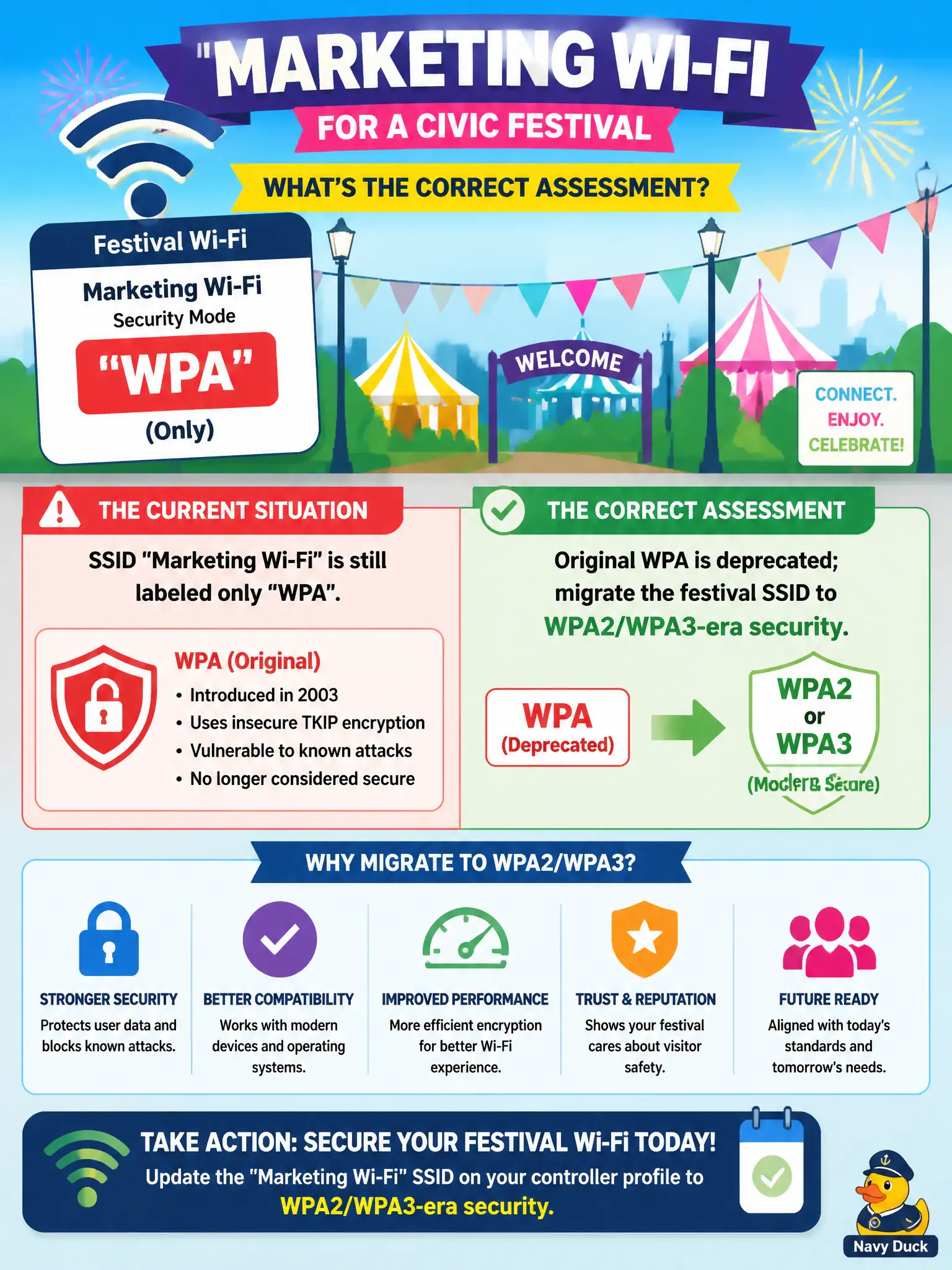
Marketing Wi-Fi for a civic festival is still labeled only 'WPA' on the controller profile, not WPA2 or WPA3. What is the correct assessment?
Select an answer to reveal the explanation.
Short Explanation
Plain 'WPA' on a festival SSID is like selling tickets printed in 2003—technically Wi-Fi history, not today’s standard. Move that civic guest network to WPA2 or WPA3 territory and leave original WPA in the museum.
Full Explanation
Original WPA—typically the TKIP-era Wi-Fi Alliance generation—is deprecated and must not remain the labeled security mode for marketing Wi-Fi at a civic festival. Controllers still offering undifferentiated WPA profiles should be migrated to WPA2/WPA3-era configurations with modern ciphers and AKM appropriate to the event's risk. Treating original WPA as the current gold standard misstates the alliance roadmap. Assuming any profile containing the letters WPA is equally modern conflates naming with cryptographic generation. Believing WPA without a generation number auto-upgrades to WPA3 overnight is operationally false; firmware and SSID profiles must be explicitly updated. Exam caveat: distinguish WPA, WPA2, and WPA3 as generations; mixed or legacy WPA labels often still permit TKIP and are scored as deprecated-risk configurations under CWSP objectives. Operational check: open the festival SSID profile, confirm WPA2 or WPA3 with AES-based ciphers, remove bare WPA/TKIP options, and validate with a WLAN auditor that beacon/RSN information reflects the intended generation before gates open. Archive the pre-event screenshot in the municipal event Wi-Fi checklist for after-action review.