
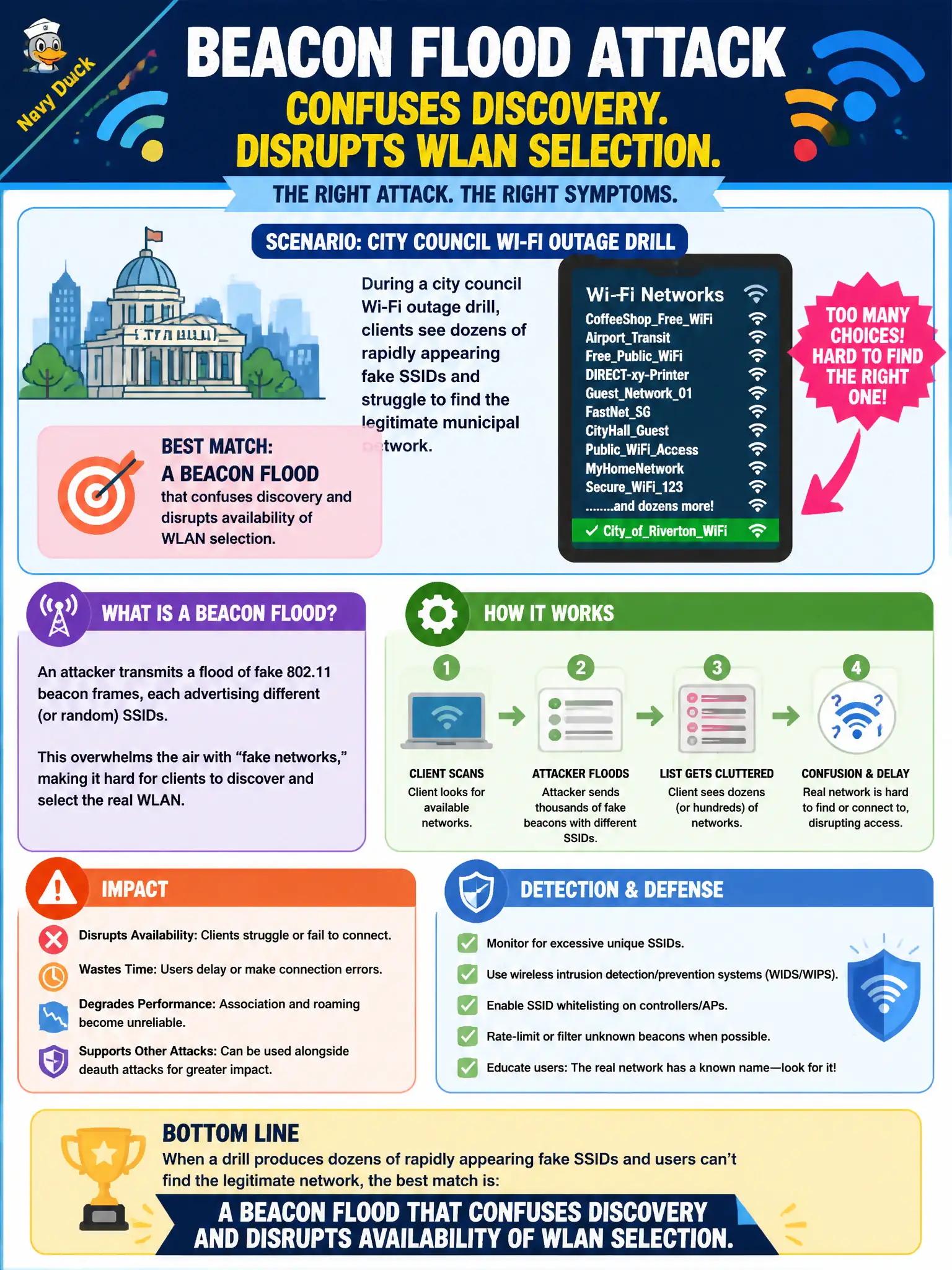
During a city council Wi-Fi outage drill, clients see dozens of rapidly appearing fake SSIDs and struggle to find the legitimate municipal network. Which attack best matches this symptom?
Select an answer to reveal the explanation.
Short Explanation
Fake beacons are like stuffing a hundred phantom radio stations into the dial—the real city SSID gets lost in the noise. That discovery chaos is a beacon flood hitting availability. Proper EAP-TLS or OWE would not spray junk SSIDs.
Full Explanation
During a city council Wi-Fi outage drill, when clients see dozens of rapidly appearing fake SSIDs and struggle to find the legitimate municipal network, the attack that best matches is a beacon flood that confuses discovery and disrupts availability of WLAN selection. Floods of bogus beacons overwhelm scan lists and delay or prevent association to the real civic SSID. EAP-TLS mutual authentication completing with valid server certificates is successful secure authentication, not the symptom described. OWE opportunistic encryption on an otherwise open visitor SSID is a confidentiality improvement for open networks. SNMPv2c GET-BULK of interface counters on the core switch is wired management traffic unrelated to fake SSID storms. Council chambers and public meeting spaces are disruptive environments where beacon floods quickly become availability incidents. Exam caveat: beacon floods are primarily availability/confusion attacks; pair detection with RF location and containment rather than only raising transmit power. Operational check: capture beacon rates and unique SSIDs during the symptom window, use WIPS location to find the transmitter, contain or remove it, and verify council-chamber clients can again discover the legitimate municipal SSID promptly.