
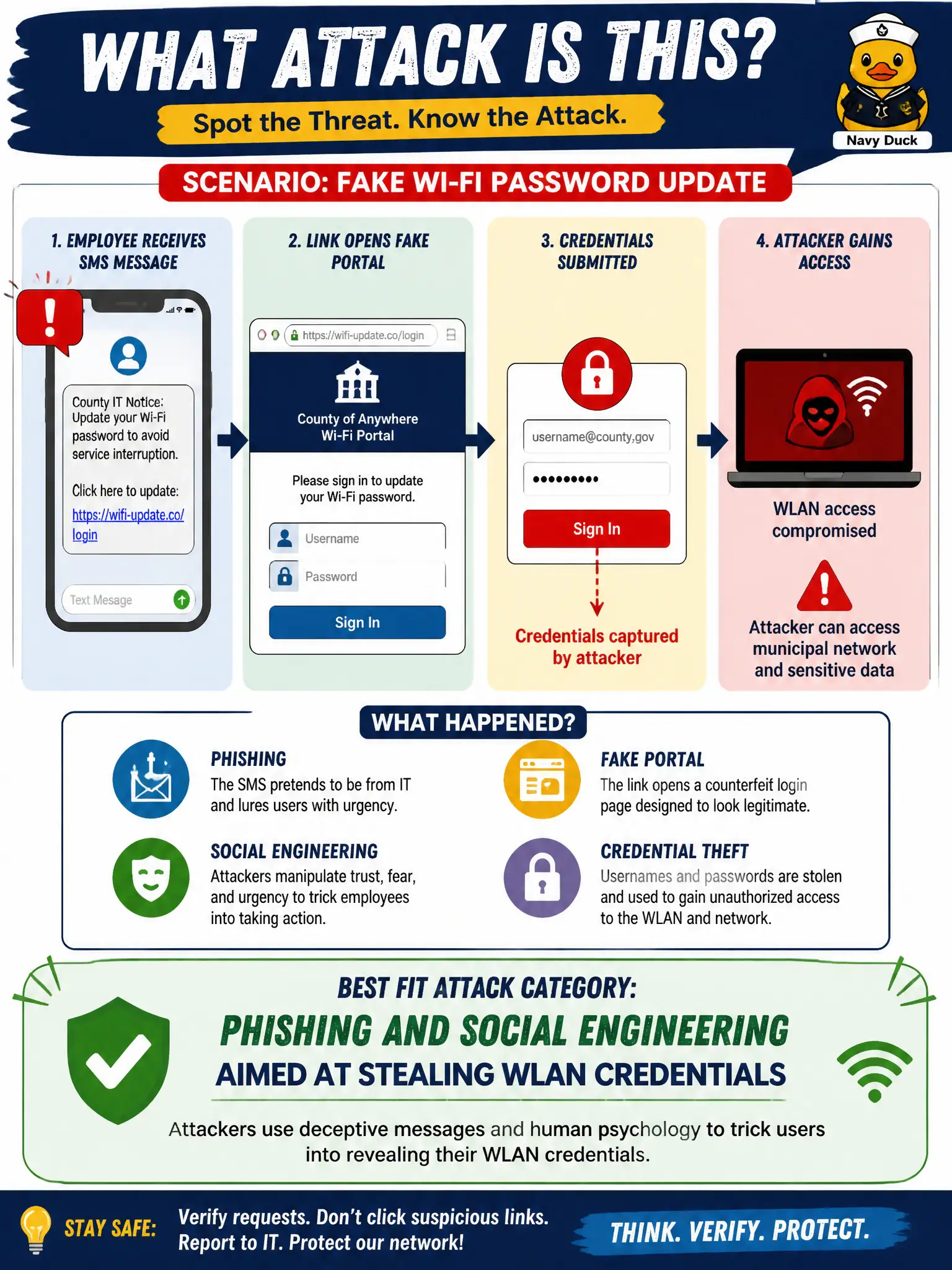
County employees receive SMS messages saying “update your Wi-Fi password” with a link to a fake portal that asks for municipal network credentials. Which attack category best fits?
Select an answer to reveal the explanation.
Short Explanation
That text is a con artist in a hard hat—“click here to fix Wi-Fi”—not a radio glitch. Social engineering and phishing steal secrets by tricking people, not by breaking AES. Treat the link like a stranger asking for the city badge.
Full Explanation
County employees who receive SMS messages saying "update your Wi-Fi password" with a link to a fake portal that asks for municipal network credentials are facing phishing and social engineering aimed at stealing WLAN credentials. The attack abuses trust and urgency rather than breaking 802.11 cryptography directly. RF beacon flooding that confuses SSID discovery lists is a wireless discovery DoS technique, not an SMS lure. GCMP MIC failures caused by damaged antennas on outdoor APs are physical/RF integrity symptoms, not credential phishing. Legitimate Passpoint online signup using OpenRoaming brokers is a standards-based onboarding path and does not match unsolicited SMS to a fake portal. Civic workforces with mobile phones are routinely targeted by Wi-Fi-themed phishing that bypasses carefully built EAP designs if users type passwords into impostor sites. Exam caveat: strong WLAN crypto does not stop credential phishing; awareness and credential hygiene remain required controls. Operational check: instruct staff that IT will not request Wi-Fi passwords via SMS, route suspicious messages to the SOC, force resets for any entered municipal credentials, and include Wi-Fi-themed SMS lures in the county awareness program.