
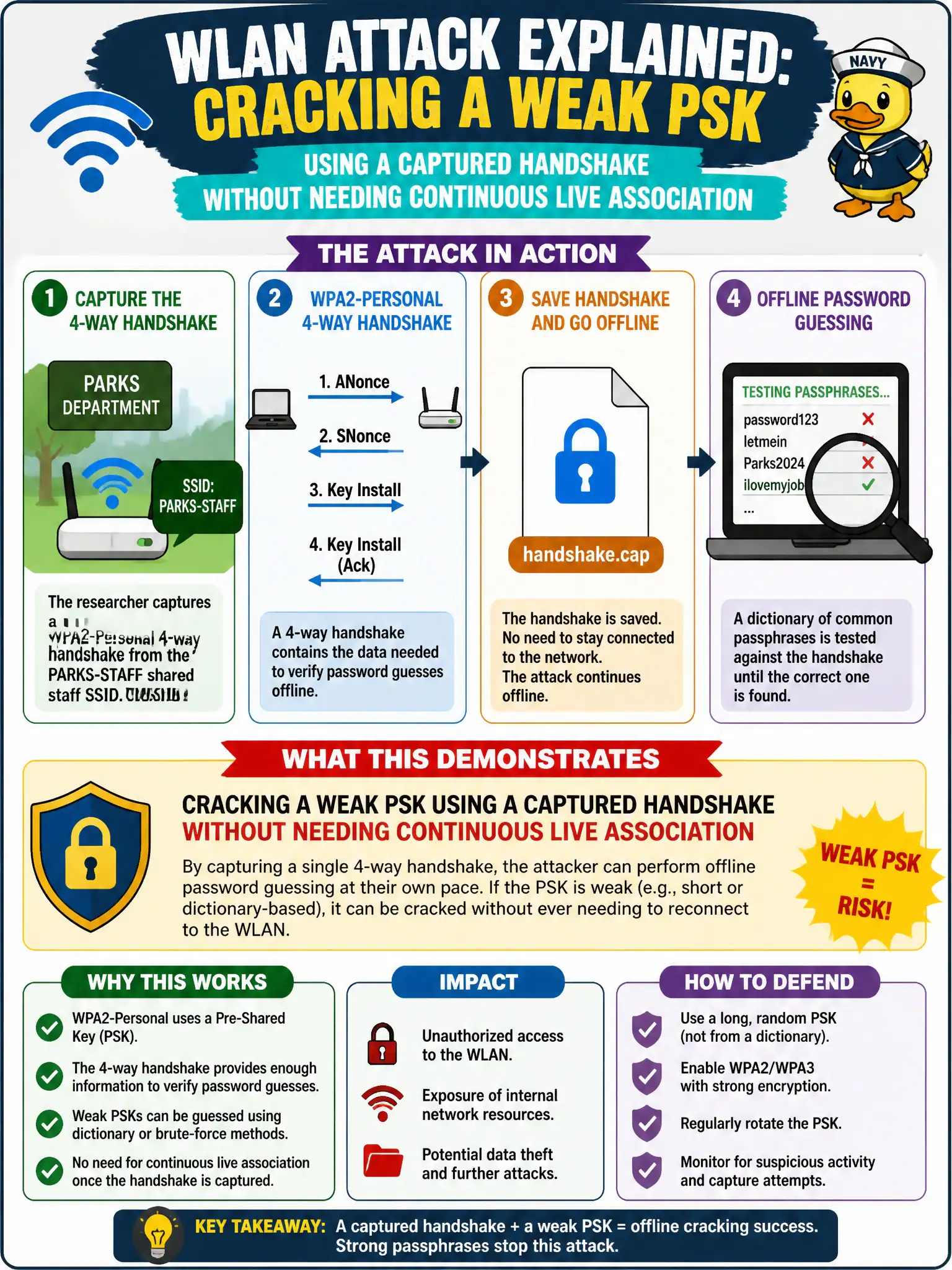
A researcher captures a WPA2-Personal 4-way handshake from a parks-department shared staff SSID that uses a short dictionary passphrase, then runs an offline password guess against that handshake. Which WLAN attack does this demonstrate?
Select an answer to reveal the explanation.
Short Explanation
Once someone bags the handshake, they can grind passwords at home like cracking a padlock photo offline. Weak shared PSKs on Personal mode make that crossword solvable. Probe-lure KARMA and SNMP polls are different games.
Full Explanation
A researcher who captures a WPA2-Personal 4-way handshake from a parks-department shared staff SSID that uses a short dictionary passphrase, then runs an offline password guess against that handshake, demonstrates cracking a weak PSK using a captured handshake without needing continuous live association. Once the handshake is obtained, guessing can proceed offline against the PMK derivation, which is why short dictionary PSKs on civic Personal SSIDs are high risk. KARMA responses that only answer probes for open hotel SSIDs describe a different client-luring technique. SNMPv3 authPriv polling of AP CPU temperature OIDs is legitimate or management monitoring, not PSK cracking. DHCP starvation on the wired guest VLAN behind a captive portal is a wired resource-exhaustion attack unrelated to handshake cracking. Parks and recreation shared PSKs are frequently weak and widely distributed, making this exact pattern common. Exam caveat: offline PSK cracking risk is controlled by passphrase strength, rotation, and preferably migrating staff SSIDs to Enterprise 802.1X where each user has unique credentials. Operational check: inventory Personal-mode staff SSIDs, measure passphrase entropy policy, rotate exposed keys, migrate parks staff WLAN to 802.1X where possible, and monitor for unusual deauth-plus-capture patterns that precede handshake theft.