
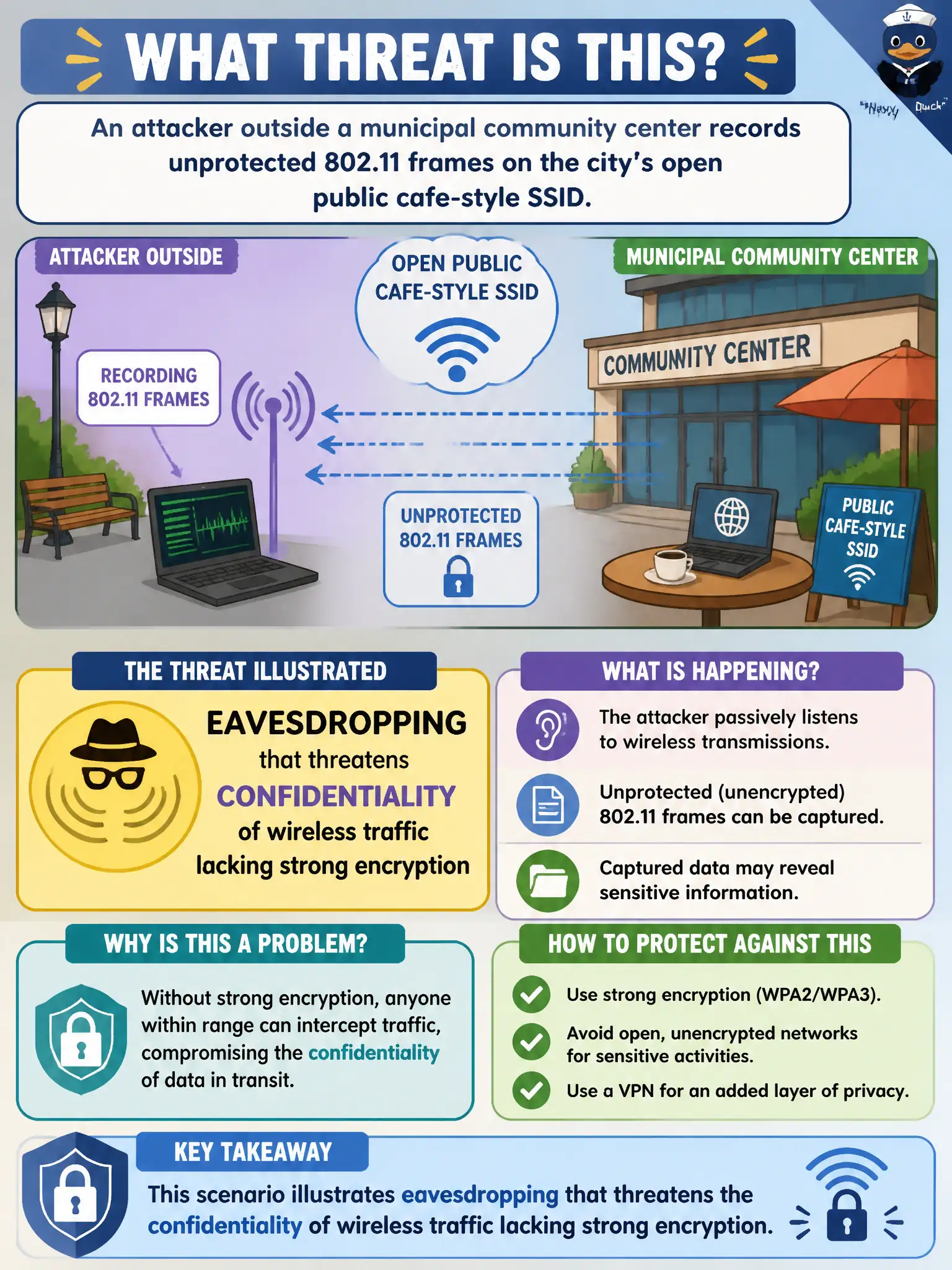
An attacker outside a municipal community center records unprotected 802.11 frames on the city’s open public cafe-style SSID. Which threat does this scenario primarily illustrate?
Select an answer to reveal the explanation.
Short Explanation
Open Wi-Fi is like shouting city business across a park picnic table—anyone with a radio can listen. That capture of unprotected frames is classic eavesdropping, a confidentiality hit. Fake-SSID floods or BGP drama are different problems.
Full Explanation
An attacker outside a municipal community center who records unprotected 802.11 frames on the city’s open public cafe-style SSID primarily illustrates eavesdropping that threatens confidentiality of wireless traffic lacking strong encryption. Open or otherwise unprotected SSIDs allow passive observers to capture user payloads and metadata from the parking lot or sidewalk. Beacon flooding that exhausts client scan tables with fake SSIDs is a different availability/confusion attack. Offline WPS PIN brute force against enrollment on enterprise APs targets a specific enrollment weakness not described here. Layer-3 BGP hijacking of the city’s Internet edge routers is a WAN routing attack outside this RF capture scenario. Civic public Wi-Fi designs should assume passive observers and either encrypt (for example OWE/WPA3 options where appropriate) or treat the SSID as hostile for sensitive tasks. Exam caveat: open SSIDs may still be offered for public access, but the threat demonstrated is confidentiality loss from eavesdropping—not a license to ignore higher-sensitivity traffic on the same air. Operational check: confirm which community-center SSIDs lack link encryption, move sensitive staff or payment use off those SSIDs, consider OWE or secured alternatives for public access where feasible, and educate patrons that open Wi-Fi is observable.