
A controller vulnerability for the municipal WLAN requires valid administrator credentials before it can be exploited. How should that affect remote risk relative to an unauthenticated wireless exploit?
Select an answer to reveal the explanation.
Short Explanation
If the attacker already needs the keys to the kingdom, the bug is still real—but it is not the same as an unauthenticated wireless free-for-all. Privilege needed dials the remote-risk story down a notch.
Full Explanation
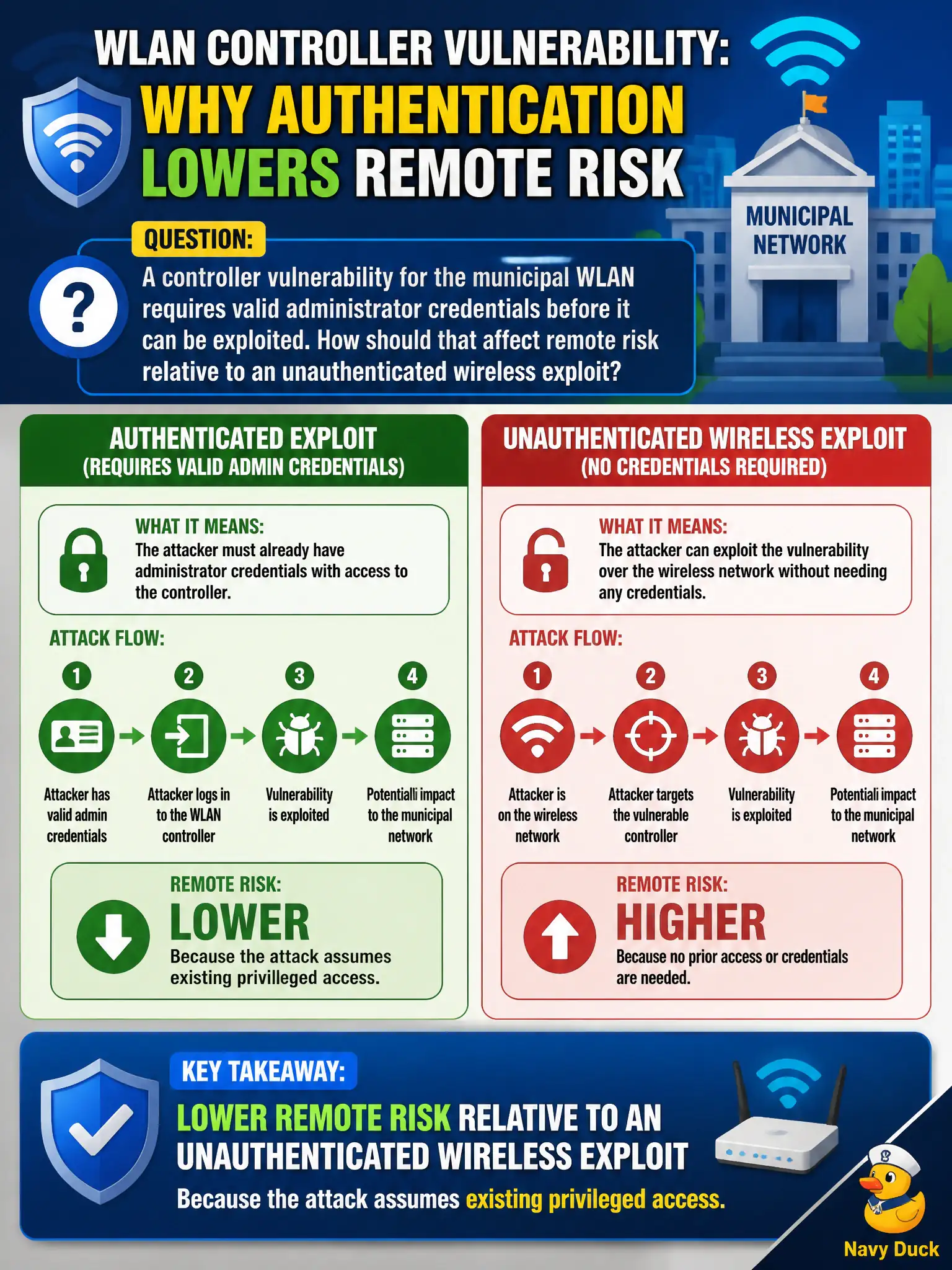
A controller vulnerability for the municipal WLAN that requires valid administrator credentials before exploitation should lower remote risk relative to an unauthenticated wireless exploit because the attack assumes existing privileged access. Privilege requirements are meaningful preconditions: opportunistic internet attackers cannot trigger the flaw without first stealing or abusing admin credentials, whereas an unauthenticated wireless exploit may be reachable by any nearby adversary. Increasing remote risk above unauthenticated wireless exploits solely because "admin bugs are always worse" oversimplifies without considering preconditions. Ignoring privilege requirements when comparing WLAN vulnerability risk ratings discards critical likelihood data. Treating credential requirements as proof the CVE is a false positive is wrong—the flaw is real but conditional. Civic teams should still patch admin-conditioned bugs quickly because stolen admin sessions happen, yet prioritization versus unauthenticated wireless RCEs should reflect the precondition. Exam caveat: authenticated-only flaws can still be severe after credential theft; the comparison point is relative remote likelihood versus unauthenticated wireless exploits. Operational check: document the admin-auth precondition in the risk register, harden admin MFA and session controls immediately, schedule the controller patch, and keep unauthenticated wireless issues at equal or higher urgency when exposure is broader.