
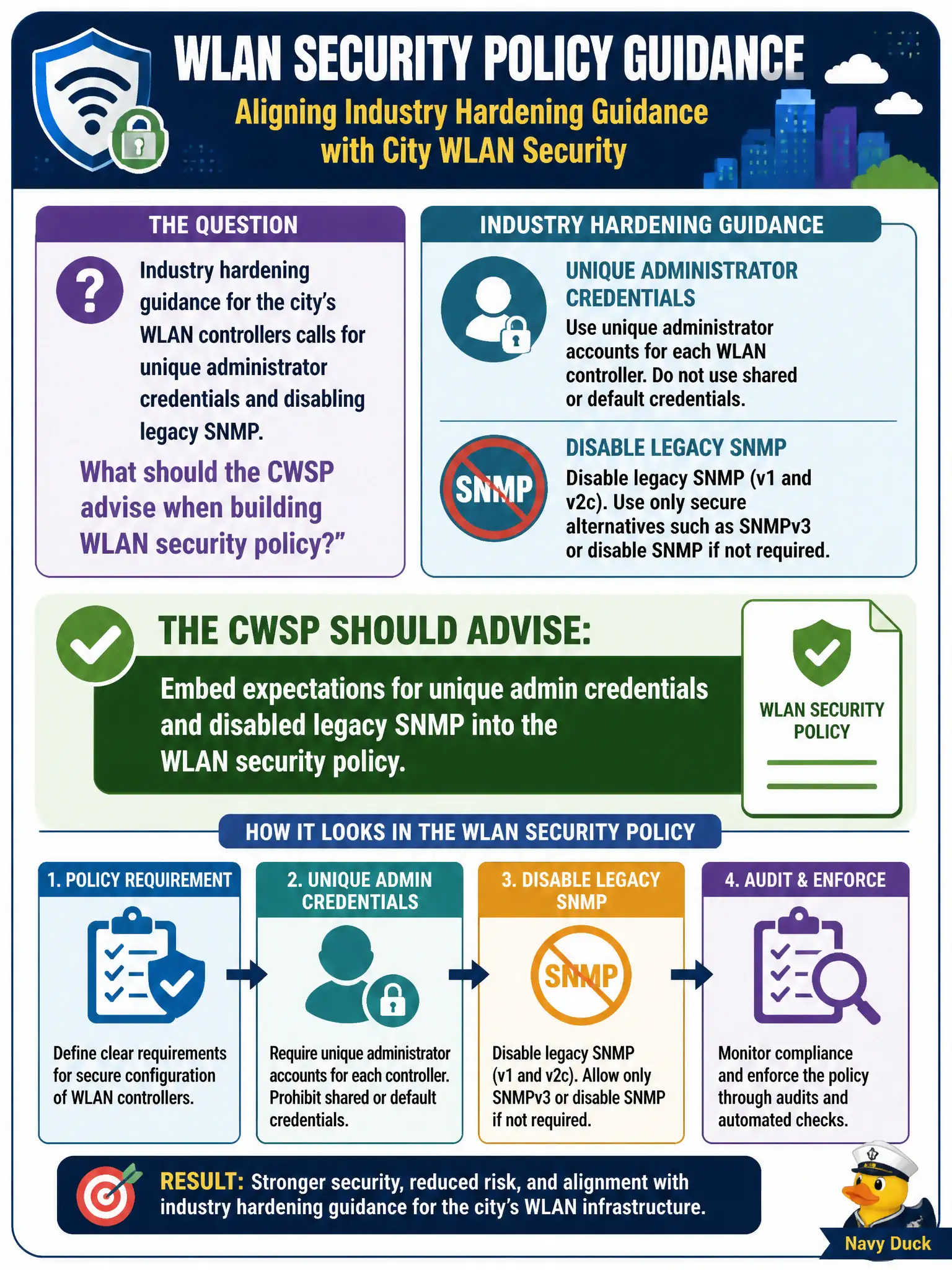
Industry hardening guidance for the city's WLAN controllers calls for unique administrator credentials and disabling legacy SNMP. What should the CWSP advise when building WLAN security policy?
Select an answer to reveal the explanation.
Short Explanation
Standards already told you the boring-but-vital stuff: one admin identity per person, and retire ancient SNMP. Put that in the city WLAN policy so it is not optional folklore whispered in the NOC.
Full Explanation
When industry hardening guidance for the city's WLAN controllers calls for unique administrator credentials and disabling legacy SNMP, the CWSP should embed those expectations into the WLAN security policy so operations cannot treat them as optional tribal knowledge. Unique admin credentials support accountability and reduce shared-password blast radius; disabling legacy SNMP (especially SNMPv1/v2c with community strings) removes a classic cleartext management weakness on infrastructure. Ignoring vendor and industry hardening notes because municipal networks are supposedly exempt is incorrect—civic status does not repeal weak management protocols. Requiring a shared "wifiadmin" password across all APs while leaving SNMPv1 enabled maximizes credential reuse and eavesdropping risk. Documenting only SSID names and leaving credential and SNMP decisions to each technician's preference produces irreversible configuration drift. Policy should set the management-plane baseline; procedures then detail how to configure AAA for admins and SNMP versions. Exam caveat: hardening items may appear in standards referenced by policy; the exam point is that unique admin credentials and elimination of legacy SNMP are expected WLAN security policy content, not optional tips. Operational check: audit controller and AP admin accounts for unique identities or centralized AAA, confirm SNMPv1/v2c community access is disabled or absent, enable SNMPv3 or API-based monitoring where needed, and record exceptions with owners and sunset dates.