
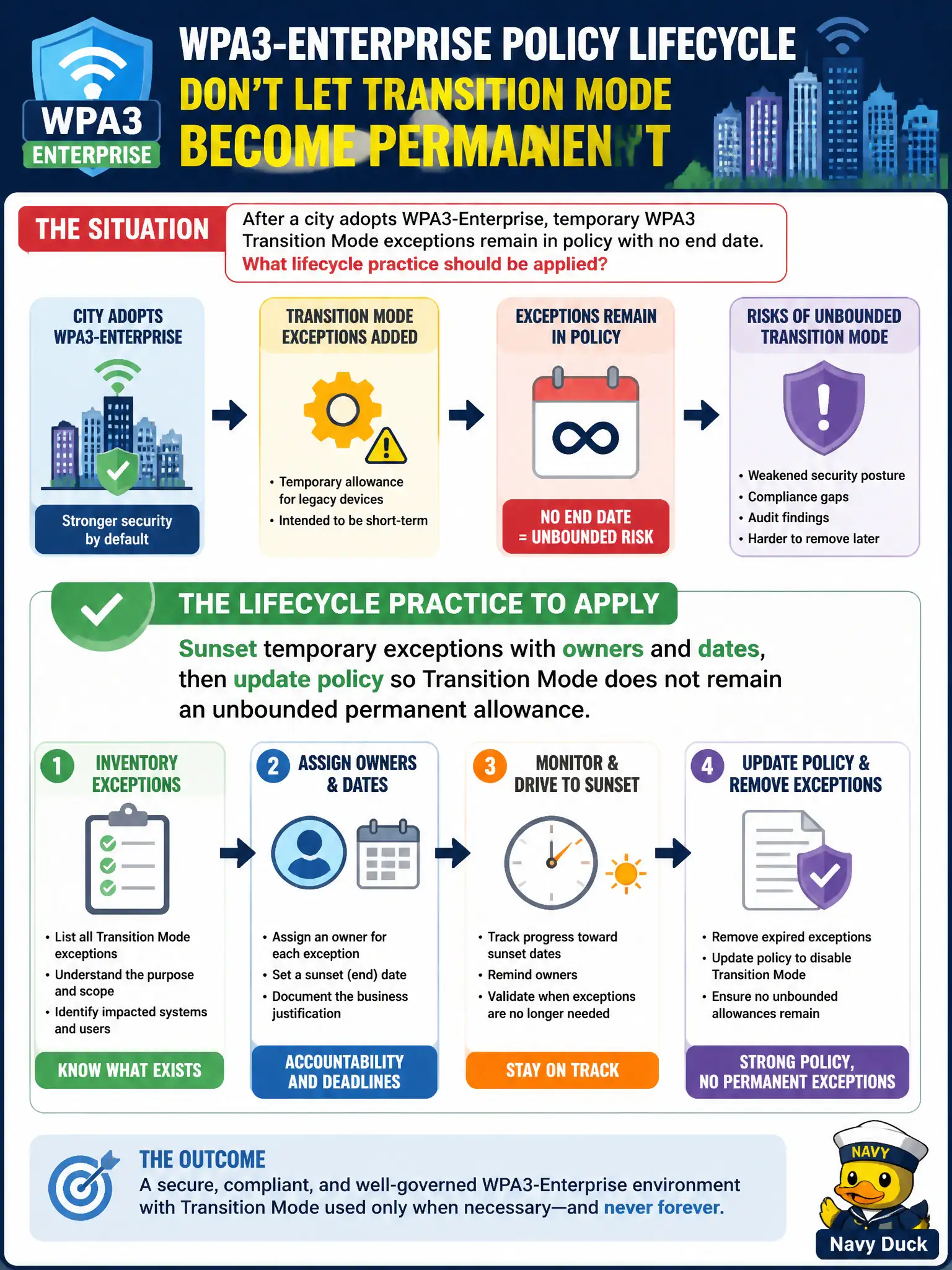
After a city adopts WPA3-Enterprise, temporary WPA3 Transition Mode exceptions remain in policy with no end date. What lifecycle practice should be applied?
Select an answer to reveal the explanation.
Short Explanation
Transition Mode exceptions are temporary bridges—put an end date and an owner on them, then tear the bridge down once clients can do full WPA3-Enterprise.
Full Explanation
After a city adopts WPA3-Enterprise, temporary WPA3 Transition Mode exceptions that remain in policy with no end date undermine lifecycle discipline and leave weaker mixed-mode behavior as a de facto permanent allowance. Proper practice is to sunset temporary exceptions with named owners and dates, then update policy so Transition Mode does not remain an unbounded carve-out. Converting every exception into a forever carve-out removes urgency to finish client migration and expands the window for downgrade-style risk. Hiding exceptions in an unmarked wiki page nobody maintains prevents governance, audit, and operations from knowing which SSIDs are still transitional. Replacing policy entirely with a sticky note on the NOC monitor is not controlled lifecycle management and will not survive staffing changes. Transition Mode can be a legitimate bridge for mixed client fleets, but only when tracked as temporary. Exam caveat: exam answers favor time-bounded, owned exceptions over silent permanence when stronger modes are the stated target state. Operational check: inventory each Transition Mode SSID with owner, business justification, and sunset date; monitor client capability reports; communicate deadlines to device owners; and remove the exception from policy and configuration when the last dependent client class is upgraded.