
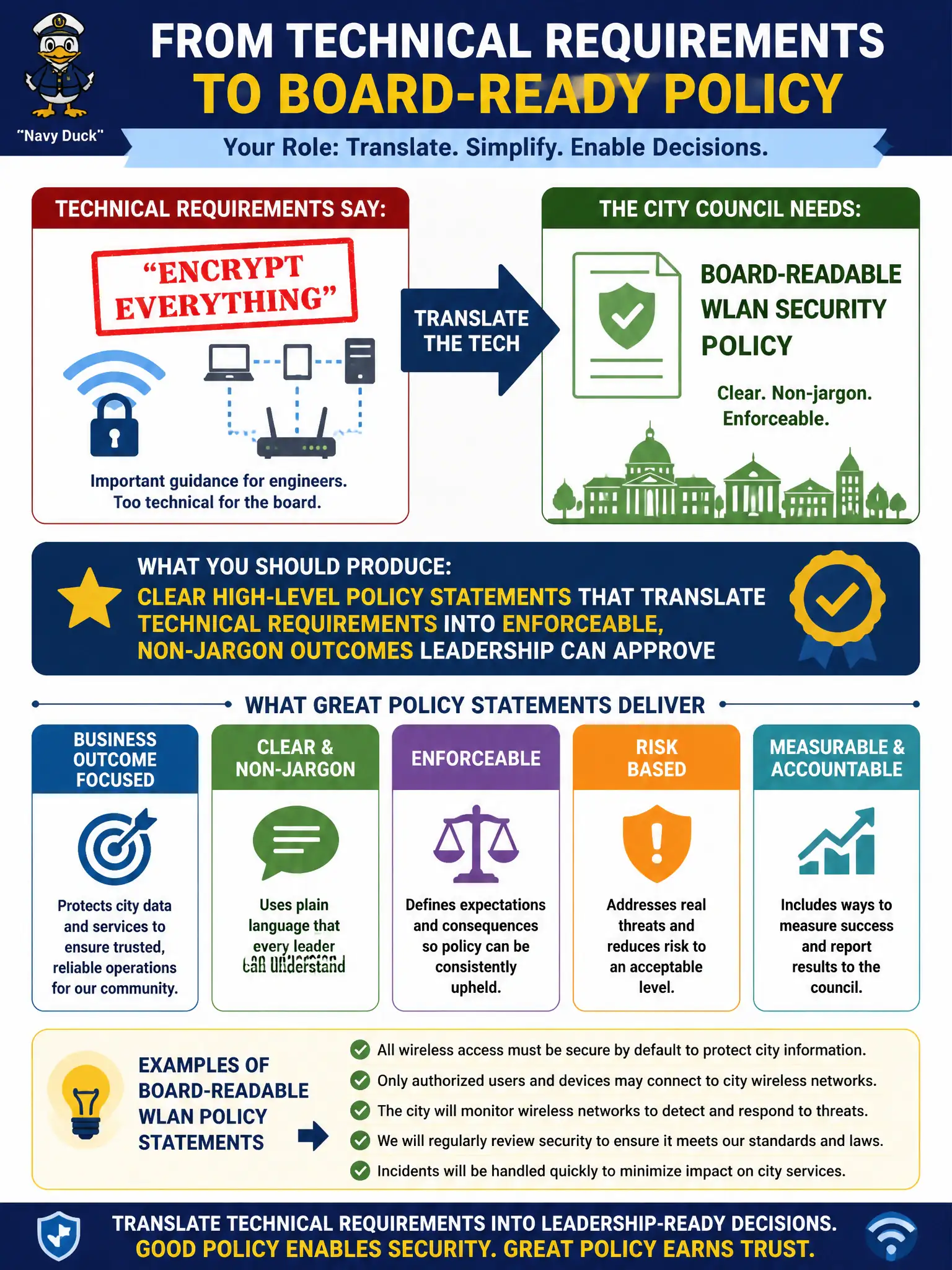
Technical requirements say "encrypt everything," but the city council needs board-readable WLAN security policy. What should the security professional produce?
Select an answer to reveal the explanation.
Short Explanation
Councils don't approve tcpdumps. Turn "encrypt everything" into plain, enforceable statements leadership can sign—then engineers map those statements to the knobs.
Full Explanation
When technical requirements say "encrypt everything" but the city council needs board-readable WLAN security policy, the security professional should produce clear high-level policy statements that translate technical requirements into enforceable, non-jargon outcomes leadership can approve. High-level policy communicates what must be true for staff, guest, and IoT wireless—such as enterprise authentication, strong encryption, guest isolation, and restricted administrative access—without forcing elected officials to interpret handshake traces. A packet capture of a 4-way handshake is useful forensic or engineering evidence, not a policy document. A CLI dump from every AP reflects transient operational state and cannot serve as the durable enforceable standard. Vendor SKU lists with no outcomes stated lock procurement to brands without defining the security results those products must achieve, and they become stale when platforms change. CWSP practice separates policy outcomes from engineering artifacts so sponsors can approve direction while engineers select mechanisms. Exam caveat: leadership approves outcomes; standards and procedures then specify EAP methods, cipher suites, and product baselines. Operational check: rewrite jargon into statements such as "staff WLAN shall use enterprise authentication and strong encryption" and "guest WLAN shall be isolated from staff networks," obtain council or delegate approval, store the approved text in the official repository, and map each statement to technical standards used by WLAN operations.