
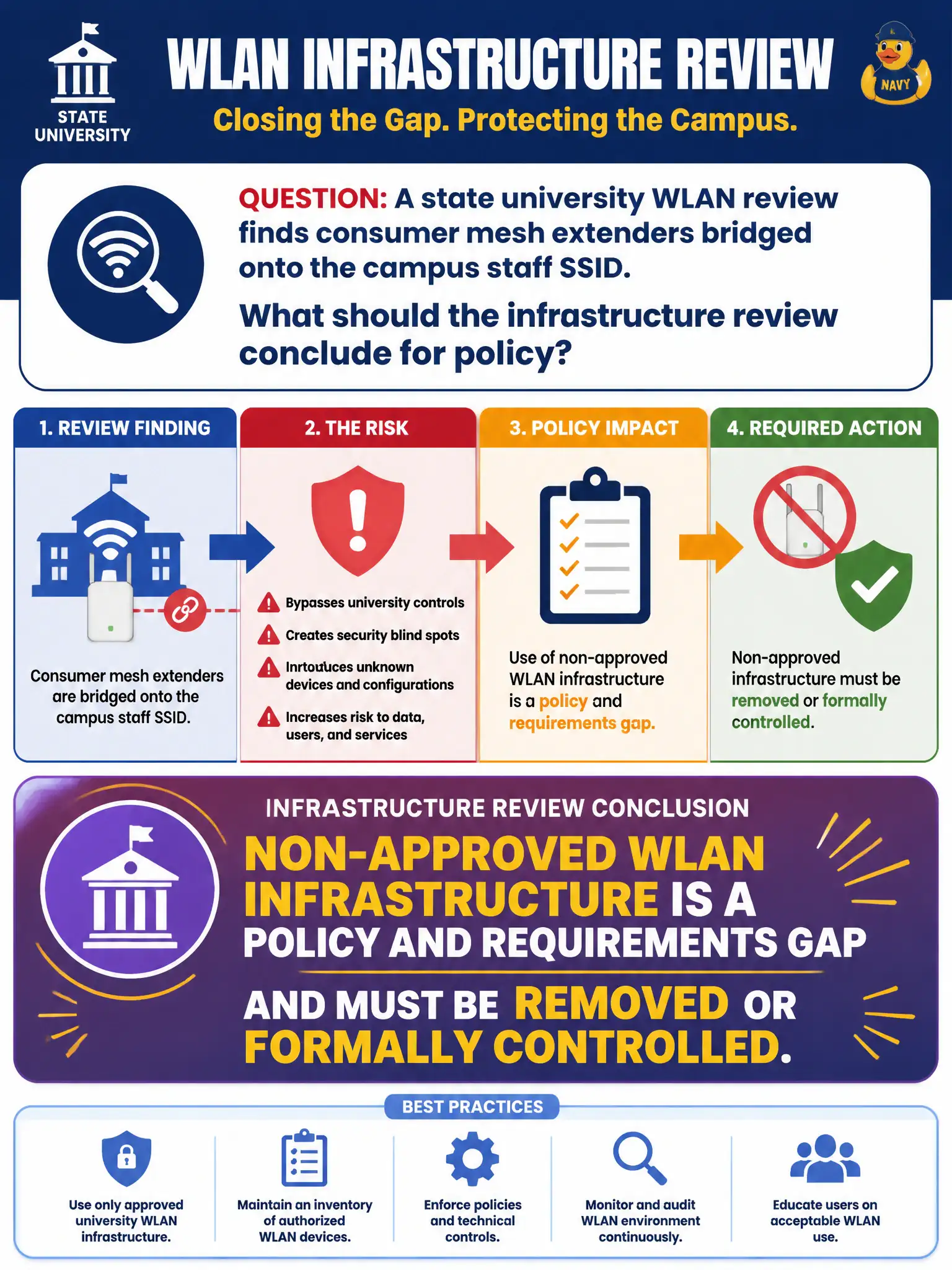
A state university WLAN review finds consumer mesh extenders bridged onto the campus staff SSID. What should the infrastructure review conclude for policy?
Select an answer to reveal the explanation.
Short Explanation
Someone's living-room mesh hanging off the staff SSID is a rogue road on your highway. Policy review should flag unapproved infrastructure and yank or formally govern it—not pretend it somehow "inherits" enterprise security.
Full Explanation
A state university WLAN review that finds consumer mesh extenders bridged onto the campus staff SSID should conclude that non-approved WLAN infrastructure is a policy and requirements gap requiring removal or formal control. Unauthorized consumer bridges typically lack enterprise management, certificate-based admin access, centralized logging, and hardening baselines, yet they extend Layer-2 adjacency into staff segments. Consumer mesh is not preferred for enterprise density or security architecture. The finding is not irrelevant merely because AP count looks fine; bridged consumer gear expands attack surface and can bypass intended encryption and monitoring boundaries. Bridged consumer equipment does not automatically inherit campus WPA3-Enterprise policy, PMF settings, or WIPS classification simply because it forwards frames for the same SSID name. Leaving such devices in place trains departments to self-provision coverage and undermines the approved design. Exam caveat: unauthorized bridges can leak staff VLANs or weaken trust boundaries even when officially managed APs are correctly configured. Operational check: hunt for non-inventory BSSIDs and consumer OUIs on staff SSIDs, trace switchports feeding unknown extenders, quarantine or remove them, update the infrastructure inventory, and publish a request path so departments seek approved coverage instead of installing living-room mesh on staff wireless.