
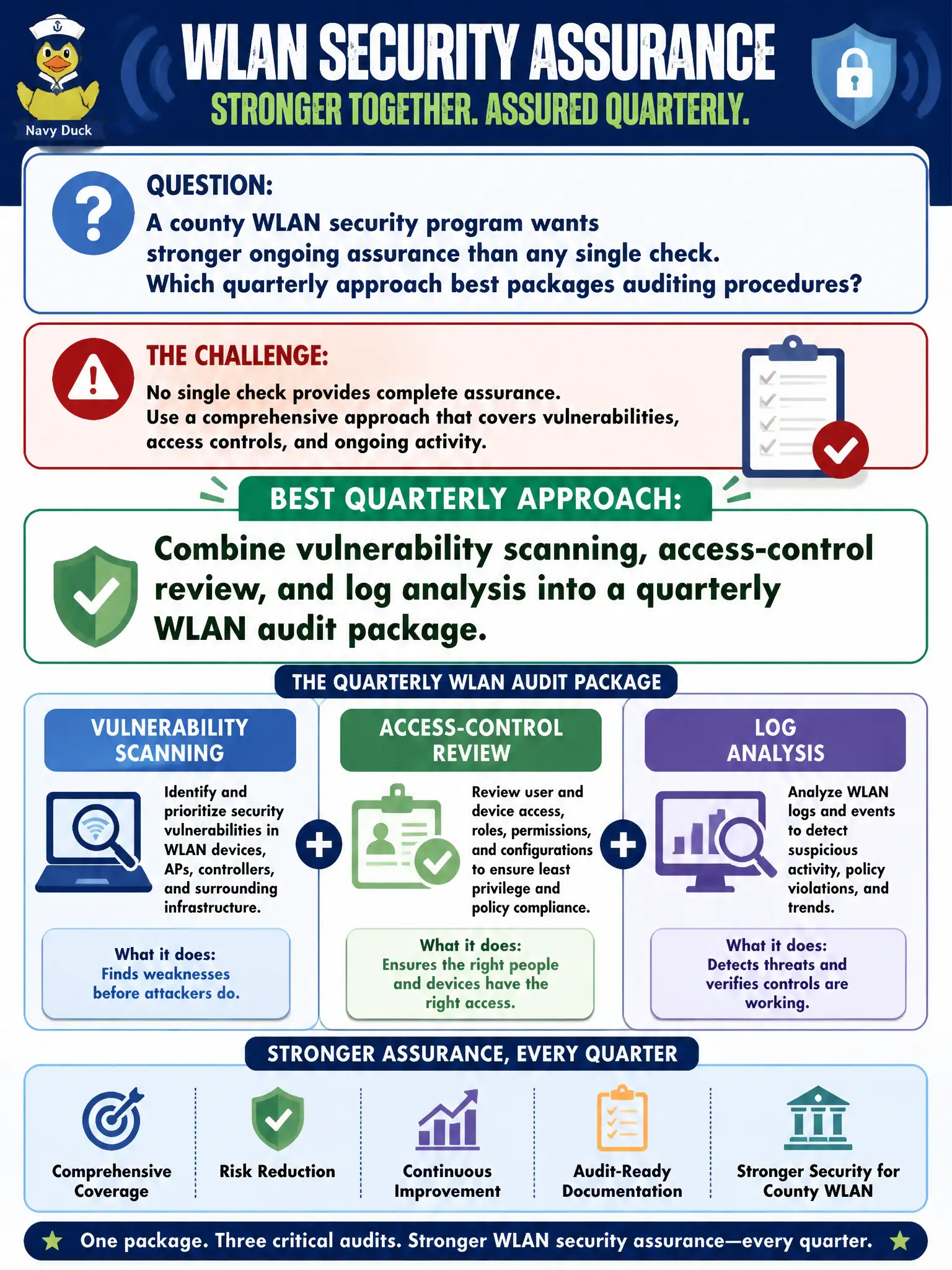
A county WLAN security program wants stronger ongoing assurance than any single check. Which quarterly approach best packages auditing procedures?
Select an answer to reveal the explanation.
Short Explanation
One tool is a snapshot; a package is a photo album. Mix vuln scans, access reviews, and log analysis each quarter. Hallway chats alone do not equal a WLAN audit program.
Full Explanation
For a county WLAN security program aiming to achieve stronger ongoing assurance beyond the limitations of any single security check, the most effective quarterly approach is to integrate multiple auditing procedures into a comprehensive WLAN audit package. This approach typically combines vulnerability scanning, access-control reviews, and log analysis. Vulnerability scanning systematically probes the wireless network for known technical weaknesses such as outdated firmware, misconfigured encryption, or exposed services, providing a technical baseline of the network’s security posture. Access-control reviews complement this by verifying that user permissions and administrative roles are correctly assigned and enforced, ensuring that only authorized personnel have the appropriate levels of access, which mitigates risks from insider threats or privilege escalation. Log analysis adds a behavioral dimension by scrutinizing system and network logs for anomalies, unusual access patterns, or policy violations that may not be apparent through scanning or reviews alone. This layered methodology provides a holistic view of WLAN security, increasing the likelihood of detecting and addressing vulnerabilities before they can be exploited. Conversely, relying solely on informal, once-a-year hallway conversations lacks the rigor and technical depth necessary for effective security assurance; it is anecdotal and prone to oversight. Similarly, performing vulnerability scans without reviewing administrative access or analyzing logs misses critical aspects of security posture, such as insider misuse or subtle attack indicators. Finally, outsourcing only a superficial task like a logo redesign and labeling it as a wireless audit is irrelevant, undermining the program’s credibility and failing to address any actual security concerns. A key caveat is that audit procedures must be tailored to the specific municipal WLAN architecture, threat landscape, and compliance requirements to maximize their effectiveness. Operationally, the audit package should be scheduled regularly, with all findings thoroughly documented, prioritized, and remediated to ensure continuous improvement and adherence to municipal security policies.