
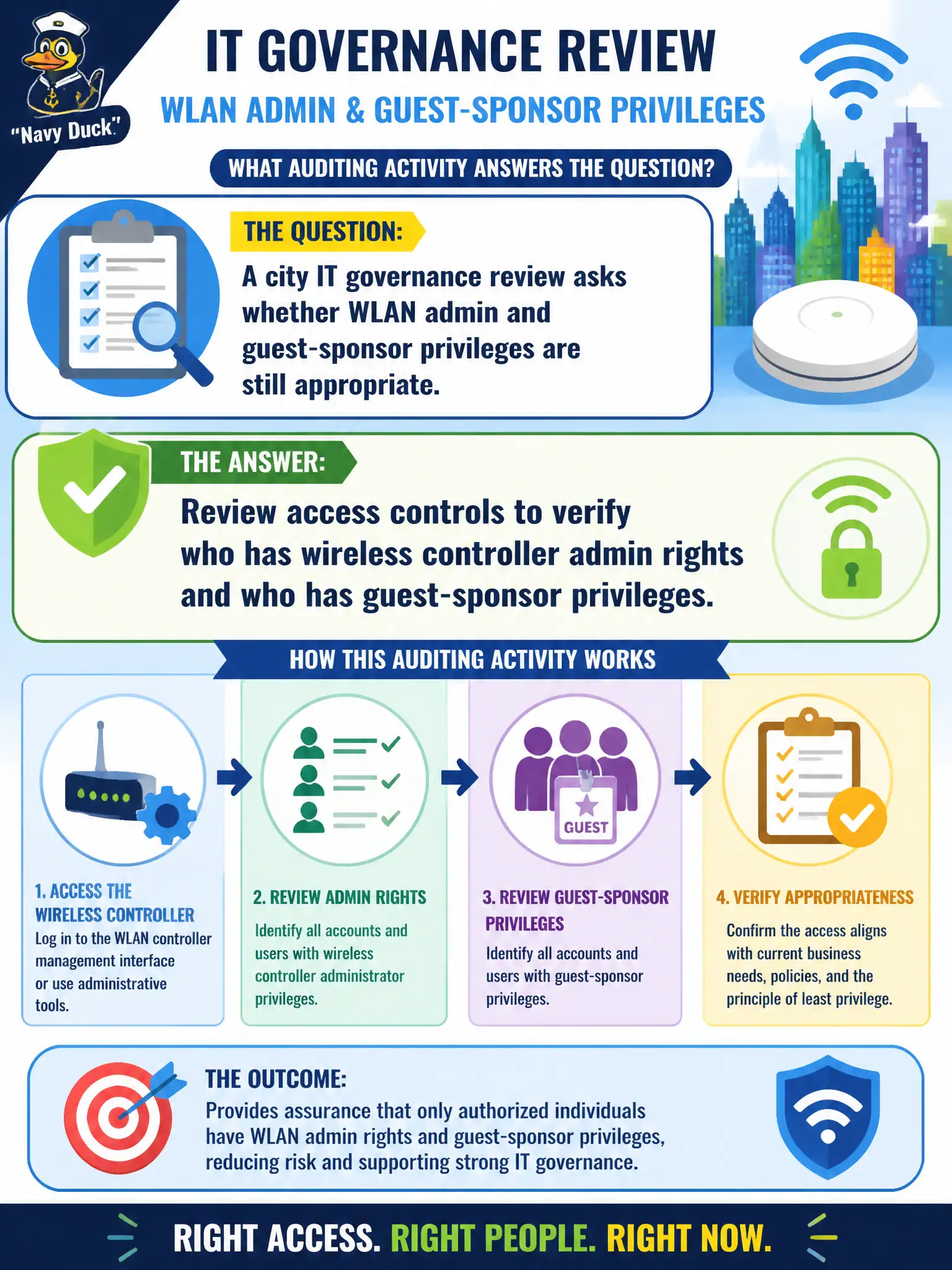
A city IT governance review asks whether WLAN admin and guest-sponsor privileges are still appropriate. What auditing activity answers that question?
Select an answer to reveal the explanation.
Short Explanation
Who holds the keys matters as much as how strong the locks are. Review WLC admins and guest sponsors on a cadence. Privilege creep is quiet until someone sponsors the wrong guest—or worse.
Full Explanation
In municipal WLAN administration, reviewing access controls is crucial to ensure that only authorized personnel hold sensitive privileges such as wireless controller (WLC) admin rights and guest-sponsor roles. This activity involves auditing user accounts, group memberships, and role assignments within the WLAN management system to verify that privileges align with current job functions and security policies. Correctly limiting admin rights reduces risk exposure by preventing unauthorized configuration changes or data access, while reviewing guest-sponsor privileges ensures that temporary access is appropriately managed and revoked when no longer needed. Simply measuring signal strength or RSSI heatmaps without verifying user identities and privileges misses the core governance concern of who can control or sponsor WLAN access, leaving potential insider threats unaddressed. Granting permanent WLC admin rights broadly, such as to all help-desk interns, violates the principle of least privilege and increases attack surface unnecessarily. Assuming guest-sponsor rights never need review ignores that temporary assignments can become permanent by oversight, leading to privilege creep. The audit should be scoped to include all WLAN administrative roles and guest-sponsor accounts, with periodic reviews to maintain compliance. Operationally, administrators should verify current access control lists and user role assignments in the WLAN controller interface or identity management system, confirming that only authorized personnel retain these critical privileges.