
New warehouse barcode scanners will join a municipal logistics WLAN. After identification and requirements assessment, what should the team do next?
Select an answer to reveal the explanation.
Short Explanation
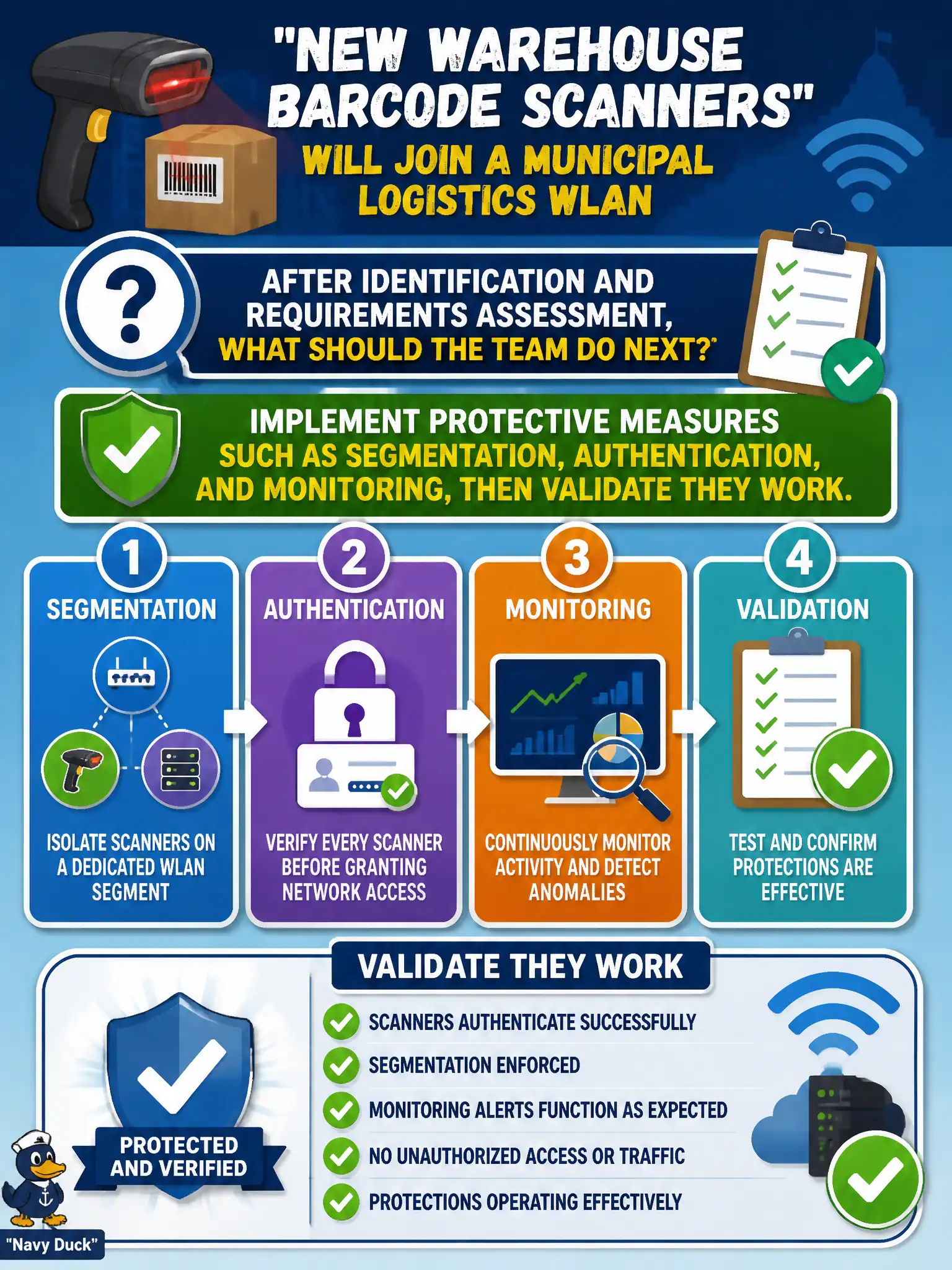
Once you know the scanners are coming, you do not just wave them onto the staff LAN. Segment, authenticate, watch—and then prove those controls actually stick, like a dry run before opening day.
Full Explanation
After identifying new warehouse barcode scanners and assessing their requirements for joining a municipal logistics WLAN, the next critical step is to implement protective measures such as network segmentation, robust authentication, and continuous monitoring, followed by validation of their effectiveness. Segmentation isolates scanner traffic from other network segments, limiting potential lateral movement by attackers. Strong authentication ensures only authorized devices connect, preventing rogue devices from infiltrating the WLAN. Continuous monitoring detects anomalies or unauthorized access attempts in real time. Validating these controls confirms they operate as intended and meet security objectives. Granting unrestricted corporate access without validation exposes sensitive systems to risk and neglects the principle of least privilege. Merely documenting the integration idea without implementation and monitoring is insufficient to mitigate threats. Relying solely on SSID renaming as a protective measure is superficial and does not provide actual security controls. The caveat is that protective measures must be tailored to device capabilities and operational context. Operationally, the team should configure VLANs or firewall rules for segmentation, deploy WPA3-Enterprise or equivalent authentication, enable logging and alerting, and conduct penetration testing or audits to verify security before full deployment.