
A county campus wants a new BLE/Wi-Fi location-services overlay. What should happen before enablement?
Select an answer to reveal the explanation.
Short Explanation
Location overlays are like adding cameras and badges to a civic campus map—you decide privacy and access rules before you switch them on. Assess first; flip the switch second.
Full Explanation
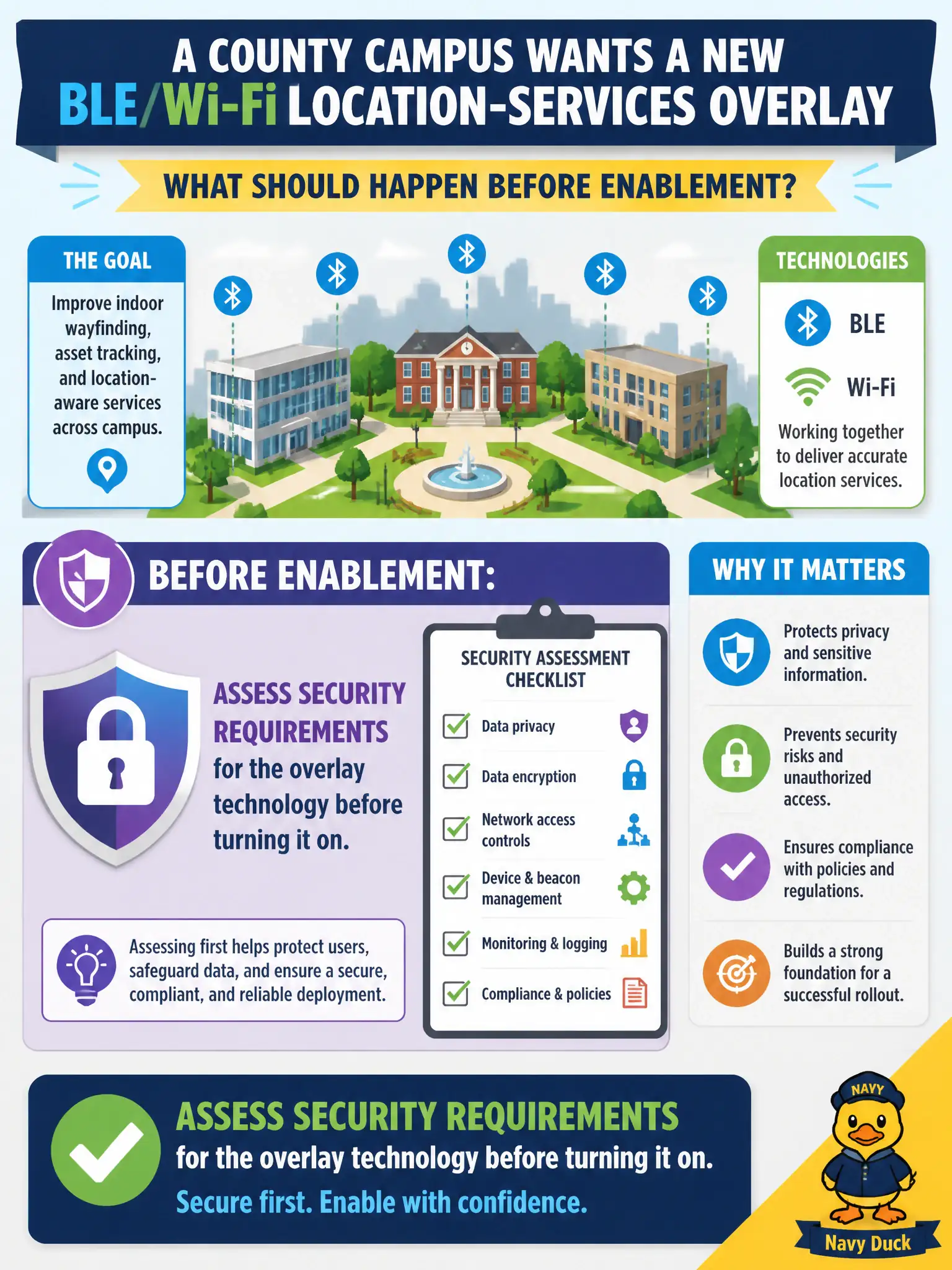
Before enabling a new Bluetooth Low Energy (BLE) and Wi-Fi location-services overlay on a county campus, it is critical to assess the security requirements specific to the overlay technology. This assessment includes evaluating data privacy concerns, potential attack vectors introduced by the overlay, and compliance with municipal policies and regulations. The overlay may process sensitive location metadata, which if unprotected, could lead to privacy violations or targeted attacks. Enabling the overlay citywide prior to documenting requirements is premature and risks widespread exposure to unmitigated vulnerabilities. Assuming location overlays never process sensitive metadata underestimates the value and sensitivity of location data, which can reveal user habits and movements. Binding the overlay exclusively to Wired Equivalent Privacy (WEP) for legacy device compatibility is a poor security practice because WEP is deprecated and vulnerable to attacks; modern overlays should use robust encryption standards. The key caveat is that location services must balance functionality with privacy and security mandates. Operationally, the team should conduct a risk assessment, define access controls, and implement encryption before enabling the overlay to safeguard user data and maintain trust.