
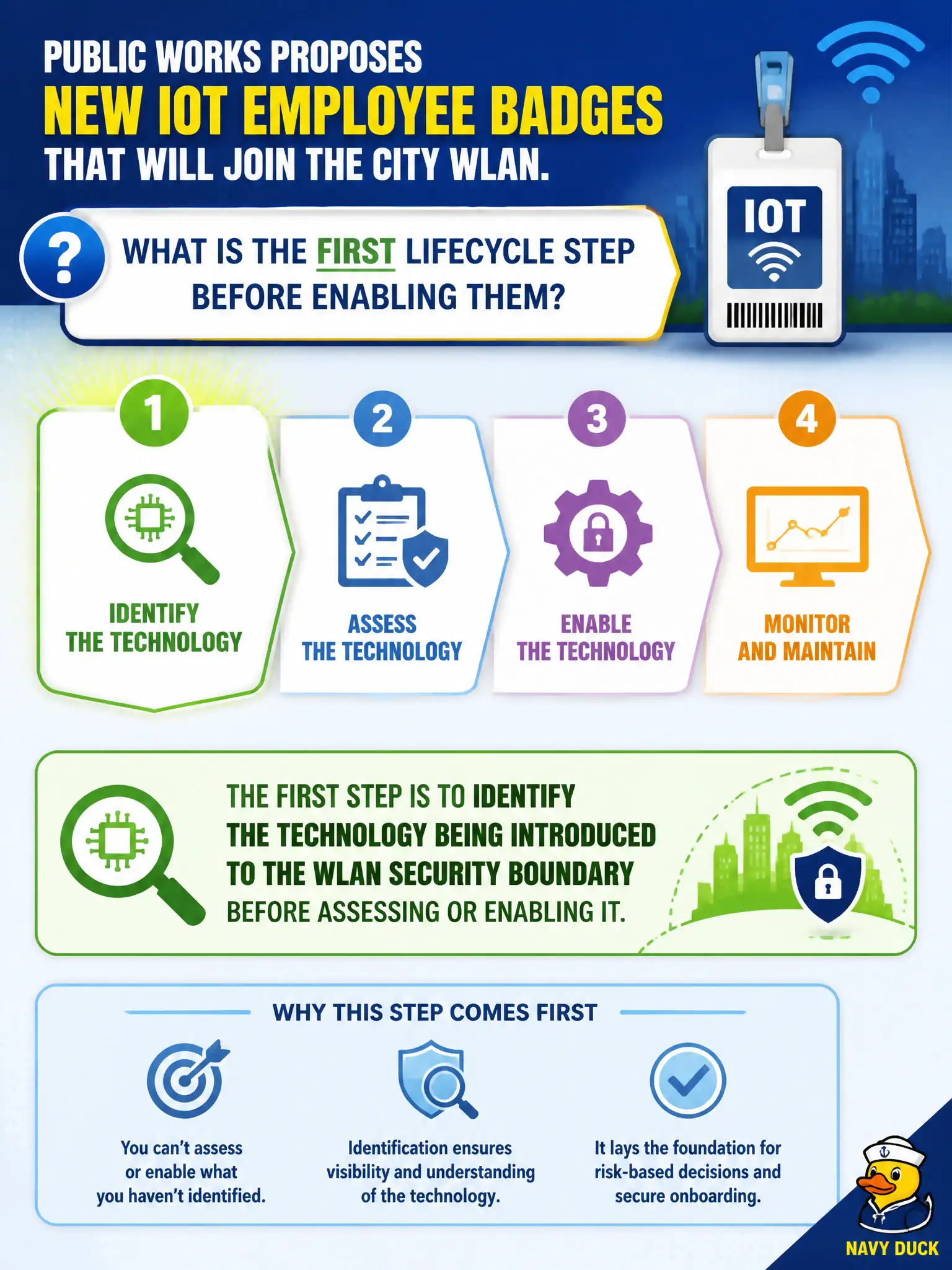
Public works proposes new IoT employee badges that will join the city WLAN. What is the first lifecycle step before enabling them?
Select an answer to reveal the explanation.
Short Explanation
New badges on Wi-Fi are a new neighbor moving onto the block—you name who they are before you hand over keys. Identification comes first; permissions and monitoring come after you know what showed up.
Full Explanation
Before integrating new IoT employee badges into a city WLAN, the essential first step is to identify the technology being introduced within the WLAN security boundary. This identification process involves understanding the device capabilities, communication protocols, and security features inherent to the badges. Recognizing these parameters allows the security team to assess potential risks, compatibility with existing infrastructure, and necessary controls before enabling network access. Granting immediate full access to the staff SSID with Active Directory rights without prior assessment exposes the network to unknown vulnerabilities and potential unauthorized access, as the badges may not yet be vetted or properly configured. Skipping identification under the assumption that IoT badges are too small or insignificant ignores the reality that even small devices can be exploited as entry points for attackers, especially in municipal environments where sensitive data and services are at stake. Delaying continuous monitoring until after a breach is reactive and undermines proactive security principles; continuous monitoring should be in place from the outset to detect anomalies early. The key caveat is that identification must be thorough and encompass both hardware and software aspects to ensure comprehensive security posture. Operationally, this means the team should catalog badge specifications, firmware versions, and communication methods before enabling network access, ensuring that any integration does not compromise the WLAN's integrity or the city’s data security.