
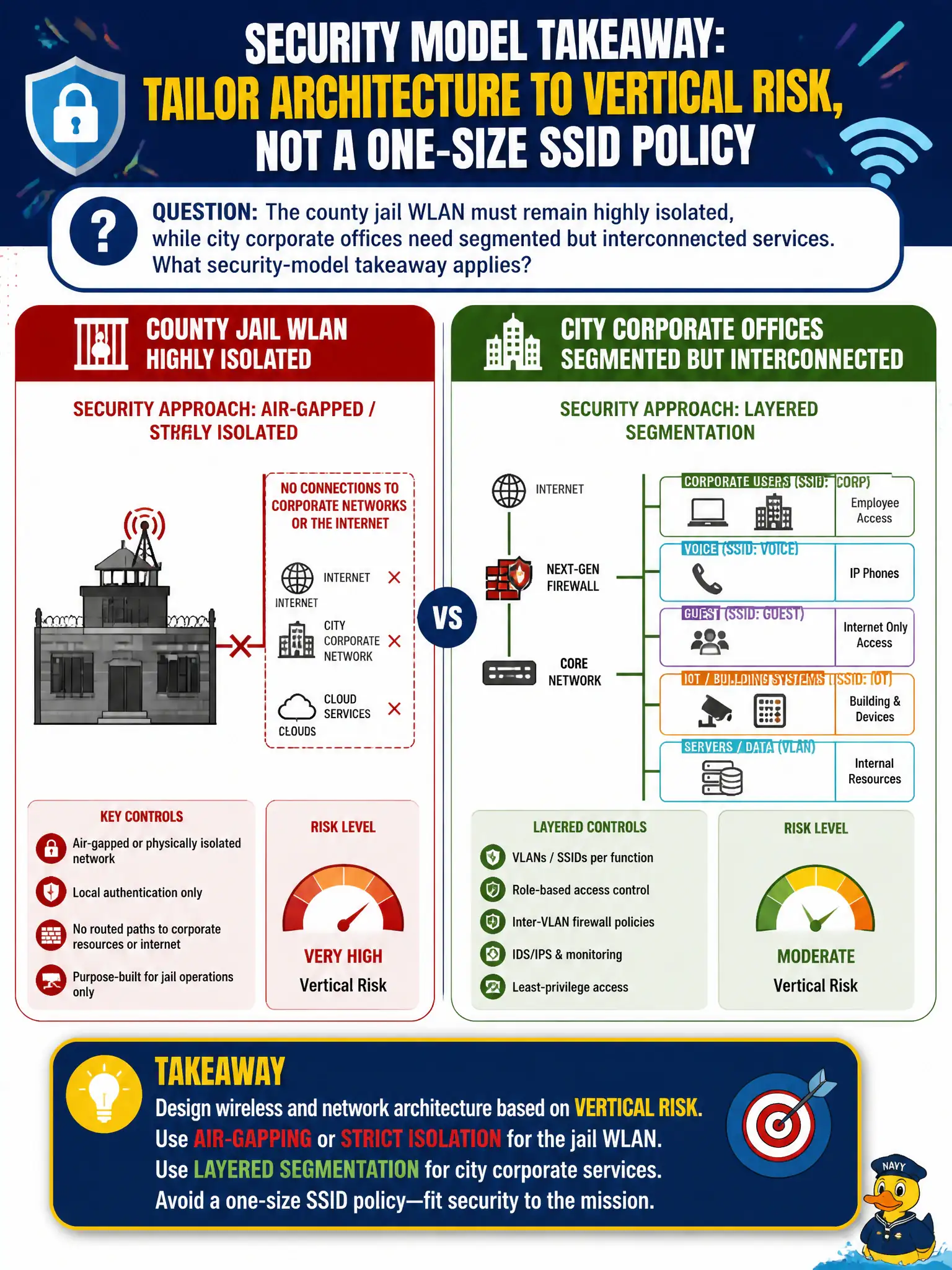
The county jail WLAN must remain highly isolated, while city corporate offices need segmented but interconnected services. What security-model takeaway applies?
Select an answer to reveal the explanation.
Short Explanation
A jail and city hall are not the same risk animal. Isolate corrections hard; segment corp thoughtfully. Copy-paste open portals or bridging cameras into finance is vertical malpractice.
Full Explanation
A county jail WLAN that must remain highly isolated, while city corporate offices need segmented but interconnected services, illustrates that architecture must be tailored—air-gapping or strict isolation for the jail versus layered segmentation for city corp—based on vertical risk, not a one-size SSID policy. Civic environments are not homogeneous; corrections and open offices do not share the same trust model. Copy-paste SSID templates across verticals create either under-isolation or broken business workflows.
Applying identical open guest portals in the jail and city hall for policy consistency ignores risk disparity. Air-gapping city corp email so it matches jail isolation exactly over-constrains business systems. Bridging jail cameras onto the finance VLAN to reuse DHCP scopes is a severe trust boundary violation.
Exam caveat: “tailor by vertical” still requires written standards per environment—not ad hoc one-off snowflakes without review. Operational check: compare jail and corp wireless architectures against their risk profiles, confirm jail has no casual routes to corp finance, and document the distinct control baselines. In municipal WLAN programs, capture the decision in the wireless standard and re-check it at change review so the next project inherits the same control bar instead of rediscovering the failure during an outage.