
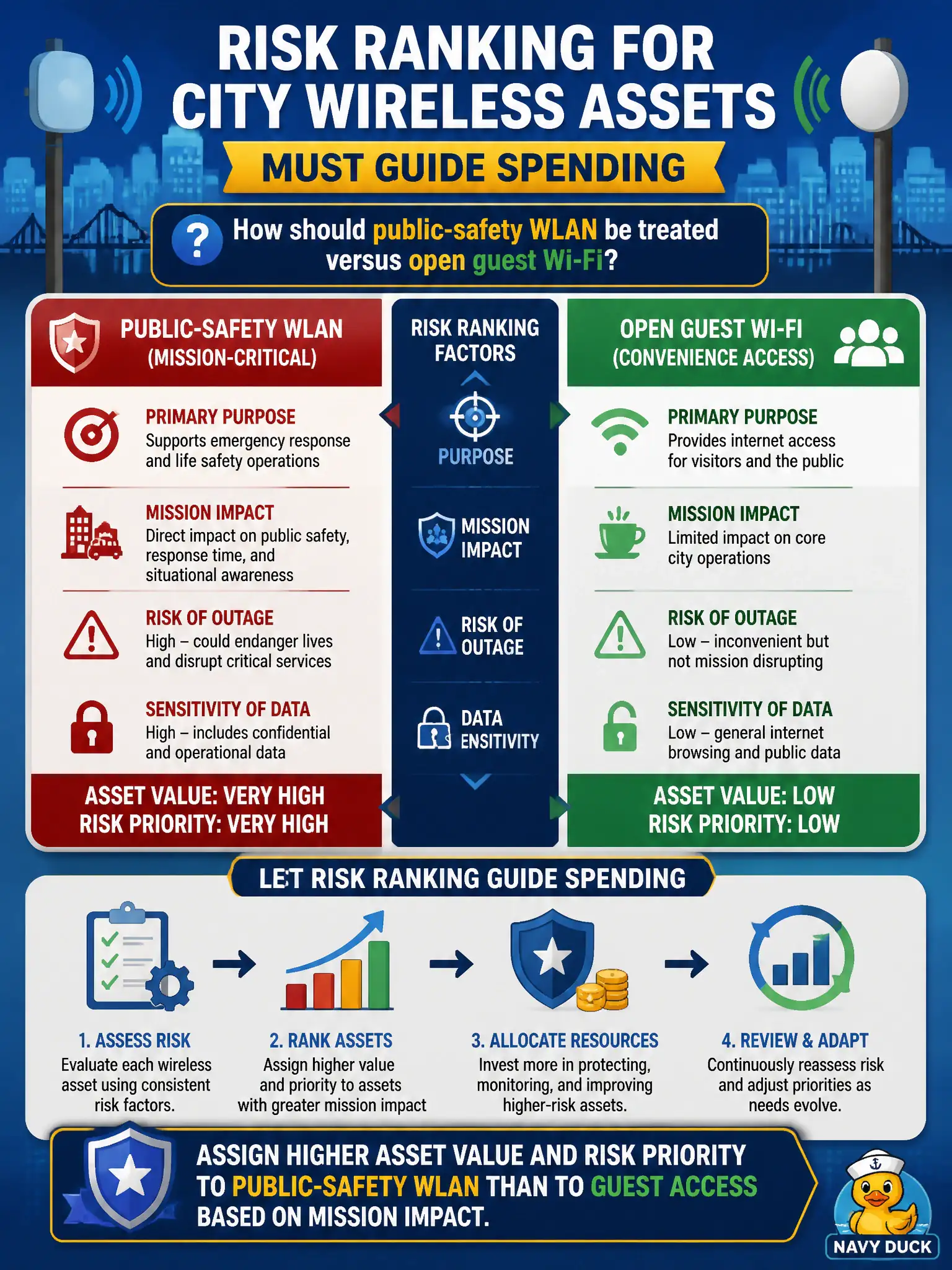
Risk ranking for city wireless assets must guide spending. How should public-safety WLAN be treated versus open guest Wi-Fi?
Select an answer to reveal the explanation.
Short Explanation
More users does not mean more precious. Public-safety Wi-Fi failing hurts response; guest Wi-Fi failing mostly hurts coffee-shop vibes. Rank by mission impact, not by headcount on the splash page.
Full Explanation
Risk ranking for city wireless assets must guide spending by mission impact: assign higher asset value and risk priority to public-safety WLAN than to open guest Wi-Fi. Loss of public-safety connectivity during an incident has different consequences than slow cafe browsing on the plaza. Civic risk registers that treat every SSID as equal misallocate hardening budget and resilience spend.
Rating guest Wi-Fi as higher value because it has more daily users confuses popularity with mission criticality. Treating all SSIDs as equal risk regardless of mission impact erases prioritization. Ignoring asset value and only counting APs per building measures hardware inventory, not risk.
Exam caveat: guest Wi-Fi still needs baseline security; lower priority is not the same as no controls. Operational check: update the wireless risk register with asset valuations, map controls spend to public-safety first, and confirm guest receives isolation and monitoring without consuming public-safety’s resilience budget. In municipal WLAN programs, capture the decision in the wireless standard and re-check it at change review so the next project inherits the same control bar instead of rediscovering the failure during an outage. In municipal WLAN programs, capture the decision in the wireless standard and re-check it at change review so the next project inherits the same control bar instead of rediscovering the failure during an outage.