
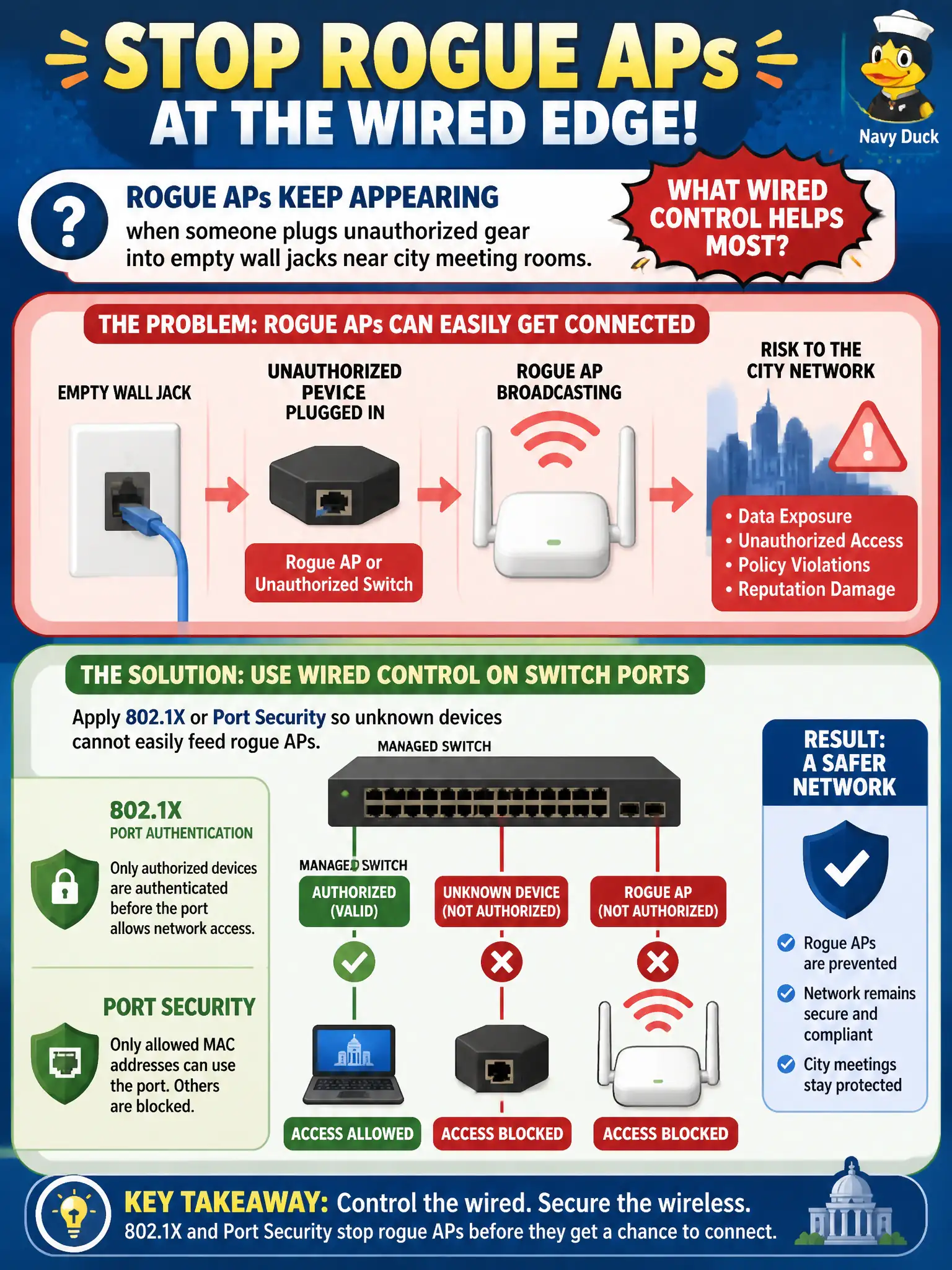
Rogue APs keep appearing when someone plugs unauthorized gear into empty wall jacks near city meeting rooms. What wired control helps most?
Select an answer to reveal the explanation.
Short Explanation
Rogue APs often start life as “just a cable in the wall.” Lock the switch ports with 802.1X or port security so mystery boxes do not get free PoE and uplink. Cable-tie colors are not a control plane.
Full Explanation
Rogue APs that appear when someone plugs unauthorized gear into empty wall jacks near meeting rooms are as much a wired problem as a wireless one. Applying 802.1X or port security on switch ports so unknown devices cannot easily feed rogue APs attacks the root attachment path. Civic meeting rooms with open jacks under tables are perennial sources of shadow APs and hubs.
Leaving all unused switch ports enabled and trusted for faster furniture moves maximizes easy rogue power and uplink. Disabling switchport security features so APs can use any Ethernet adapter removes the control on purpose. Relying only on colored Ethernet cable ties as access control is theater.
Exam caveat: port security/802.1X must allow sanctioned AP MACs or modern AP onboarding methods—or facilities cannot install legitimate gear. Operational check: plug a consumer AP into a meeting-room jack, confirm the port stays unauthorized or unauthenticated, and validate that a sanctioned AP still authenticates and passes traffic. In municipal WLAN programs, write the control into standards and verify it during change review so the next project inherits the same bar rather than rediscovering the failure mode under outage pressure.