
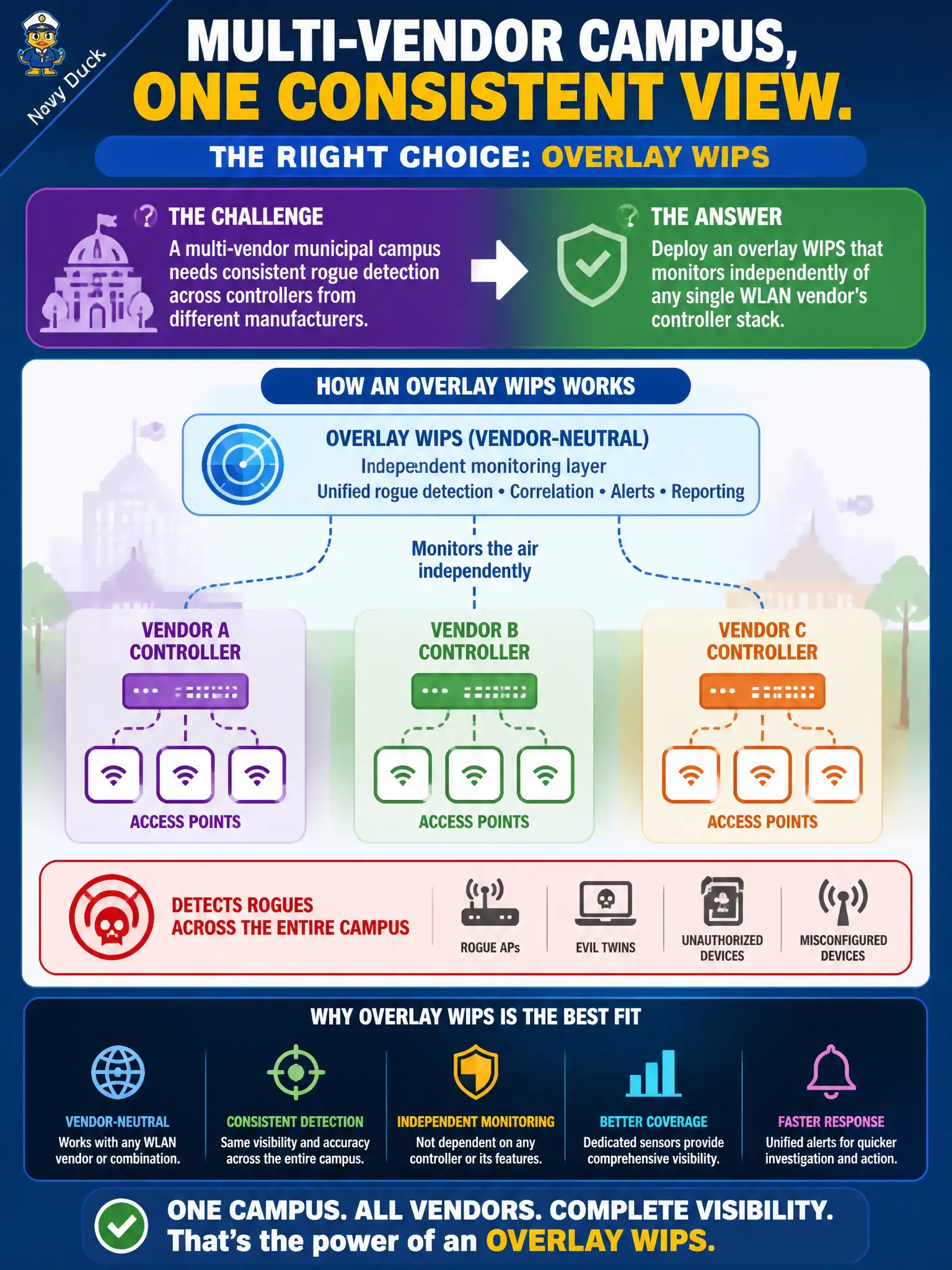
A multi-vendor municipal campus needs consistent rogue detection across controllers from different manufacturers. Which WIPS approach best fits?
Select an answer to reveal the explanation.
Short Explanation
When city Wi-Fi is a mix of vendor puzzles, one brand’s built-in WIPS often can’t see the whole board. An overlay sensor layer watches the airwaves without picking favorites. That beats hoping mismatched controllers magically agree.
Full Explanation
A multi-vendor municipal campus rarely gets consistent rogue detection from each controller vendor’s integrated WIPS alone, especially after annexations and phased procurements. Deploying an overlay WIPS that monitors independently of any single WLAN vendor’s controller stack provides a coherent detection plane across mixed AP estates and reduces “it is fine on our brand” blind spots. Cities need one operational picture of evil twins and unauthorized APs, not three partial ones.
Depending only on each vendor’s integrated WIPS and accepting blind spots where products disagree leaves classification gaps attackers can exploit at vendor boundaries. Disabling wireless intrusion features in favor of annual paper audits abandons continuous detection. Replacing every AP overnight with consumer mesh units that advertise open SSIDs is not a monitoring architecture and creates new risk.
Exam caveat: overlay WIPS still needs tuning, allowlists, and operational ownership—or it becomes another unread alert silo. Operational check: place a known test rogue on each vendor island, confirm the overlay classifies consistently, and document escalation paths into the municipal SOC with sample alert evidence.